Introduction
At swimming pools across Taiwan, you can see two distinctly different types of swimmers: one slows down as they approach the wall, reaches out to touch it, and turns around slowly; the other flips, kicks off the wall, and shoots out like an arrow. The flip turn is not only a standard technique in competitive swimming—for serious swimming enthusiasts, it is also the most direct opportunity to stop “wasting time” on every single lap. Mastering the flip turn in a 25-meter pool over 1000 meters (40 turns), saving 0.5 seconds per turn, adds up to a full 20-second difference.
Breaking Down the Flip Turn Technique
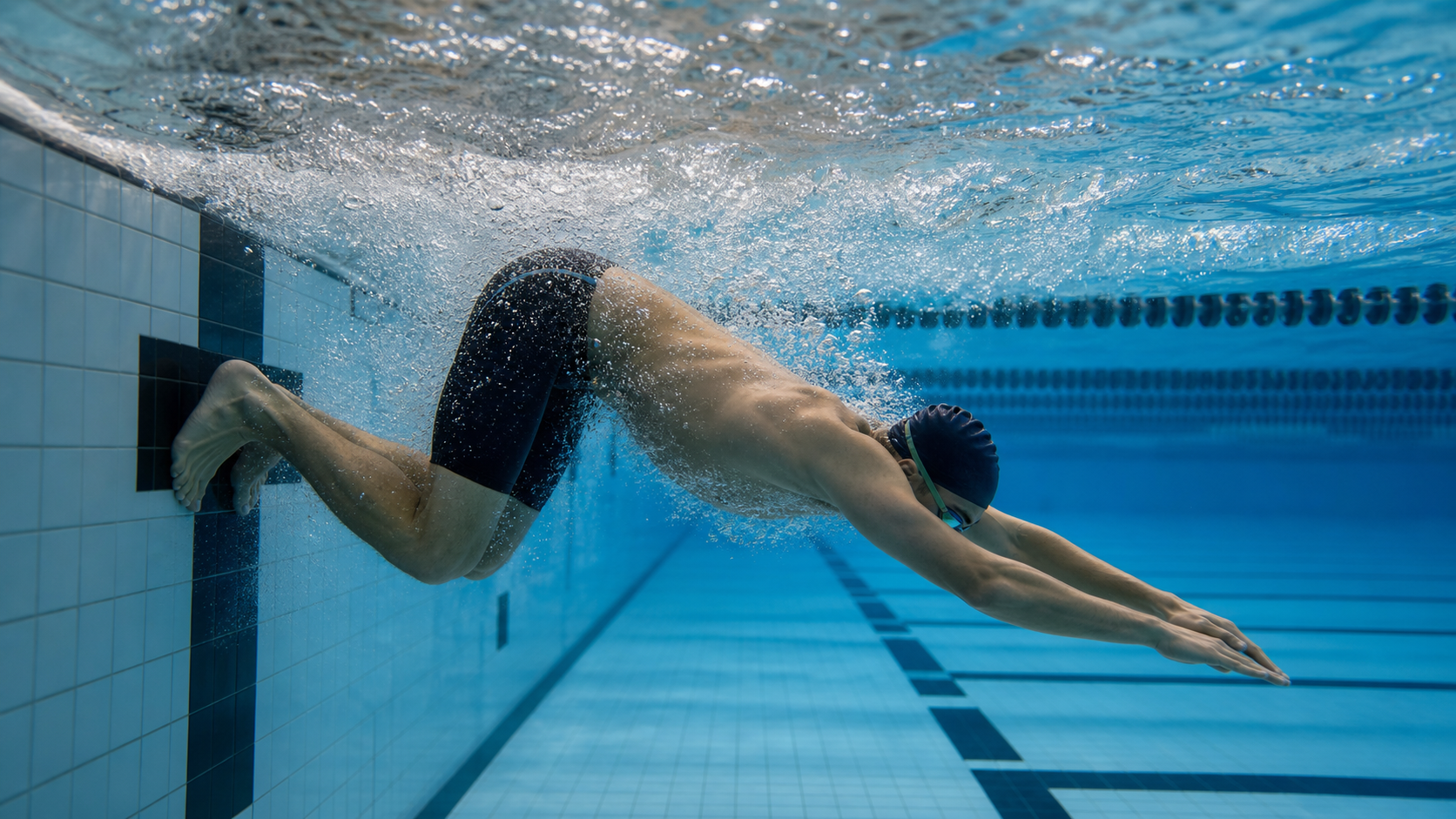
A complete flip turn can be divided into four phases:
- Approach: Judging distance and maintaining speed
- Somersault: Executing a quick forward roll
- Push-off: Planting the soles of the feet on the wall and pushing off powerfully
- Underwater Glide: Streamlined gliding with dolphin kicks
Each phase has key technical points, and a problem in any single element can significantly impact overall efficiency.
Judging Wall-Contact Timing
Calculating “How Many Strokes Before Flipping”
This is the biggest confusion for beginners. The answer is: there is no fixed stroke count—develop the feel through practice. Here is the recommended learning method:
- Starting from 5 meters away from the wall, swim slowly toward it, and attempt the flip at the point where you feel “one more stroke and I’m there”
- If your feet can’t reach the wall after flipping → you flipped too early; next time, flip closer to the wall
- If your knees hit the wall after flipping → you flipped too late; next time, flip a bit earlier
- Keep adjusting until your feet plant on the wall at a comfortable angle after the flip
The walls of standard 25-meter pools in Taiwan have a black T-mark. When you are 1.5 meters from the end, the mark is right in front of you—this serves as a visual reference point. Many swimmers have the habit of “flipping one stroke after seeing the T-mark,” but the exact rhythm varies from person to person.
Biomechanics of the Push-Off Angle
| Push-off angle (relative to the water surface) | Effect | Suitable scenario |
|---|---|---|
| 15°–20° (nearly horizontal) | Longest underwater glide distance, but too deep | Competitive swimming in deep lanes |
| 25°–35° (optimal range) | Balances glide efficiency and surfacing timing | General competition and training |
| 40°+ (excessive angle) | Surfaces too quickly, losing glide propulsion | Not recommended |
Direction of Push-Off Force
When pushing off the wall, the force should be directed forward (primarily the horizontal component), not downward against the water. Many beginners push downward when kicking off, causing their bodies to dive toward the bottom, wasting energy needlessly and requiring more movements to correct back to the proper swimming depth.
Flip Turn Drills
Drill 1: Land Flip Turn at the Pool Edge
Sit at the pool edge with your feet in the water and practice the forward rolling motion, finding the feeling of tucking your head and the rhythm of your hips flipping over. This doesn’t involve the underwater environment, reducing psychological pressure.
Drill 2: Stationary Flip in the Water
Stand in the shallow end, take a deep breath, and perform a forward somersault in place. Once you grasp the feel of the water during the flip, add swimming movements.
Head technique during the flip:
- Tuck the chin toward the chest to trigger the flip
- Sweep the palms outward (backward) to accelerate the rotation
- Let the feet follow the body’s rotation, with the soles facing the wall
Drill 3: Segmented Approach Practice
Practice the flip turn from 3 meters, 5 meters, and 7 meters away from the wall respectively, familiarizing yourself with the entry rhythm from different distances.
Drill 4: Full Turn Followed by Underwater Dolphin Kicks
After pushing off the wall, maintain a streamlined position and perform 2–3 dolphin kicks underwater before surfacing, maximizing propulsion from every turn. Competitive swimmers typically maintain an underwater position for 7–12 meters after pushing off before surfacing to breathe.
The Importance of Breathing Management
Breathing management during the flip turn is another key technical point:
- Complete your breath exchange 5–7 meters from the wall (the last 2–3 strokes)
- Exhale slowly through the nose during the flip through the push-off and glide (to prevent water inhalation)
- Take your next breath on the first or second stroke after surfacing
Breathing too early (breathing during the flip itself) disrupts the flip’s rhythm; breathing too late causes oxygen deprivation and panic as you approach the wall, affecting the accuracy of your distance judgment.
Common Flip Turn Mistakes
- Flipping too slowly: Hesitation makes the flip sluggish, wasting speed
- Surfacing immediately after the push-off: Failing to take advantage of the free propulsion from the underwater glide
- Incomplete body rotation before the push-off: Pushing off while still on your side, dispersing the push-off force
- Head lifting: Not keeping the head tucked during the push-off, breaking the streamline
Practical Advice
- When practicing flip turns in a 25-meter pool in Taiwan, schedule 100–200 meters of pure turn practice at the beginning and end of each session
- Learning the flip turn takes 2–4 weeks to build basic fluency; don’t give up because of early mistakes
- Although flip turns aren’t used in open water swimming, such as at Chengcing Lake in Taichung, building the habit in the pool will sharpen your awareness every time you get in the water
- Regularly time your total for 1000 meters; after improving your flip turns, the time should drop noticeably
Conclusion
The flip turn is a highly cost-effective skill investment in pool swimming technique. Correct wall-contact timing requires repeated practice to develop the feel, while optimizing the push-off angle can immediately improve speed on every lap. For serious swimming enthusiasts in Taiwan, mastering the flip turn is an important milestone toward more efficient swimming.
Related Reading
- Refining Turn Technique: Push-Off Angle and Wall-Contact Timing in Flip Turns
- Improving Swimming Turn Technique: Push-Off Timing and Streamline Maintenance in Flip Turns
- Refining Turn Technique: Hand-Foot Coordination and Push-Off Force Optimization in Touch-and-Turn
- The Complete Flip Turn Guide: Making Your Pool Training Smoother and More Efficient
大禹嶺 到 武嶺牌樓 全程前後實況錄影 | 北進武嶺 | 東進武嶺 | KOM | 訓練台 | 坡度分析 | Taiwan KOM Last 10 km HARD | 公路車
6 年前
如何把 GoPro 影片 翻轉 批次 轉正?
6 年前
CT 喇低賽) 武嶺牽車 才是王道 西進牽車四小時內秘訣 攝手位置 如何判斷 防抽筋小秘訣
7 年前
西進武嶺 免費訓練分析服務 Intervals | 練不夠還是練過頭?你哪一種類型選手?AI模型告訴你! | 備戰神器 | 公路車 訓練 | CT Yeh
4 年前
公路車 爬坡 破PR 紀錄 小技巧 分享
6 年前
風櫃嘴時間 預測西進武嶺時間?13000名車友統計數據分析告訴你 !
5 年前
碟煞公路車 銑面器 !? 原來銑完差這麼多! 降低蹭碟機率! | TIME 公路車 保養小記錄 | CT Yeh
3 年前
Live) 備戰2019彰化經典百K 賽前攻略 (已完賽請看新影片
7 年前