Introduction
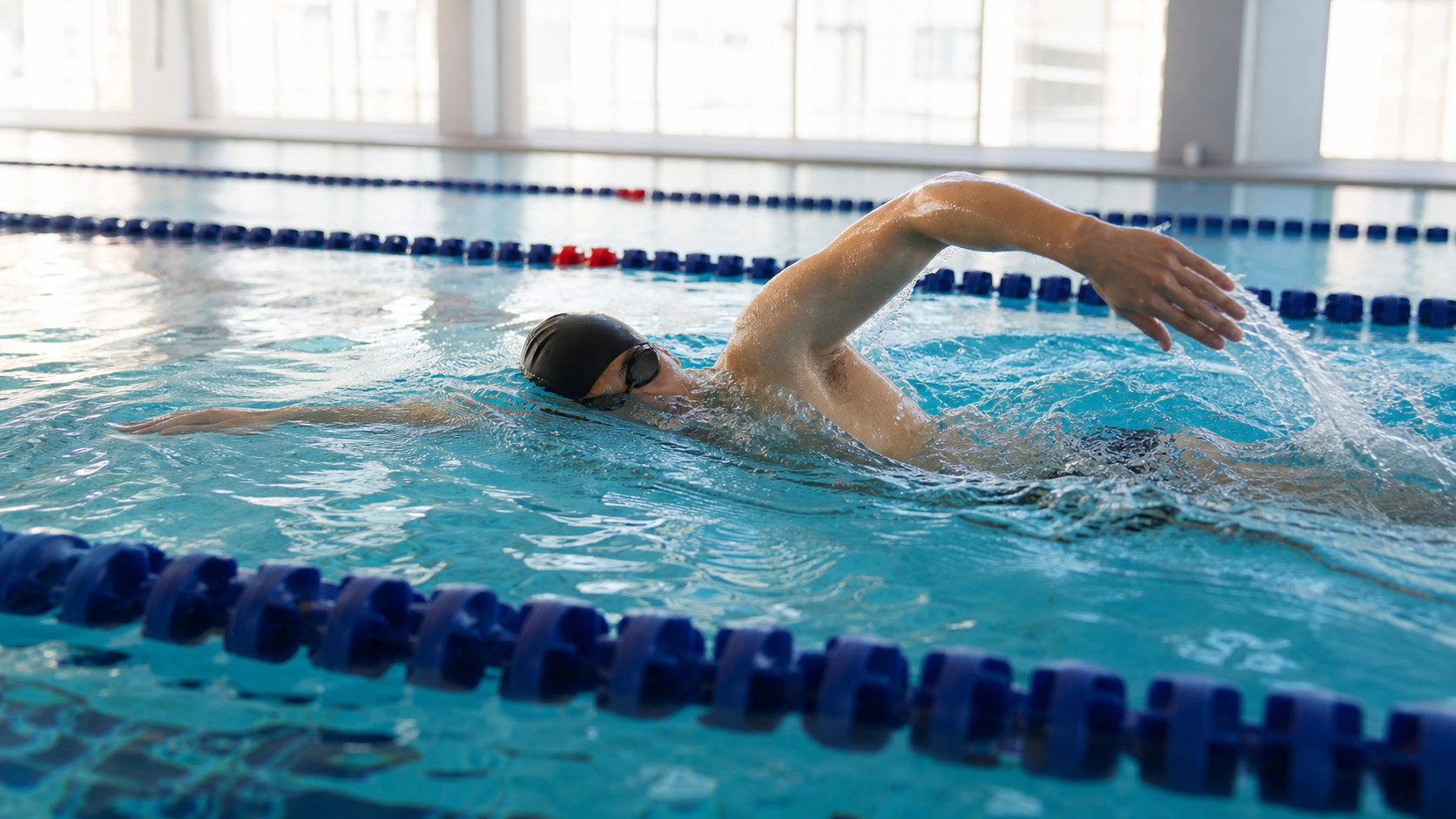
In advanced technique courses at swimming schools across Taiwan, there is one nearly ubiquitous auxiliary drill: the catch-up drill. This seemingly simple exercise is one of the most powerful tools for improving freestyle technique efficiency. The catch-up drill involves one hand waiting at the front (not stroking) until the other hand completes a full stroke cycle and returns to the front position, at which point the front hand begins to stroke. This “waiting” action forces the swimmer to slow down the tempo and feel the completeness and glide of each stroke.
Technical Enhancement Effects of the Catch-Up Drill
Effect 1: Reinforcing Stroke Completeness
In regular freestyle, the stroke tempo is faster, and many swimmers start the front hand stroking before the back hand has finished its push phase. The catch-up drill’s “waiting mechanism” forces every stroke to push all the way through (to the thigh) before initiating the next stroke, effectively building muscle memory for a complete stroke.
Effect 2: Cultivating the Forward Extension Glide
During the waiting period, the front hand extends through the water, and the body experiences the presence of the glide—this is the core sensation of a long stroke length (high DPS). Many swimmers who practice the catch-up drill begin to “feel” the glide even during normal swimming, and their DPS naturally improves.
Effect 3: Improving Stroke Tempo and Breathing Coordination
The slow tempo of the catch-up drill provides a generous breathing window, allowing swimmers to practice precise breathing mechanics without rushing, thereby improving breathing efficiency at higher swimming speeds.
Effect 4: Exposing Technical Weaknesses
When speed drops, technical flaws become impossible to hide. The catch-up drill often makes swimmers realize for the first time that their stroke on one side is incomplete, that they over-rotate their body when breathing, or that their hand entry angle is off.
Correct Execution of the Catch-Up Drill
| Step | Key Action | Common Mistake |
|---|---|---|
| 1. Front hand extension | Extend the front hand forward with the thumb pointing down, maintaining a streamlined position | Front hand sinks or bends |
| 2. Back hand stroke | Back hand performs a complete stroke: catch → pull → push → exit → recovery | Incomplete stroke, rushing the entry |
| 3. “Catch-up” touch | After the recovery hand completes its entry, lightly touch the front hand with the back of the hand | Starting to stroke without waiting for the touch |
| 4. Switch hands | After the touch, the front hand begins stroking, and the back hand becomes the waiting hand | Both hands moving simultaneously |
| 5. Breathing | Breathe during the back hand’s push phase, with ample time | Breathing too late or too rushed |
Technical detail: During the “catch-up,” both hands briefly meet at the front—this streamlined two-hand extension position is the lowest-drag posture in freestyle technique.
Advanced Variations of the Catch-Up Drill
Variation 1: 1-2-3 Drill (Delayed Counting Stroke)
A stricter version than the catch-up drill: after the front hand enters the water, pause and count 1, 2, 3 (approximately 1.5–2 seconds) before beginning the stroke. This drill demands greater control of hip rotation.
Variation 2: Single-Arm Catch-Up (One Arm Strokes, One Arm Always Waits)
Use only one arm to stroke while the other remains extended forward, propelling with a continuous kick. This is the most extreme version, providing a very clear sensation of propulsion from each stroke. It is recommended to do 25 meters on each side and compare the stroke feel between the two sides.
Variation 3: Catch-Up Followed by Normal Swimming
25 meters of catch-up drill → immediately followed by 25 meters of normal-speed swimming, “transferring” the feel established by the catch-up drill into the normal stroke tempo. This ratio training is the most effective way to translate technique.
Variation 4: Catch-Up with Resistance Equipment
Perform the catch-up drill wearing a pull buoy plus a resistance band, reinforcing a complete push through each stroke under resistance.
Training Volume Recommendations
- Technique training days: 400–600 meters of catch-up drill per session, which can account for 30–40% of total training volume
- Regular training days: 200–300 meters of catch-up drill per session as a technical warm-up
- Week before a competition: Reduce catch-up drill volume, replacing it with normal-speed technique swimming to consolidate the feel
Common Mistakes and Corrections
- Front hand sinks while waiting: The front hand should maintain a horizontal position 10–15 cm below the water surface and should not sink
- Body stops rotating while waiting: Rotation should not be interrupted by the wait; body position should remain the same as in normal swimming
- Swimming too slowly: The catch-up drill should be swum at a “slower but not ultra-slow” pace; swimming too slowly prevents you from feeling the true water pressure and glide
Practical Tips
- At swimming club technique classes in Taipei, Taichung, Kaohsiung, and elsewhere, the catch-up drill is usually a regular part of the curriculum—feel free to ask to join in
- Use a lap-tracking watch (such as the Garmin Swim 2) to record stroke counts during the catch-up drill and track DPS improvement trends
- Write down your sensations after each technique session—for example, “Today my left arm push felt more complete”—to build a quantitative awareness of progress
- The catch-up drill is especially suitable for practice after learning the flip turn, because building the glide sensation helps with underwater gliding awareness after turns
Conclusion
The catch-up drill may look simple, but it is a foundational technical tool that even professional swimmers practice regularly. For swimming enthusiasts in Taiwan, this drill is a “technical mirror”—each lap clearly reflects the quality of your stroke and guides you toward areas for improvement.
Related Reading
- Swimming Breakdown Training: Technique Enhancement with Single-Arm Swimming and Catch Drills
- Swimming Technique Sessions: Designing a Weekly Schedule with One Technique-Focused Session
- The Complete Freestyle Technique Guide: Key Details from Stroke to Kick
- 10 Freestyle Drills Every Adult Swimmer Must Practice: Each with Purpose and Reps
西進武嶺 免費訓練分析服務 Intervals | 練不夠還是練過頭?你哪一種類型選手?AI模型告訴你! | 備戰神器 | 公路車 訓練 | CT Yeh
4 年前
一起升級!海鷗盃LSD團練...JJSC Zone2招待 騎到手抖 / 公路車 / CT Yeh
1 天前
風櫃嘴 衝刺慢動作回放!
8 年前
CT 喇低賽) 武嶺牽車 才是王道 西進牽車四小時內秘訣 攝手位置 如何判斷 防抽筋小秘訣
7 年前
CT暗黑廚房) 車友必備 宇宙無敵鮮蚵湯 幫助訓練恢復 天然食補 好市多 超肥鮮蚵 破PR
7 年前
[教學] Premiere 影片 手震 修正 教學 防抖 單眼 影像 GoPro 穩定 Video Stabilization
8 年前
一個測試有沒有認真練車的方法😂 #公路車
10 個月前
實景訓練台) 彰化經典百K 高強度喵團 90分鐘 跟著一起練功 2019 Indoor workout Changhua Classic 100 Taiwan
7 年前