Introduction
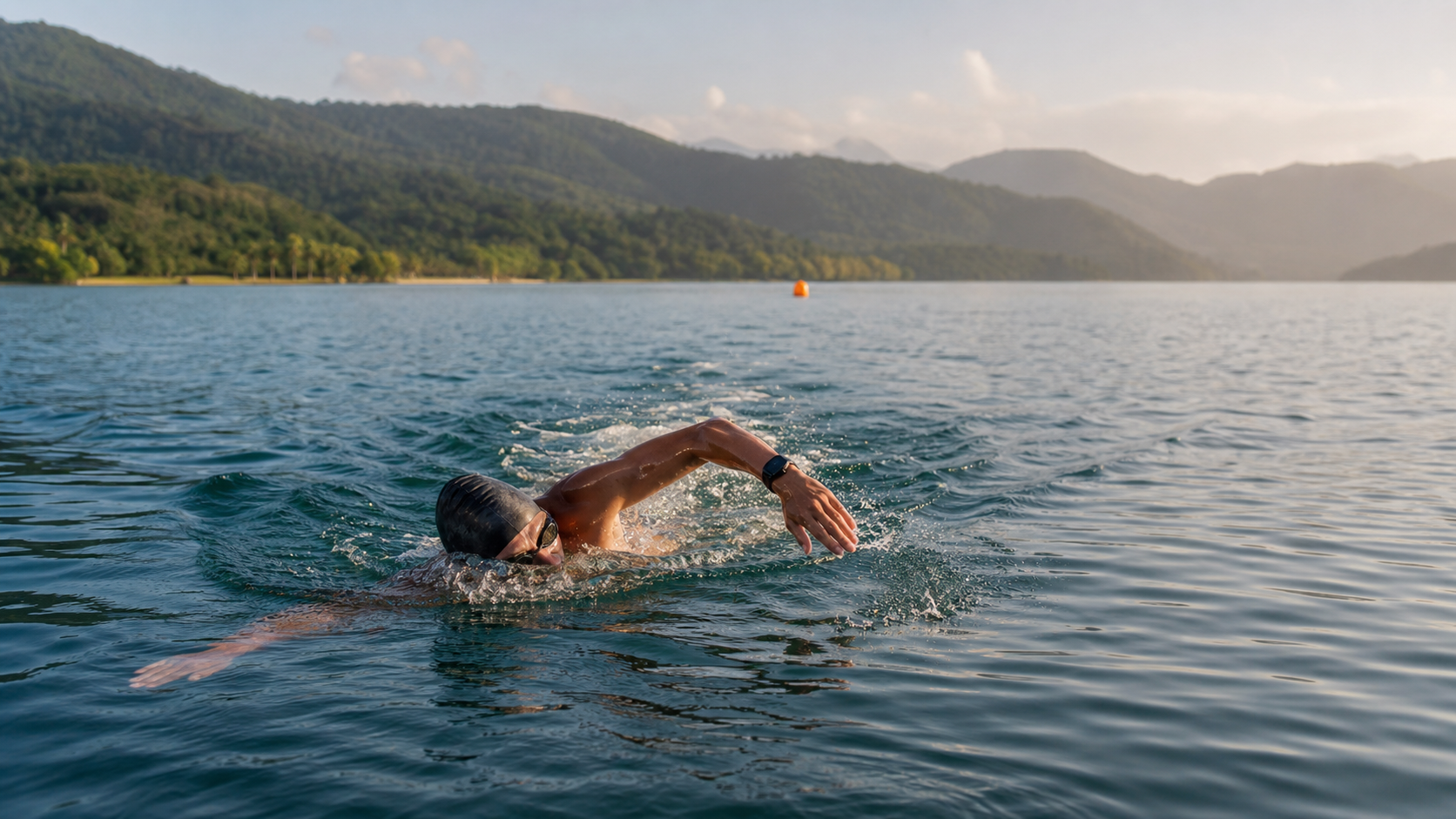
From the IRONMAN Taiwan in Taitung, the Chengcing Lake Triathlon in Taichung, to the Kaohsiung Chengcing Lake swimming race, open water swimming has become an important part of swimming in Taiwan, with events held across the island every year. However, many swimmers accustomed to the pool face the same frustration the first time they swim in open water: “Why do I feel like I’m swimming straight, but in reality I’m covering a lot of unnecessary distance?” The key lies in the “Sighting” technique—the strategy of lifting your head to check your direction at the right moments is the core skill for swimming in a straight line in open water.
Why Is It Easy to Drift Off Course in Open Water?
Swimmers in the water cannot directly see the finish line or target buoy, relying only on occasionally lifting their heads to confirm direction. Factors affecting straight-line swimming include:
- Asymmetrical technique: Breathing side is stronger, non-breathing side pulls weaker, causing a gradual drift to one side over time
- Currents and tides: Waters off Taiwan’s east coast have stronger currents, and southern regions often experience lateral currents in summer
- Loss of visual reference: Pools have black lane lines; open water does not
- Insufficient sighting: Checking direction too rarely leads to swimming extra distance
- Excessive sighting: Lifting the head every stroke creates more drag and slows you down
Detailed Breakdown of the Sighting Technique
The core movement of sighting: Lift your head to look forward at the buoy while simultaneously rotating to breathe. The standard technique comes in two versions:
Version 1: Crocodile Sighting
During the stroke, lift your head slightly (eyes and nose just breaking the surface), then immediately rotate your head to breathe once you’ve spotted the buoy. The entire motion flows continuously with minimal drag. This is the mainstream method used by competitive athletes.
Version 2: Lift and Breathe (Separated Look and Breathe)
Lift your head to look on one stroke (head fully out of the water), then rotate to breathe on the next stroke. Suitable for beginners, the movements are more separated and easier to master, but energy expenditure is higher.
Factors Determining Optimal Sighting Frequency
| Situation | Recommended Sighting Frequency | Reason |
|---|---|---|
| Clear water, buoy clearly visible | Every 10–12 strokes | Direction is stable, no need for frequent checks |
| Crowded race water (many swimmers) | Every 6–8 strokes | Need to check position to avoid collisions |
| Stronger current water | Every 4–6 strokes | Current requires continuous course correction |
| Beginners or low visibility | Every 4–6 strokes | Build directional awareness, safety first |
| Final sprint segment (within 100m) | Every 4 strokes | Ensure a straight line to the finish |
The benefit of swimming a few extra strokes between sightings
Research shows that each sighting costs approximately 1.5 times the energy of normal swimming (because lifting the head causes the hips to drop). Therefore, reducing unnecessary sightings saves a significant amount of overall pacing energy over long distances.
Timing Techniques for Sighting
Technique 1: The “Stroke-Lift-Breathe” Triple Motion
- One stroke (right hand enters the water)
- Mid-pull with the right hand, slightly lift the head (look forward for 0.5 seconds)
- Immediately rotate the head to breathe on the left side
- Return the head to the water, right hand completes the pull
This triple motion completes both sighting and breathing within a single stroke cycle, adding almost no extra time.
Technique 2: Using the Sun or Landmarks as Auxiliary References
When swimming in Chengcing Lake in Taichung or Living Lake in Taitung, observe the buoy’s position relative to the sun, mountains, or tall buildings before starting. If you temporarily lose sight of the buoy during the swim, use these fixed landmarks to help confirm your general direction.
Technique 3: Even-Stroke Breathing Rhythm
Set your breathing rhythm to every 4 strokes (an even number) so that sighting is performed on a consistent right- or left-hand stroke, establishing a predictable lifting rhythm.
Additional Technical Considerations for Open Water Swimming
Positioning at the Start
At the start of triathlon events in Taiwan, dozens to hundreds of swimmers enter the water simultaneously. Positioning and collision avoidance at the start are crucial skills. Beginners are advised to start on the outer edge or further back to avoid being caught in the surge of the crowd.
Drafting Technique
During a race, swimming behind a competitor of similar speed (staying 1–2 meters behind) can save 20–30% of your energy. Sighting frequency can be reduced while drafting (because the swimmer ahead navigates for you), but be sure to maintain a safe distance from the swimmer in front.
Practical Advice
- Before open water swimming events in Taiwan, practice the sighting motion in the pool first—lift your head to look at the marker at the far end of the pool, and only head to open water once the motion feels smooth
- Living Lake in Taitung and Chengcing Lake are ideal venues for your first open water practice; start with short distances (200–400 meters) to build directional awareness
- Before a triathlon, complete at least 2–3 open water training sessions in the actual race venue to familiarize yourself with local currents and buoy placement
- Wear a brightly colored swim cap (orange, yellow) to increase visibility, and make sure your companions know your swimming plan—safety first
Conclusion
Swimming in a straight line in open water is a comprehensive test of technique, perception, and strategy. Mastering the correct sighting frequency and timing will help you swim far less “off-course distance” in Chengcing Lake, Liyu Lake, or any open water venue, reaching the finish faster and more efficiently. Developing this skill—starting with practice in the pool and gradually validating it in open water—is the advanced progression every serious swimmer should follow.
Related Reading
- Sighting Technique: The Key Training for Swimming Straight in Open Water
- Navigation Techniques for Open Water Swimming: Lifting to Breathe and Target Locking
- Open Water Navigation Techniques: Lifting to Breathe and Target Point Positioning
- The Complete Guide to Open Water Positioning: The Sighting Head-Lift Method Every Triathlete Must Learn
CT 喇低賽) 武嶺牽車 才是王道 西進牽車四小時內秘訣 攝手位置 如何判斷 防抽筋小秘訣
7 年前
風櫃嘴 | 全台最多大砲的單車路線 | 尋寶網攝影師告訴你怎麼擺拍起來才好看 | 熱門攝影地點巡禮
6 年前
西進武嶺 免費訓練分析服務 Intervals | 練不夠還是練過頭?你哪一種類型選手?AI模型告訴你! | 備戰神器 | 公路車 訓練 | CT Yeh
4 年前
西進武嶺 自製新版AI配速表產生器 x 賽前攻略 抱佛腳! 沒有功率計也可以產生配速表嗎?有什麼其他眉角賽前要注意的呢? | 西進武嶺 / 東進武嶺 KOM 攻略 | 公路車 | CT Yeh
4 年前
抖肩舞 台灣x日本交流版 (台灣 vs 前橋) 赤城山登山賽 coincidance
8 年前
#公路車 #西進武嶺 配速配瓦實驗 坡度分析 四小時內攻略 建大盃 NeverStop #西進武嶺攻略
6 年前
風櫃嘴時間 預測西進武嶺時間?13000名車友統計數據分析告訴你 !
5 年前
備戰 戀戀197 賽前關門點分析 西濱團練 #公路車 4K高畫質
6 年前