Swimming CSS Critical Swim Speed Testing and Training Applications: Find Your Aerobic Threshold Pace
Introduction
At swimming pools across Taiwan, whether it’s the Taipei City University pool, Hsinchu City pool, or Kaohsiung’s Lingya Sports Center, you’ll often see swimmers doing lap after lap without knowing whether their training intensity is appropriate. CSS (Critical Swim Speed) is exactly the tool to solve this problem.
The CSS concept originates from exercise physiology and represents the theoretical maximum pace a swimmer can sustain aerobically, similar to lactate threshold pace in running. Once you master CSS, you can design precise training plans and avoid the twin traps of overtraining or undertraining.
How to Test Your CSS
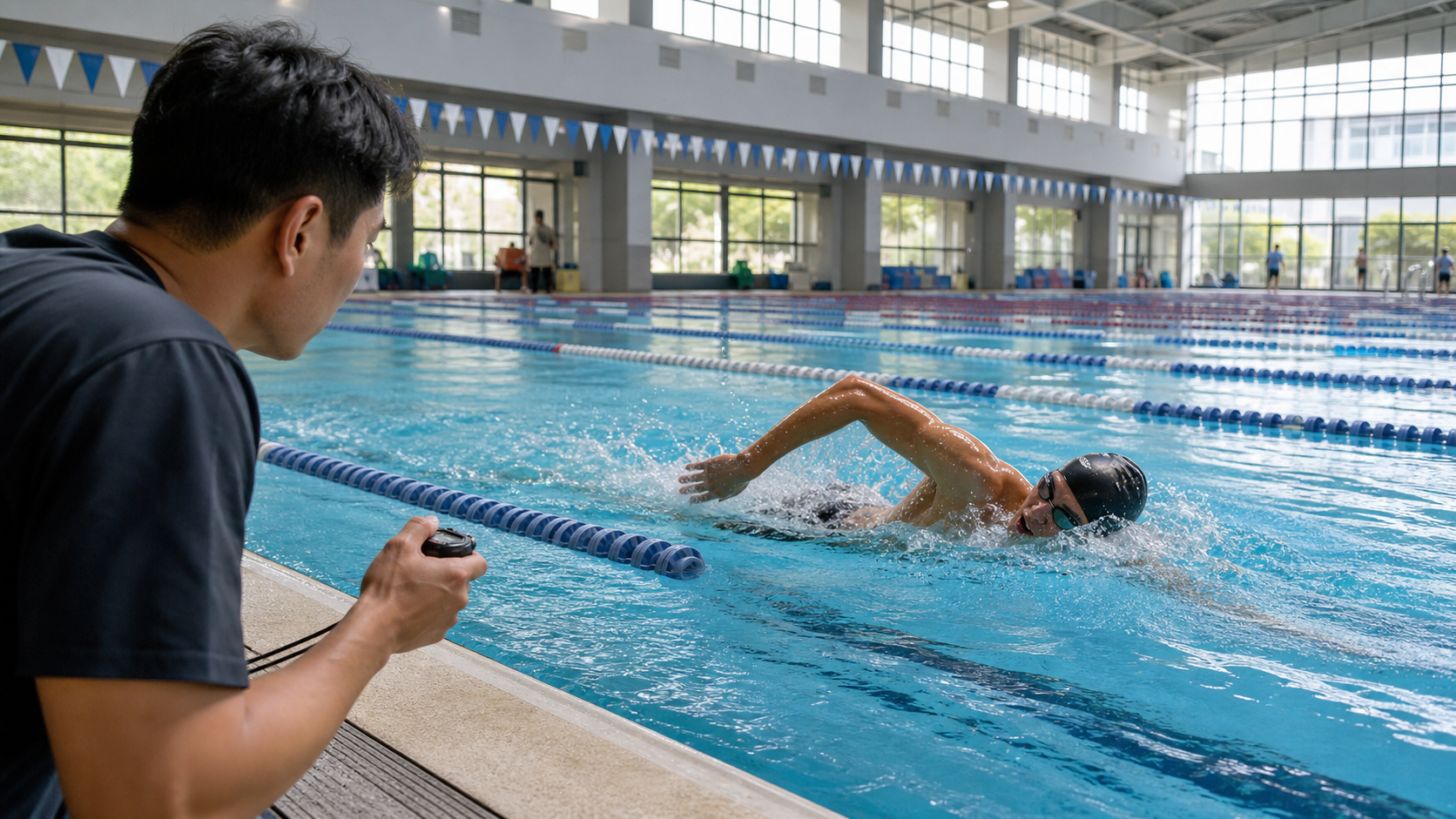
The CSS test is simple—all you need is a standard 25m or 50m pool and a stopwatch.
Testing procedure:
- Warm up thoroughly for 10–15 minutes (including an easy 400m swim + a few fast 25m sprints)
- Rest for 5 minutes, then complete a maximal 400m timed swim (record time T400)
- Rest for 10 minutes, then complete a maximal 200m timed swim (record time T200)
- Plug the times into the formula:
CSS (per 100m pace) = (T400 − T200) ÷ 2
Example: If T400 = 6:40 (400 seconds) and T200 = 3:10 (190 seconds), then CSS = (400 − 190) ÷ 2 = 105 seconds / 100m, or approximately 1:45/100m.
CSS Training Intensity Zones
Once you know your CSS, you can divide training into different intensity zones, each corresponding to specific training goals:
| Intensity Zone | Pace Relative to CSS | Energy System | Training Purpose |
|---|---|---|---|
| Z1 Recovery | CSS + 20+ seconds | Low-intensity aerobic | Active recovery, technique work |
| Z2 Aerobic Base | CSS + 10–20 seconds | Aerobic | Build aerobic base, long-distance endurance |
| Z3 Critical Speed | CSS ± 5 seconds | Aerobic threshold | Improve lactate threshold |
| Z4 Anaerobic Threshold | CSS − 5–15 seconds | Anaerobic onset | VO2max enhancement |
| Z5 Maximal Intensity | CSS − 15 seconds or faster | Anaerobic/ATP-PC | Speed and power |
Designing a Weekly Training Plan with CSS
A swimmer training three times per week can structure their schedule like this:
Example weekly plan (using CSS = 1:45/100m):
- Monday (Aerobic Base): 400m warm-up + 8 × 200m @ CSS + 15 seconds, 30 seconds rest between sets + 200m cool-down
- Wednesday (Critical Speed Session): 400m warm-up + 6 × 100m @ CSS, 15 seconds rest between sets + 300m cool-down
- Saturday (Long Distance): Continuous 1500–2000m @ Z2 (CSS + 15 seconds), focusing on technique
Training centered around CSS ensures every session falls within a meaningful intensity range, avoiding the common problem among Taiwanese swimmers of “swimming at roughly the same pace in every workout.”
Practical Tips
- Retest your CSS every 4–6 weeks: As your fitness improves, your CSS will increase, and your workout intensities need to be adjusted accordingly
- Be mindful of wasted time at Taiwanese pools: Peak hours are crowded—try going between 6–7 AM or during lunch breaks to ensure test quality
- Match your breathing rhythm: When swimming at CSS pace, maintain a breathing pattern of every 3 strokes, which helps sustain a steady tempo
- Log data from every session: Use the swim mode on your Garmin, Polar, or Apple Watch to record workouts for tracking progress over time
- Watch for water temperature effects: If pool water temperature exceeds 30°C in Taiwan’s summer, CSS may drop by 2–3 seconds; the opposite applies in winter
Conclusion
The CSS test is one of the most cost-effective tools in swim training—just 20 minutes of testing provides precise pacing guidance for an entire training cycle. Whether you’re a recreational swimmer preparing for the “Sun Moon Lake Crossing” event or an athlete training for a triathlon, mastering CSS will make your time in the water more purposeful and efficient. On your next pool session, start by doing a CSS test!
Related Reading
- Swimming CSS (Critical Swim Speed) Test: How to Calculate with 400m and 200m
- Building Your Swimming Aerobic Base: CSS Critical Speed Training Methods
- 8-Week Swimming CSS Pace Training: Core Workouts for Mastering Critical Speed
- Swimming Interval Training: Calculating and Applying CSS (Critical Swim Speed)
西進武嶺 免費訓練分析服務 Intervals | 練不夠還是練過頭?你哪一種類型選手?AI模型告訴你! | 備戰神器 | 公路車 訓練 | CT Yeh
4 年前
一起升級!海鷗盃LSD團練...JJSC Zone2招待 騎到手抖 / 公路車 / CT Yeh
1 天前
#公路車 #Vo2Max #最大攝氧量 測驗 體驗 | 心肺測試
6 年前
實景訓練台) 彰化經典百K 高強度喵團 90分鐘 跟著一起練功 2019 Indoor workout Changhua Classic 100 Taiwan
7 年前
西進武嶺 自製新版AI配速表產生器 x 賽前攻略 抱佛腳! 沒有功率計也可以產生配速表嗎?有什麼其他眉角賽前要注意的呢? | 西進武嶺 / 東進武嶺 KOM 攻略 | 公路車 | CT Yeh
4 年前
2023桃園團體繞圈賽 / 海鷗繞圈賽 | 全程空拍數據版 | 公路車 | CT Yeh
2 年前
武嶺配速表最佳使用方式 #bike
1 年前
Live) 備戰2019彰化經典百K 賽前攻略 (已完賽請看新影片
7 年前