Saddle Selection and Adjustment: The Matching Logic Between Sit Bone Width Measurement and Saddle Shape
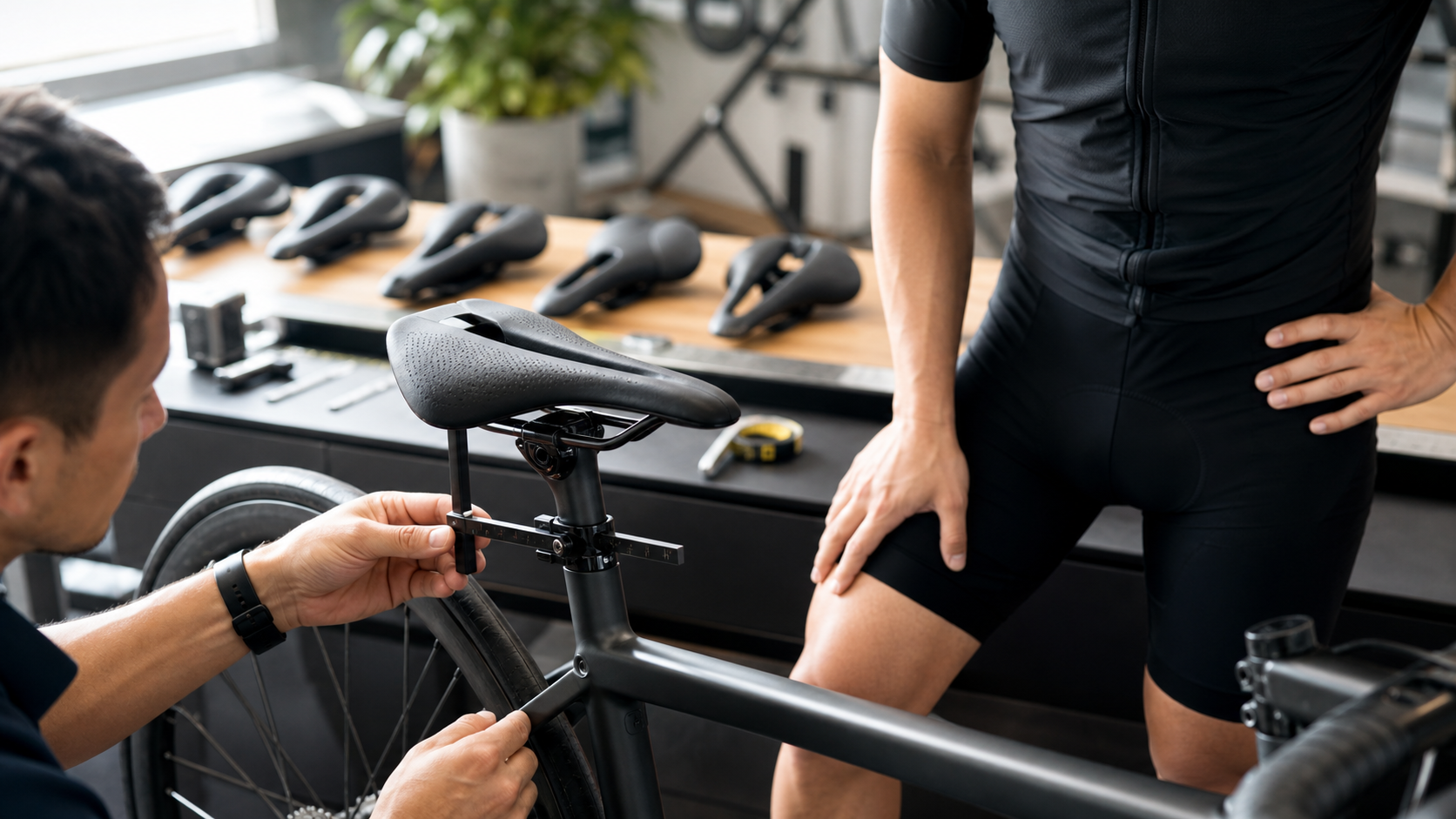
Introduction
“An uncomfortable saddle makes cycling pure torture.” This is the first impression many beginner cyclists have, and it’s also one of the main reasons why many potential riders quit the sport. Choosing a saddle is far more complex than most people think—it’s not just about softness or firmness, but also about matching sit bone width, pelvic tilt angle, and overall riding posture.
The Importance of Sit Bone Width
The sit bones (Ischial Tuberosity) are the primary weight-bearing bones when seated on a bicycle saddle. The effective support width of the saddle should match your sit bone width:
| Sit Bone Width Range | Recommended Saddle Width | Suitable For |
|---|---|---|
| < 100mm | 130–140mm | Men with narrow pelvises, competitive riding |
| 100–120mm | 140–155mm | Standard men, most women |
| > 120mm | 155–165mm+ | Wide pelvis body types, endurance riding |
How to measure sit bone width:
- Sit on a piece of corrugated cardboard or a clay board from a stationery store (simulate the pelvic tilt used while riding—lean forward as much as possible)
- Measure the distance between the center points of the two indentations
- Add 20–30mm to this distance to get the recommended saddle support area width
Many bike shops in Taiwan offer free sit bone width measurement services. It is highly recommended to complete this measurement before purchasing a saddle.
Saddle Shape Design Analysis
Categorized by cutout design:
- Solid saddles: Larger surface area, even pressure distribution, suitable for upright riding positions on commuter bikes and mountain bikes
- Central channel saddles: Reduce perineal pressure, suitable for moderately forward-leaning positions in general road cycling
- Center cut saddles: Significantly reduce perineal compression, suitable for deep forward-leaning competitive riding, with noticeable improvement for nerve compression issues in men
- Short nose saddles: A popular design in recent years—while maintaining fore-aft stability, the shortened nose reduces inner thigh friction, suitable for high-cadence riding styles
Three Key Dimensions of Saddle Adjustment
Even with the right saddle, incorrect installation position can still cause discomfort:
1. Height adjustment
Saddle height is the most critical parameter affecting pedaling efficiency and knee health. Common calculation methods:
- Inseam length × 0.883 = recommended saddle height (from BB center to saddle top)
- Rough verification: at the lowest point of the pedal stroke, the knee should maintain a 25–35° bend angle
2. Fore-aft position
The knee’s fore-aft position should align vertically with the pedal spindle. Using a plumb line dropped from the bottom of the kneecap, it should align with the pedal spindle or be slightly behind it. A saddle positioned too far forward causes anterior knee pain, while too far back affects pedaling efficiency.
3. Horizontal tilt
Most riders are suited to a level saddle or one tilted slightly downward (approximately -2° to 0°). Excessive upward tilt increases perineal pressure, while too much downward tilt causes the body to constantly slide forward, adding strain to the wrists.
Recommended Saddles for the Taiwan Market
- Fizik Aliante R1 Carbon Fiber Base: Suitable for standard forward-leaning positions, excellent long-distance comfort, approximately NT$6,000–8,000
- Selle Italia SLR Boost: Pioneer of short nose design, top choice for high-cadence riders, approximately NT$5,000–7,000
- Specialized Power Arc Pro: Suitable for muscular legs, center cut design is especially friendly for men, approximately NT$4,500–6,500
- Prologo Dimension NDR: Designed for Asian body types, moderate forward tilt, approximately NT$3,500–5,000
Practical Advice
- Don’t believe that “softer means more comfortable”: Overly soft saddles actually cause the sit bones to sink, leading to friction between the inner thighs and soft tissue
- A break-in period is normal: After switching to a new saddle, a 200–400 km break-in period is typically needed; initial discomfort doesn’t mean the saddle isn’t right for you
- The quality of cycling shorts matters just as much: A high-quality chamois can significantly reduce the pressure of saddle selection
- Seek professional assessment: If you have long-term saddle discomfort issues, a Bike Fit assessment is recommended—it can usually resolve the problem in one session
Conclusion
The core of saddle selection is “matching,” not “the most expensive.” A NT$500 saddle that fits your sit bone structure will be more comfortable than a NT$8,000 branded saddle. We recommend using bike shop trial services (some shops offer a 30-day trial exchange program) to find the saddle that suits you best through actual riding, rather than relying on others’ opinions to make your decision.
Related Topic Reading
- The Complete Guide to Bicycle Saddle Selection: Full Analysis of Sit Bone Width Measurement, Curved vs. Flat Saddle Types and Their Target Groups
- The Complete Guide to Bicycle Saddle Selection: Say Goodbye to the Pain Nightmare of Long-Distance Riding
- The Science of Road Bike Saddle Selection: Shape, Material, Sit Bone Width, and Pressure Map Analysis
- Bicycle Saddle Selection and Test-Ride Guide: Finding Your Perfect Saddle
Nepest NOVA 碳條輪組:輕量、空力、舒適一次滿足!/ 公路車 / CT Yeh
7 個月前
#公路車 #Fitting 靠人工智慧APP 幫你調整單車
6 年前
Vision Metron RS 37碳幅條輪組 (非SL)官網沒有的 低調開箱 / 這重量太銷魂了 / 公路車 / CT Yeh
6 個月前
再一組! 全碳幅條 碟煞/無內胎輪組 開箱! 到底好騎嗎? UNAAS X40 | 公路車 | CT Yeh
4 年前
靠單車減肥35公斤 心得分享與整理
7 年前
單車 一日北高 ( 雙城 ) 肥宅雙人瘋狂行 紀錄片 REACTO
10 年前
鉅齒紋輪組!? ControlTech MEG-T50 EVO 碳纖維幅條輪組/ 功率對比實驗 / 公路車 / CT Yeh
2 年前
訓練台體驗) 2019台北自行車展 三大家 訓練台體驗 Tacx Neo Flux 2 Xepdo Apx Wahoo Kickr
7 年前