Bicycle Braking Systems: Disc Brakes vs. Rim Brakes Performance Differences on Taiwan's Mountain Roads
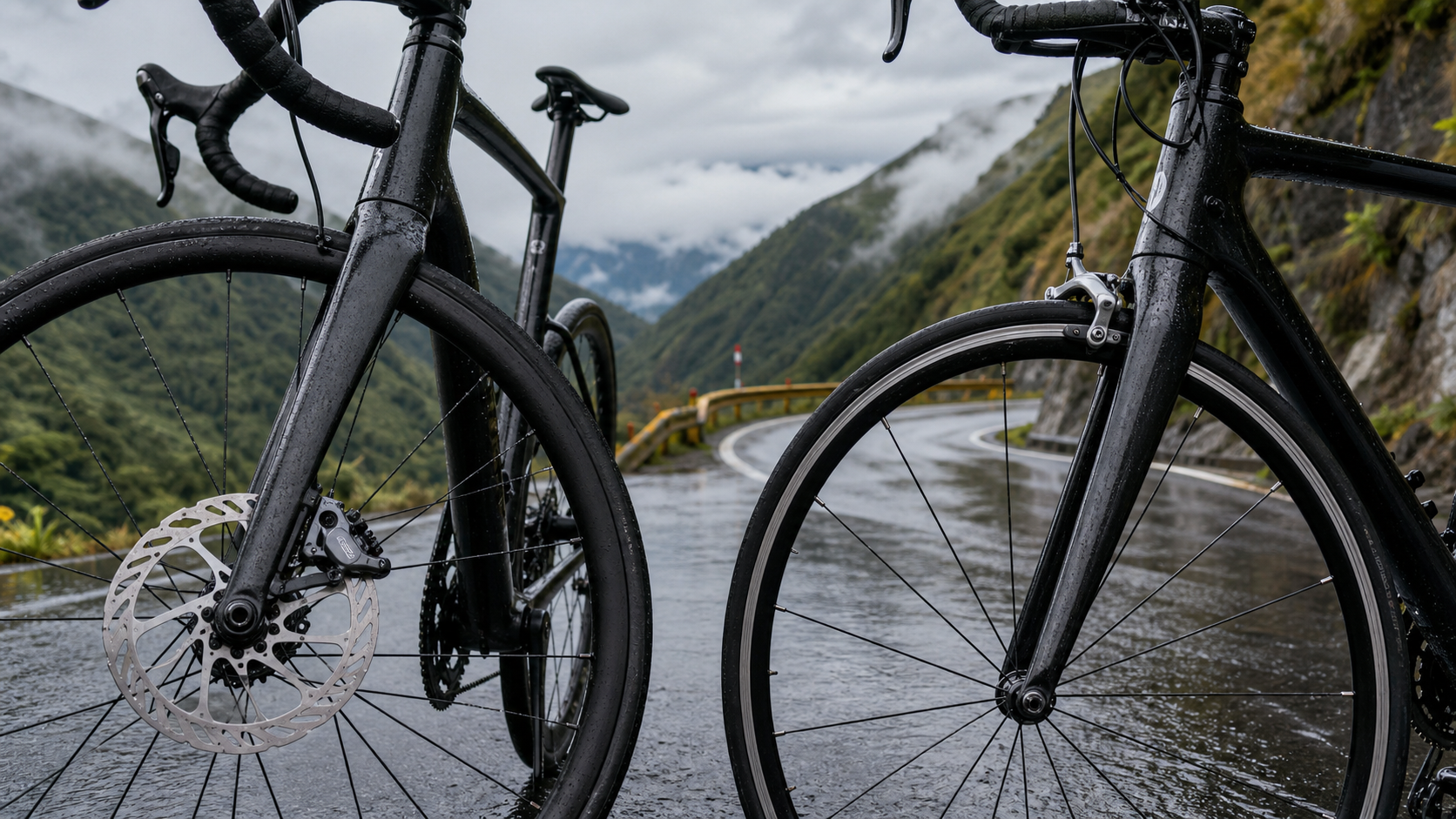
Introduction
“Should I use disc brakes or rim brakes for descending Wuling?” This is a question that gets discussed every year in Taiwan’s road cycling community. As disc brake road bikes gradually become the market mainstream, the choice is becoming clearer, but for riders who already own rim brake bikes, whether it’s worth upgrading to a new bike remains a question worth discussing in depth.
System Specification Comparison
| Comparison Item | Hydraulic Disc Brakes | Mechanical Disc Brakes | Rim Brakes (V Brake) |
|---|---|---|---|
| Maximum braking power | Strongest | Strong | Moderate |
| Braking power degradation in rain | Almost none | Slight degradation | Significant degradation (30–50%) |
| Rim heat fade | None (disc, not rim) | None | Yes (significant with carbon rim brake models) |
| Modulation adjustability | Most precise | Moderate | Coarser |
| System weight | Heavier (hub + disc + caliper) | Heavier | Lightest |
| Maintenance difficulty | Medium (requires bleeding) | Low | Lowest |
| Spare parts availability | Available in major cities across Taiwan | Easy | Easiest |
| Price difference (complete system) | Higher (approx. +NT$3,000–8,000) | Moderate | Lowest |
Advantages of Disc Brakes on Taiwan’s Mountain Roads
Taiwan boasts high-altitude mountain roads rare in Northeast Asia. Routes like Wuling (3,275m), the Hehuan Mountain area, and the Northern Cross-Island Highway feature continuous descents of 20–40 kilometers. This environment puts braking systems under extremely demanding conditions:
Braking power in the rain is the most critical advantage of disc brakes. Northern Taiwan experiences over 200 rainy days per year. With rim brakes on aluminum rims, braking distance can increase by 40–60% in wet conditions, which is a clear safety hazard during high-speed descents. Disc brake performance is almost unaffected by wet conditions.
Heat fade issues: The Wuling descent spans approximately 30 kilometers with an elevation drop exceeding 2,000 meters. Prolonged light braking can cause rim temperatures to rise significantly. Carbon wheels paired with rim brakes carry the risk of rim overheating and even tire blowouts during Taiwan’s summer heat; disc brake setups completely eliminate this concern.
Advantages of Rim Brakes and Suitable Scenarios
Rim brakes are not an outdated design and still offer advantages under specific conditions:
- Weight advantage: A complete rim brake system is approximately 300–500g lighter than disc brakes, which matters to climbing-focused riders who are meticulous about weight
- Easy maintenance: Adjusting and replacing brake pads only requires basic tools, suitable for riders who prefer DIY maintenance
- Suitable for entry-level training bikes: If your primary riding routes are flat roads in the Taipei Basin, rim brakes are more than sufficient
- Compatibility with older frames: Many older frames currently in use only support rim brakes, allowing continued use without needing a frame replacement
Disc Brake Maintenance Considerations
There are several points Taiwanese riders need to pay special attention to regarding disc brake maintenance:
- Hydraulic bleeding: Hydraulic disc brakes need to be bled and topped up with fluid every 1–2 years or when the lever feel becomes soft. It’s recommended to have this done by a bike shop
- Discs must not contact oil: When applying chain lubricant, you must protect the discs with a cover. Oil contamination on the discs significantly reduces braking power and is very difficult to fully remove
- Disc thickness monitoring: Discs worn down to minimum thickness (usually 1.5–1.8mm) must be replaced immediately. Overly thin discs may deform under high temperatures
- Pay attention to heat dissipation on Taiwan’s long summer descents: On continuous long descents, brake intermittently to avoid sustained high disc temperatures that could cause hydraulic fluid vaporization (sudden loss of braking power)
Purchase Recommendations
- For those buying a complete new bike: Choose disc brakes without hesitation. The design trend for modern road bikes is clear, and after-sales support is more comprehensive
- For those upgrading from an existing rim brake bike: If your riding routes are primarily flat roads, no upgrade is needed; if you frequently ride mountain routes like Wuling or the Northern Cross-Island Highway, it’s worth considering a new disc brake bike
- For those on a limited budget: Mechanical disc brakes are a good entry-level disc brake option. Braking power sits between hydraulic disc brakes and rim brakes, but maintenance convenience is close to rim brakes
Conclusion
In Taiwan’s riding environment, the safety advantages of disc brakes are overwhelming for mountain road riders. It’s not that rim brakes aren’t good enough—it’s that the challenges of Taiwan’s mountain roads happen to amplify the advantages of disc brakes. For riders planning to conquer Wuling, tour around the island, or cross the Northern Cross-Island Highway, a disc brake road bike is a safer, more reassuring choice. The one-time additional investment buys you complete confidence on every descent.
Related Reading
- The Evolution of Road Bike Braking Systems: Mechanical Disc vs Hydraulic Disc vs Rim Brake Comparison
- Complete Road Bike Braking System Comparison: Rim Brakes vs Disc Brakes, Which Suits Taiwan Riding?
- Road Bike Brake Upgrades: Differences Between Mechanical Disc and Hydraulic Disc Brakes
- Road Bike Brake System Selection: A Comprehensive Comparison of Disc Brakes vs Rim Brakes
碟煞公路車 銑面器 !? 原來銑完差這麼多! 降低蹭碟機率! | TIME 公路車 保養小記錄 | CT Yeh
3 年前
再一組! 全碳幅條 碟煞/無內胎輪組 開箱! 到底好騎嗎? UNAAS X40 | 公路車 | CT Yeh
4 年前
碟煞公路車 優缺點?換車一年半實際經驗分享 / 公路車 / CT Yeh
2 年前
Unaas X50 全碳纖幅條輪 數據實測對比PK | Lun Hyper 的高階版 | 板輪爬坡也可以很厲害? ! 武嶺2小時大師一起親測! CP值超高 | 公路車 | CT Yeh
4 年前
公路車 BB培林大升級! / 備戰海鷗繞圈賽 Canyon Aerod & TIME 一起改 / MIT大廠 CEMA對鎖式陶瓷培林BB & 導輪 / 公路車 / CT Yeh
2 年前
2026 車錶排行榜!誰是最多車友正在使用?練家子最愛哪款?🏆 (2萬名車友數據) / 公路車 / CT Yeh
5 個月前
多到選擇障礙... 換個單車把帶想一個小時 / BTP / 編織&軟木特有材質超吸睛! / 公路車 / CT Yeh
1 年前
再快都跟的上!? 單車跟隨攝影機之王 HOVERAir X1 PROMAX 全面實測 / 唯一!8K畫質&自行車專用模式和跟蹤信標&前後避障 / DJI Neo 可參考/ 公路車 / CT Yeh
1 年前