Swimming Dry-Land Auxiliary Training: Swim-Specific Exercises with Resistance Bands, Core Boards, and Yoga Balls
Introduction
Many swimming enthusiasts in Taiwan assume that conditioning can only be done in the pool, overlooking the immense benefits that dry-land auxiliary training can bring to swimming performance. In fact, world-class swimmers often spend 30–40% of their training time on land—from strength training to resistance-band stroke simulation, every movement is designed with a specific logic aimed at improving swimming performance.
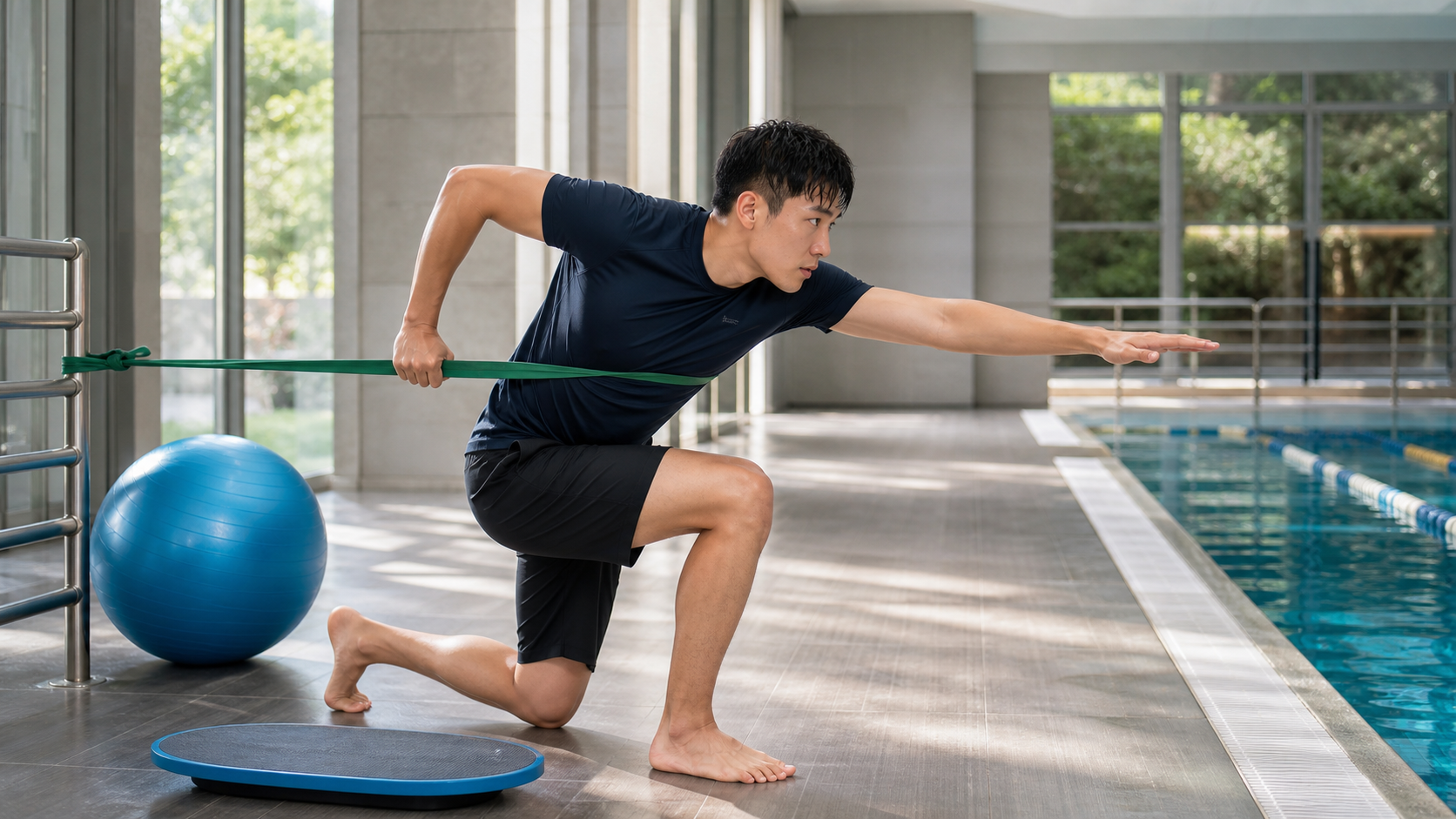
This article introduces three dry-land training tools that are most accessible and safe for swimmers in Taiwan: resistance bands, balance boards, and yoga balls, along with specific swim-specific exercises.
Why Can Dry-Land Training Improve Swimming Performance?
Swimming requires a highly integrated set of physical abilities, including:
- Shoulder joint stability: Every freestyle stroke places rotational torque on the shoulder joint; an unstable shoulder can easily lead to swimmer’s shoulder
- Core rotational strength: The roll motion in freestyle relies on core strength rather than the shoulders; a stronger core leads to more powerful strokes
- Hip flexor and gluteal strength: The propulsion of the freestyle kick comes from the coordination of these muscle groups
- Thoracic spine mobility: Breaststroke and butterfly require good thoracic extension, which dry-land training can effectively improve
Resistance Bands: The Best Tool for Simulating Strokes
Resistance bands are the dry-land tool that most faithfully replicates the stroke path of swimming. Here are three core exercises:
Exercise 1: Resistance Band Stroke Simulation
- Standing position, with the band anchored behind you at shoulder height
- Simulate the freestyle “S-shaped pull path”: catch (high elbow position) → pull (elbow stationary, forearm pulling back) → push
- 3 × 15 reps, 45 seconds rest between sets
Exercise 2: External Shoulder Rotation Strengthening
- Seated position, with the band anchored to the side, elbow bent at 90 degrees
- Rotate the forearm outward, hold for 2 seconds, then slowly return
- Target muscles: infraspinatus, teres minor (key for preventing swimmer’s shoulder)
- 3 × 20 reps (each side)
Exercise 3: Straight-Arm Press-Down (Lat Pulldown Variation)
- Standing position, holding the band with both hands (anchored directly in front at head height)
- Press both arms straight down to the hips, simulating the freestyle “finish” motion
- Strengthens the latissimus dorsi—the most important muscle group for the pulling phase
- 3 × 15 reps
Balance Boards: Building the Dynamic Core Stability Swimming Requires
| Exercise Name | Target Muscles | Swimming Relevance | Sets × Time |
|---|---|---|---|
| Balance Board Plank | Transversus abdominis, multifidus | Streamlined body position | 3 × 45 seconds |
| Balance Board Single-Leg Stand | Gluteus medius, ankle joint | Kick stability | 3 × 30 seconds (each side) |
| Balance Board Stroke Simulation | Full-body coordination | Center-of-mass stability during the pull | 3 × 12 reps (each side) |
| Balance Board Lunge | Gluteus maximus, quadriceps | Breaststroke kick initiation | 3 × 10 steps (each side) |
The key to balance board training lies in “controlled stability on an unstable surface,” which directly simulates the ability to maintain a streamlined position in the unstable environment of water.
Yoga Balls: Deep Core and Spinal Mobility Training
Exercise 1: Yoga Ball Bridge (Rolling Version)
- Place your shoulders on the yoga ball with feet on the ground, forming a bridge position
- Slowly roll the ball side to side, simulating the freestyle roll motion
- Strengthens the glutes and lower back, improving freestyle roll efficiency
- 3 × 12 reps (each side)
Exercise 2: Yoga Ball Plank Leg Curl
- In a plank position, place both feet on the yoga ball
- Curl the ball toward your chest (bending the knees), then slowly push it back out
- Strengthens the core and hip flexors, improving kick efficiency
- 3 × 12 reps
Recommendations for Performing Dry-Land Training in Taiwan
- Venue: Gyms at sports centers in various cities and counties across Taiwan typically have resistance bands and yoga balls available for use, with low entry fees (NT$80–120)
- Frequency: 2 dry-land sessions per week, combined with 2–3 swim sessions, yields the best overall results
- Order: If training on the same day, swim first and do dry-land training afterward (to avoid dry-land fatigue compromising in-water technique quality)
- Injury Prevention: When first using resistance bands for stroke simulation, choose light resistance (yellow or red), and only progress to heavier resistance after confirming correct form
Conclusion
Dry-land auxiliary training is not an “optional extra” in a swimmer’s regimen—it is an essential component of a complete swimming conditioning program. Resistance bands strengthen pulling power, balance boards build dynamic stability, and yoga balls improve spinal mobility—each serves its own purpose, working together to address weaknesses in swimming performance. If swimmers in Taiwan want to see noticeable improvement in their next swim test, there is no better time than today to start this dry-land training program, turning every drop of sweat into accumulated speed in the water.
Related Reading
- Swimming Dry-Land Auxiliary Training: Applications of Resistance Bands and TRX in Swimming Conditioning
- Complete Dry-Land Training Plan for Swimmers: A Shoreline Training Guide with Resistance Bands, Core Work, and Flexibility
- Dry-Land Auxiliary Training for Swimmers: A Complete Guide to Resistance Bands, Pull Machines, and Power Development
- Swimming Resistance Band Dry-Land Stroke Simulation Training
CT暗黑廚房) 車友必備 宇宙無敵鮮蚵湯 幫助訓練恢復 天然食補 好市多 超肥鮮蚵 破PR
7 年前
實景訓練台) 彰化經典百K 高強度喵團 90分鐘 跟著一起練功 2019 Indoor workout Changhua Classic 100 Taiwan
7 年前
西進武嶺 免費訓練分析服務 Intervals | 練不夠還是練過頭?你哪一種類型選手?AI模型告訴你! | 備戰神器 | 公路車 訓練 | CT Yeh
4 年前
一起升級!海鷗盃LSD團練...JJSC Zone2招待 騎到手抖 / 公路車 / CT Yeh
1 天前
[教學] Premiere 影片 手震 修正 教學 防抖 單眼 影像 GoPro 穩定 Video Stabilization
8 年前
一個測試有沒有認真練車的方法😂 #公路車
10 個月前
一日北高 實用 單車手機架!Bone蹦克磁吸單車手機綁 //環島/室內訓練 / 導航的APP推薦 / 日本島波海道取景 / 公路車 / CT Yeh
2 年前
一日北高/長距離團騎 常見問題補充篇 / 組團或跟團的眉角 / 壯車友容易被瘦車友慢性拉爆 / 原來屁股痛可能是這個原因...? / 風場配速法 / 公路車 / CT Yeh
2 年前