Introduction
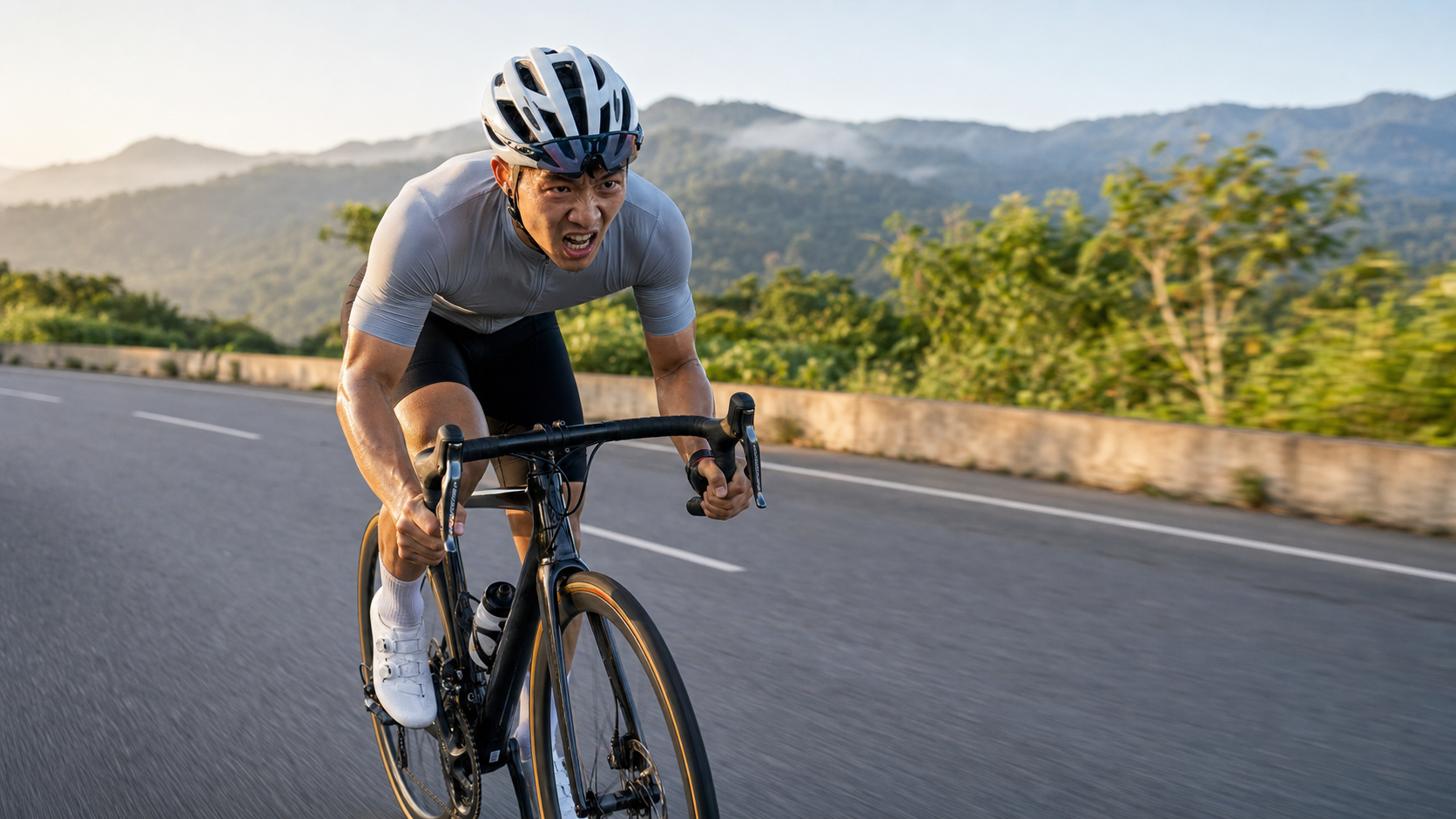
In Taiwan’s amateur races or group rides, have you ever experienced this: your endurance feels fine, but when a companion suddenly accelerates, you simply can’t keep up and get dropped within seconds? This isn’t necessarily an aerobic capacity issue—it’s likely a deficiency in anaerobic capacity and the neuromuscular system. Anaerobic training, especially Sprint training, is key to strengthening this area.
The Physiological Basis of Anaerobic Capacity
When riding intensity exceeds 120% FTP (Zone 6), the body cannot rely solely on the aerobic system to supply energy quickly enough. At this point, the phosphocreatine system (PCr, lasting 5–15 seconds) and the anaerobic glycolytic system (lasting 15–90 seconds) take over energy production in sequence.
The physiological adaptations from Sprint training include:
- Improved phosphocreatine (PCr) resynthesis rate: Allows you to recover faster from sprints
- Enhanced muscle buffering capacity: Delays the muscle fatigue sensation caused by lactate accumulation
- Improved fast-twitch (Type II) fiber recruitment efficiency: More efficient neuromuscular transmission
- Improved explosive cadence power: Ability to generate greater torque per unit of time
Types of Sprint Training
Anaerobic and neuromuscular training can be divided into three main types:
| Type | Duration | Target Power | Recovery Time | Physiological Goal |
|---|---|---|---|---|
| Ultra-short sprint | 5–8 seconds | > 200% FTP | 4–6 minutes | Neuromuscular recruitment, PCr system |
| Short sprint | 15–30 seconds | 150–180% FTP | 3–5 minutes | PCr + anaerobic glycolysis |
| Medium-long sprint | 30–90 seconds | 120–150% FTP | 4–6 minutes | Anaerobic buffering capacity |
Detailed Workout Designs
Workout 1: Neuromuscular Activation Workout (Suitable for All Levels)
Best used: As an “activation” session after the warm-up on any riding day
- Warm up for 20 minutes
- 8×8-second all-out sprints (seated or standing), with 4 minutes of Zone 1 recovery between efforts
- Continue with normal training or cool down
Note: The purpose of 8-second sprints is to activate the neuromuscular system without accumulating significant fatigue, so they can be paired with any training day.
Workout 2: Primary Anaerobic Capacity Workout
- Warm up for 25 minutes (including 3×20-second activation accelerations)
- 6×30-second all-out sprints (target 160% FTP), with 4 minutes of full recovery between efforts
- Cool down for 15 minutes
Workout 3: Taiwan Group Ride Simulation Workout (Advanced)
Simulates the “attack—follow—attack again” rhythm of group rides:
- Warm up for 20 minutes
- 5 sets of mixed intervals (each set includes):
- 5 minutes at sweet spot (90% FTP)
- Immediately followed by a 30-second all-out sprint (150%+ FTP)
- 4 minutes of Zone 1–Zone 2 recovery
- Cool down for 15 minutes
This workout simulates attacking under the fatigue commonly seen in races, training you to retain anaerobic explosive power while under aerobic load.
Standing vs. Seated Sprints
Sprint training can be performed in two positions, each with its own training focus:
- Standing sprints: Recruit the entire body’s muscle groups (glutes, back, arms), suitable for explosive starts with low cadence and high torque
- Seated sprints: Focus on cadence development, training neuromuscular coordination, with cadence reaching 120–140 rpm
It’s recommended to train both, at roughly a 50:50 ratio, alternating between weeks.
Recovery Management
Anaerobic training places far greater demands on the central nervous system (CNS) than aerobic training, making recovery management especially important:
- Maximum of 2 anaerobic workouts per week
- Do not schedule on consecutive days with VO2max or threshold training: The CNS needs adequate recovery
- Consume sufficient protein: Fast-twitch muscle repair after sprints requires more protein (25–30g within 30 minutes post-workout)
- Monitor next-day performance: If even easy aerobic riding feels heavy the next day, it indicates the CNS hasn’t fully recovered
Practical Recommendations
- Find a fixed sprint practice stretch: Many bike paths in Taiwan have straight sections suitable for practice. Record your peak power for each 8- or 10-second effort to track neuromuscular progress
- Train cadence variety: Don’t just train high power—also train high-cadence sprints (120–130 rpm) to improve muscular coordination speed
- Add Sprint workouts 2 weeks before races: Maintain an activated neuromuscular system
- Avoid sprinting while fatigued: Sprinting mechanics tend to break down when tired, which can reinforce incorrect neural patterns
Conclusion
Anaerobic capacity isn’t something you’re born with—the neuromuscular system can be significantly improved through training. For amateur riders in Taiwan, adding 1–2 Sprint workouts per week doesn’t require much time, yet it can dramatically improve your ability to respond to attacks in group rides, accelerate at the top of climbs, and deliver a strong final sprint. Your aerobic base is your engine; your anaerobic capacity is your turbocharger—having both is what makes a truly complete cyclist.
Related Reading
- Explosive Power Training for Cyclists: Neuromuscular Activation and Workout Design for Sprinting
- High-Power Output Training: Improving Sprint Strength and Anaerobic Capacity
- Sprint Power Development Training: Complete Workouts from Neuromuscular to Anaerobic Explosiveness
- Swimming Sprint Training: 10×50m All-Out Speed Development Method
西進武嶺 免費訓練分析服務 Intervals | 練不夠還是練過頭?你哪一種類型選手?AI模型告訴你! | 備戰神器 | 公路車 訓練 | CT Yeh
4 年前
#公路車 #Fitting 靠人工智慧APP 幫你調整單車
6 年前
Never Stop 西進武嶺 前後雙機 完整全程錄影 訓練台 實境
8 年前
單車 一日北高 ( 雙城 ) 肥宅雙人瘋狂行 紀錄片 REACTO
10 年前
CT 喇低賽) 單車 比賽總是沒照片? 攝影師的觀點大公開 姿勢就是力量! 請加速1.25倍收看
7 年前
一個測試有沒有認真練車的方法😂 #公路車
10 個月前
Zwift 元宇宙單車世界 如何與全世界同步騎車運動
6 年前
FTL 與 SYB 車隊專訪 西進武嶺 實用攻略分享! 2小時 如何練?!你不知道的眉角!新手準備武嶺必看 EP1 | 實力派女車友 | 精華版 | 公路車 | CTYeh
4 年前