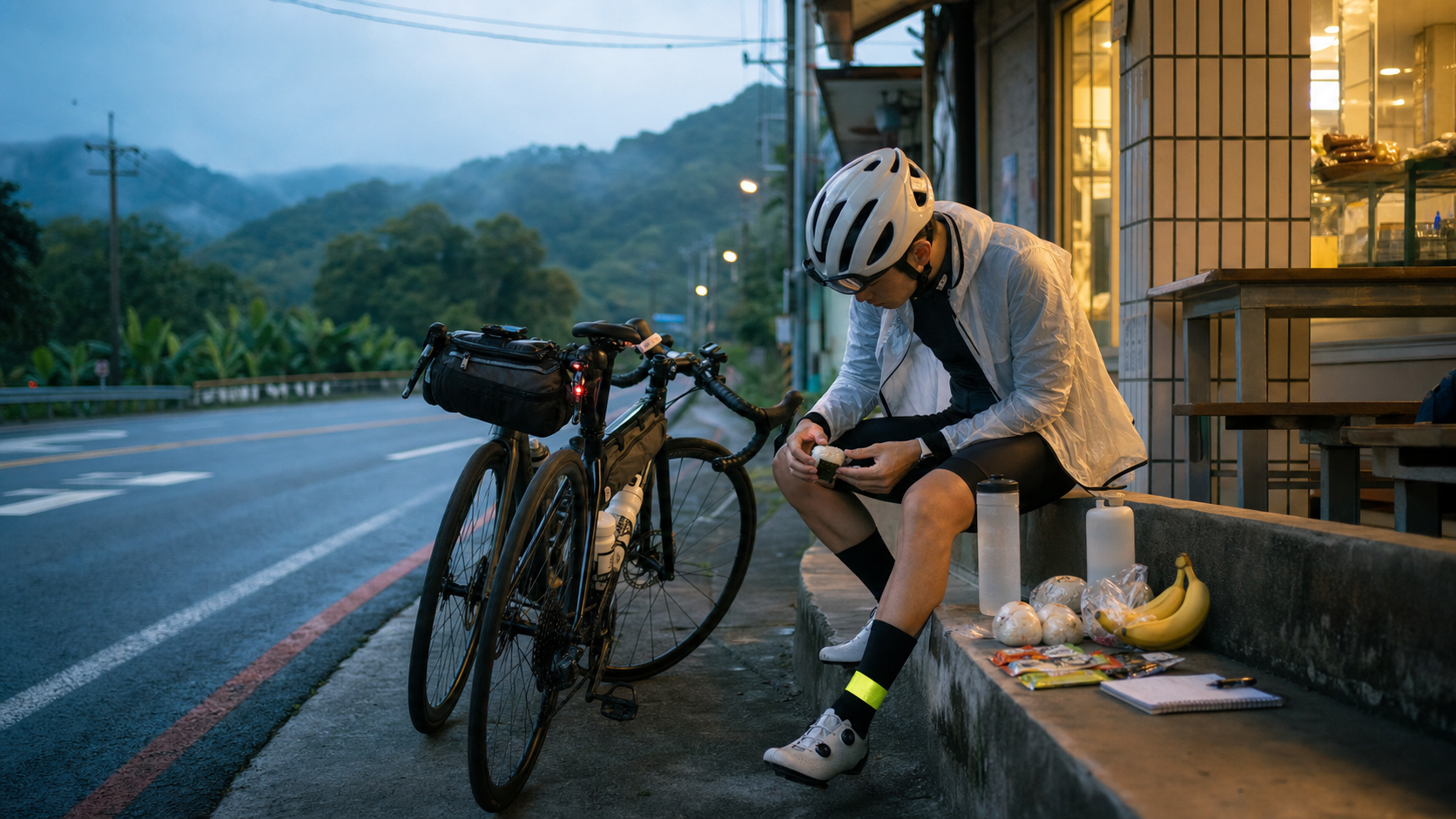
Introduction
The Audax community in Taiwan has grown rapidly in recent years, from the Taiwan Randonneurs route association (ACP-certified) to unofficial challenge rides across the island. More and more Taiwanese cyclists are taking on ultra-long-distance rides of 200, 300, 400, and 600km. Unlike regular road races, Randonnée emphasizes not speed but self-sufficiently completing the entire course within a set time limit—which makes aid station planning the decisive factor.
A poorly designed aid plan will leave you out of water and food on a mountain road in the dead of night; an overly cautious plan will have you lingering too long at convenience stores, ultimately teetering on the edge of the time cutoff. This article will help you find the right balance for Taiwan’s environment.
Time Limits and Energy Demands by Distance
| Distance | ACP Time Limit | Recommended Finish Time | Total Caloric Expenditure (70kg estimate) |
|---|---|---|---|
| 200km | 13.5 hours | 8–10 hours | 3,500–5,000 kcal |
| 300km | 20 hours | 13–16 hours | 5,500–7,500 kcal |
| 400km | 27 hours | 18–22 hours | 7,500–10,000 kcal |
| 600km | 40 hours | 28–35 hours | 11,000–15,000 kcal |
| 1200km | 90 hours | 70–80 hours | 20,000–30,000 kcal |
As the table shows, routes of 600km and above span 1–2 sleep cycles, which makes “when to sleep, how long to sleep, and where to sleep” part of aid station planning.
Aid Station Design Principles for Taiwan
Taiwan has a unique advantage for aid: convenience stores like 7-Eleven and FamilyMart are found almost every 3–5km, especially on flat terrain and in urban areas, making “refuel anytime” nearly possible. However, in mountain sections (such as the Suhua Highway, Central Cross-Island Highway, and Southern Cross-Island Highway), aid points may be 30–50km apart.
When designing aid stations, the following principles are recommended:
Fixed Stations (every 40–60km):
- Conduct formal water and food replenishment, topping up hydration bladders and feed bags
- Check physical condition (early discomfort in feet, sit bones, or neck)
- Record the time and compare against the planned pace
Rolling Refueling (every 20–30 minutes):
- Eat energy bars or bananas while riding
- Take small sips of water every 15–20 minutes (don’t wait until you’re thirsty)
- No need to stop—practice eating on the bike
Sleep Station Design (600km and above):
- The first sleep stop is recommended around the 300–350km mark, sleeping 60–90 minutes
- Avoid sleeping less than 20 minutes—this triggers “sleep inertia,” making you feel worse upon waking
- Choose a location with a shower or at least a place to wash your face
Food Selection Strategy
The food needed for ultra-long-distance riding differs from regular exercise:
- Digestibility first: Solid food digestion requires blood flow, which is reduced in the digestive system during prolonged riding. Avoid heavy, high-fat, high-protein foods
- Recommended local Taiwanese options:
- Convenience store rice balls (easy to digest, rich in carbohydrates)
- Bananas (potassium + fast carbs, helps prevent cramps)
- Sweet potato balls, salted soda crackers (sodium replenishment + easily digestible carbs)
- Soy milk (provides protein for repair on longer distances)
- Night riding specifics: Gastrointestinal motility slows late at night, so shift toward liquid nutrition (sports drinks, energy gels) and reduce the proportion of solid foods
Practical tips:
- Keep each aid station stop to no more than 10–15 minutes (for 200–400km routes)
- Prepare spare batteries, spare tubes, and dry clothing at each pre-confirmed “safe aid point”
- If you have support vehicle backup, set up an “emergency aid code word” to call for support when something goes wrong with your body
Practical Advice
Here are hard-won insights from experienced Taiwanese Randonneurs:
- Scout ahead: Before the official start, verify the 24-hour operation status of aid points during regular rides—especially mountain convenience stores, which may close after 11 PM
- Backup feed bag: Carry at least 400–600 kcal of emergency food in your saddle bag. Never put yourself in a position where you have to make decisions under “I must find food” pressure
- Sodium replenishment can’t rely on electrolyte tablets alone: During high-sweat summer rides in Taiwan, sodium loss can reach 1,000–2,000mg per hour. A single electrolyte tablet (about 300mg sodium) is far from sufficient—pair it with salty foods
- Keep an aid log: After every long-distance training ride, record what you ate, where you refueled, and whether you had any gastrointestinal discomfort, gradually building your own personal aid database
Conclusion
The charm of Audax and Randonnée lies in how it blurs the line between “racing” and “traveling.” You’re not competing against others—you’re in dialogue with time, terrain, and your own body. A good aid station plan isn’t about mindless eating and drinking; it’s about letting you focus your attention on enjoying the journey.
Taiwan offers the Pacific coast along Provincial Highway 11, the high mountain forest roads of the Southern Cross-Island Highway, and the misty roads of Alishan—each one worth savoring slowly with ample supplies in tow.
Related Reading
- Ultra-Long-Distance Riding Training: Endurance Building Strategies for 200km and Beyond
- Ultra Cycling Preparation: Taking on Challenges Above 200km
- Road Bike Long-Distance Challenge Prep: Training Methods for a 200km Day Trip
- Power Distribution for Long-Distance Riding: Intensity Management Strategies for 200km and Above
半日 小台灣 極限單車路線挑戰實錄
7 年前
一日北高前的高裝檢 | 北高 360 | 挑戰11小時的裝備 | 一日雙塔 | 補給
6 年前
JE22 百里任務體驗,心跳不能過150,三小時內有可能...? 沒有天時地利難度有多高? / 公路車 / CT Yeh
1 年前
Live) 備戰2019彰化經典百K 賽前攻略 (已完賽請看新影片
7 年前
台北闊瀨陡坡 騎旅 / 日本單車雜誌編輯車友臨時加入!/ 髮香才是最強的 / feat. 北迴歸線小隊 / 公路車 CT Yeh
6 個月前
車隊介紹) 台北 一年開團365天 車隊 Apollo Ride 晨騎 好選擇 ( 陽明山 風櫃嘴 冷水坑 平等里 聖人 關渡 大稻埕 ) 找人騎車
7 年前
西進武嶺 免費訓練分析服務 Intervals | 練不夠還是練過頭?你哪一種類型選手?AI模型告訴你! | 備戰神器 | 公路車 訓練 | CT Yeh
4 年前
CT暗黑廚房) 車友必備 宇宙無敵鮮蚵湯 幫助訓練恢復 天然食補 好市多 超肥鮮蚵 破PR
7 年前