Sleep-First Strategies for Long-Distance Cycling Training: Recovery Management for 600km Weekly Volume
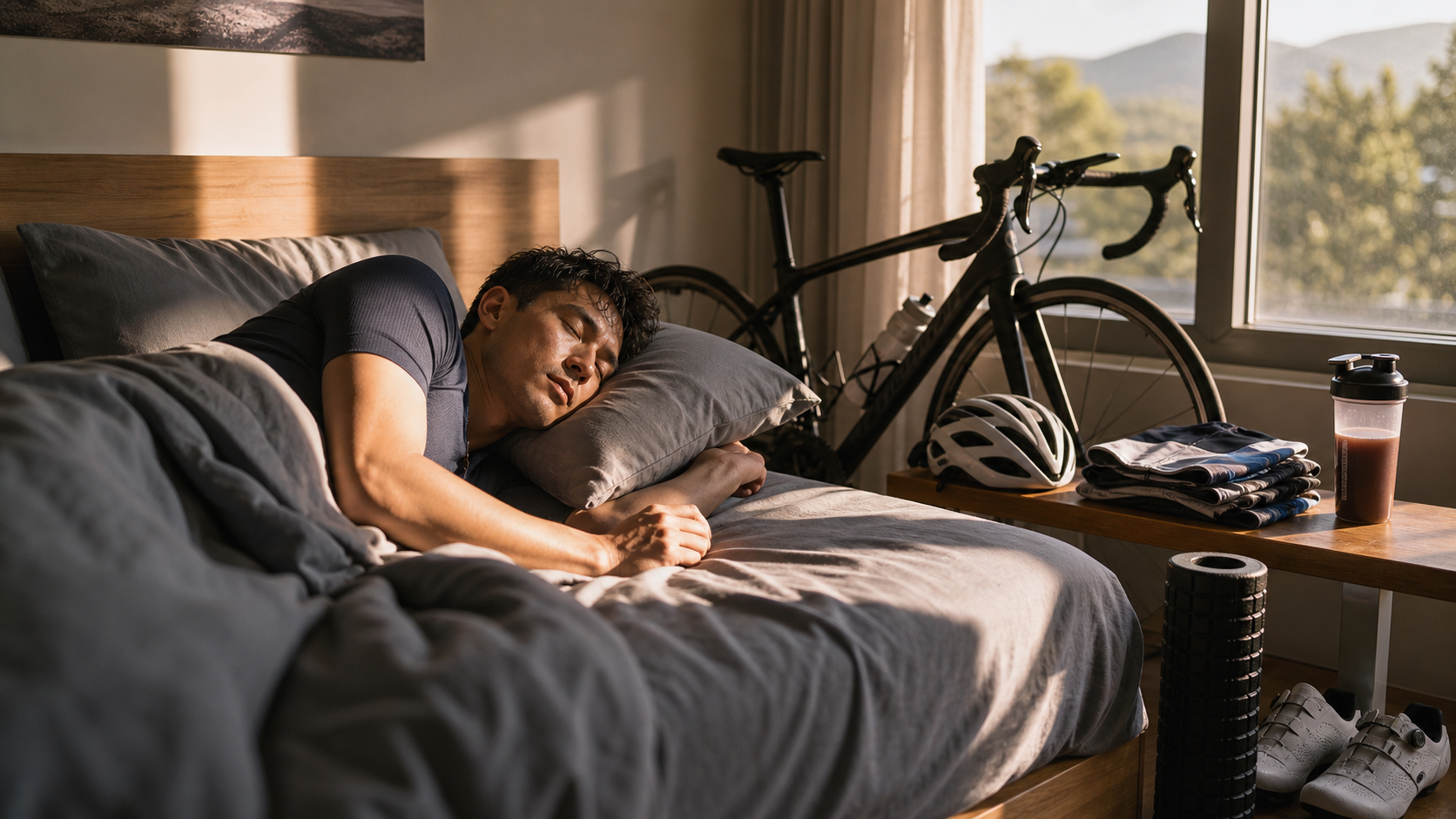
Introduction
Serious road cyclists in Taiwan have a typical training trap: they ride 300km on the weekend and stick to a 1–2 hour daily training schedule during the week, yet their performance plateaus—or worse, they start experiencing unexplained fatigue, poor sleep, and low mood.
The problem is usually not “insufficient training volume,” but “insufficient recovery.” More precisely—it’s sleep deprivation.
Sports science research has repeatedly proven that the real training adaptations happen during sleep. Muscle repair, glycogen resynthesis, hormone secretion (growth hormone, testosterone), and nervous system recovery—nearly all training adaptations are completed during sleep. This article will show you how to place sleep at the core of your training plan.
The Physiological Mechanisms of Sleep and Training Recovery
| Sleep Stage | Primary Recovery Function | Importance for Cycling Training |
|---|---|---|
| Slow-wave sleep (N3/deep sleep) | Peak growth hormone secretion, muscle protein synthesis | Directly determines the rate of muscle repair |
| REM sleep | Motor memory consolidation, nervous system recovery | Enhances technical riding ability, improves proprioception |
| Whole-night sleep | Glycogen resynthesis, inflammatory response regulation | Ensures energy reserves for the next training session |
Specific effects of sleep deprivation (research data on athletes):
- After 3 consecutive nights of 6 hours of sleep (vs. the normal 8 hours), maximal power output drops by 3–8%
- Sleep deprivation raises cortisol (stress hormone) levels, accelerating muscle catabolism
- Reaction time lengthens, increasing the risk of accidents during night riding
- Subjective fatigue ratings rise—even when physical condition is objectively good, it still feels exhausting
Optimizing Sleep Quality During High Training Volume
Sleep duration targets:
- Training volume under 300km per week: 7–8 hours/night
- Training volume of 300–500km per week: 8–9 hours/night (+ 20–30 minute nap)
- Training volume above 500km per week: 9–10 hours/night (+ nap)
Note: “Time in bed” ≠ “actual sleep time.” Many cyclists go to bed early during high-volume periods but struggle to fall asleep due to muscle soreness or elevated cortisol levels.
Specific strategies for improving sleep quality:
Improving sleep onset:
- Go to bed 2–3 hours after finishing training (allow core body temperature time to drop)
- Avoid caffeine intake in the evening after high-intensity training (cutoff time moved up to 2 PM)
- Establish a fixed “pre-sleep relaxation routine”: gentle stretching → cool/warm shower → reading in dim light
Improving sleep depth:
- Maintain bedroom temperature at 18–20°C (air conditioning is essential in Taiwan’s summer)
- Use blackout curtains (especially when you need to wake up at 5 AM for training)
- Magnesium supplementation (400–600mg magnesium citrate, taken before bed) can improve deep sleep quality while replenishing magnesium lost through riding
Sleep Management in Periodized Training
Sleep strategy for “overload weeks vs. recovery weeks”:
A well-designed training plan follows a cycle of 3 weeks of high-intensity training + 1 week of reduced-volume recovery. Sleep management should be adjusted accordingly:
- Overload weeks (3 weeks): Target 8.5–9 hours of sleep, actively schedule naps
- Recovery week (week 4): Can be slightly reduced to 7.5–8 hours, allowing the body to reach an optimal “supercompensation” state
Sleep differences between training days and rest days:
- The first night after high-intensity training carries the highest sleep demand—make sure you get enough sleep that night
- Rest days don’t require “catching up” with 10–11 hours of sleep; this can actually disrupt your circadian rhythm
The science of napping:
- 10–20 minute “Power Nap”: improves afternoon alertness and athletic performance without affecting nighttime sleep
- 90-minute “full sleep cycle”: provides deep recovery during very high training volume, but should be completed before 3 PM
- Avoid 30–60 minute naps: you may enter deep sleep and be interrupted, causing sleep inertia
Practical Recommendations
- Use sleep tracking tools: Devices such as Garmin, Polar, and Oura Ring can track deep sleep and REM ratios, helping you identify trends of declining sleep quality
- Add sleep records to your training log: Record sleep duration and subjective sleep quality (1–10 scale) daily. If the score stays below 6 for 3 consecutive days, reduce that week’s training volume by 20–30%
- Recognize early signs of “functional overtraining”: Morning resting heart rate persistently elevated (more than 7 bpm above normal) and waking up feeling more tired than the day before—these two signals indicate insufficient sleep and recovery
- Balancing social rides with sleep: Many cyclists in Taiwan set off on weekend long rides at 5–6 AM, which is understandable; but to maintain adequate sleep, you should be in bed by 10–11 PM on Friday night
Conclusion
Formally “scheduling” sleep into your training plan is a key step in progressing from a recreational cyclist to a smart trainer. A 600km weekly training load only truly becomes capital for improvement when supported by adequate sleep recovery.
Taiwan’s cycling culture is incredibly rich, but sometimes “riding less and sleeping more” brings greater progress than “riding more and sleeping less.” Learn to make sleep the most important component of your training, and your long-distance performance will reach a new level.
Related Reading
- The Impact of Sleep Quality on Cycling Training Adaptations: The Relationship Between Deep Sleep and Growth Hormone Secretion
- Sleep Management for Cyclists: A Complete Guide to Improving Recovery Efficiency
- Sleep Optimization for Cyclists: The Most Powerful Recovery Weapon
- [Nutrition & Recovery] A Guide to Sleep Hygiene and Growth Hormone Release for Endurance Athletes: The Role of Deep Sleep Stages in Repairing Central Nervous System Fatigue and Recovery Scheduling (Part 2) Practical Guide](/articles/11375)
單車 一日北高 ( 雙城 ) 肥宅雙人瘋狂行 紀錄片 REACTO
10 年前
西進武嶺 免費訓練分析服務 Intervals | 練不夠還是練過頭?你哪一種類型選手?AI模型告訴你! | 備戰神器 | 公路車 訓練 | CT Yeh
4 年前
#公路車 #Fitting 靠人工智慧APP 幫你調整單車
6 年前
DJI Osmo Action 6 / 單車運動拍攝實用技巧 公路車 CT Yeh
7 個月前
大家都在開箱的...單車用藍芽對講耳機真的有幫助嗎? SENA BiKom 20 長距離旅遊 & 海鷗繞圈賽 實際體驗心得 / 公路車 / CT Yeh
9 個月前
靠單車減肥35公斤 心得分享與整理
7 年前
一日北高 11小時 賽後心得分享篇 | TWB北高360 | 一日雙城 | 單車 | 公路車
6 年前
一日北高常見問題大集合 | 攻略 | 路線 | 訓練 | 補給 | 自行車 單車 | 一日雙城 | 雙塔 | TWB北高360 | 屁股痛
6 年前