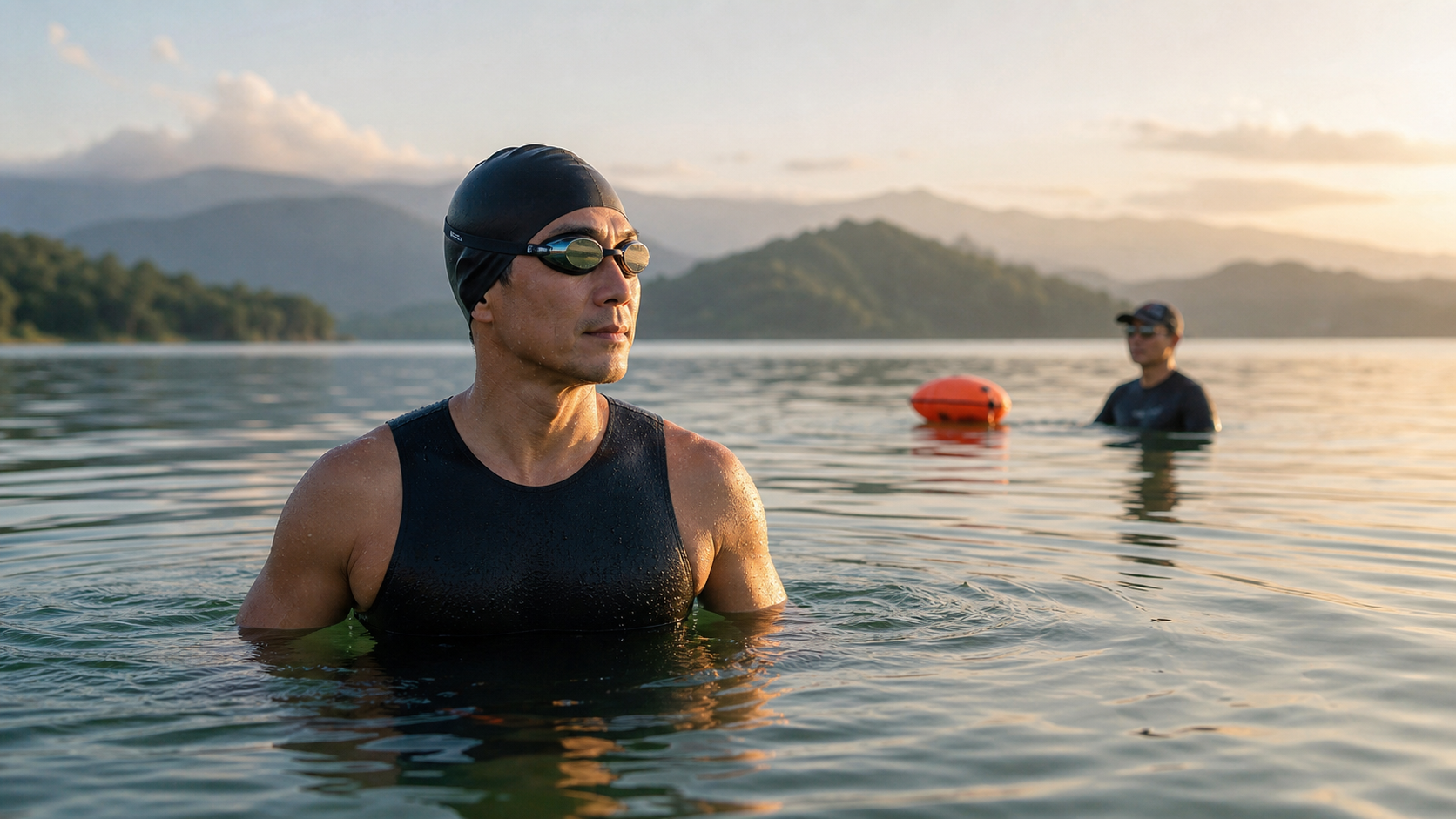
Introduction
In Taiwan, more and more swimming enthusiasts are beginning to try open-water swimming, whether preparing for the Sun Moon Lake swim, the Chengcing Lake race, or signing up for triathlon events. However, the gap between the pool and the lake is often much larger than expected—not just a technical challenge, but also a psychological test. This article will help you understand the key differences between these two environments and provide practical adaptation strategies.
Psychological Barriers: Why Lakes Make People Feel Uneasy
The sense of security in a pool comes from multiple factors: crystal-clear water, fixed lane lines, clearly visible walls, and shallow areas where you can stand at any time. Once you enter open water, all these familiar anchors disappear.
Common psychological reactions include:
- Visual anxiety: Inability to see the bottom clearly, uncertainty about what is beneath you
- Loss of spatial awareness: No lane lines, no idea where you are
- Isolation: No other swimmers or lifeguards nearby
- Hyperventilation: Anxiety leads to rapid breathing, disrupting your swimming rhythm
The first step in overcoming these psychological barriers is to prepare mentally before actually entering the lake. You can practice swimming 10 meters with your eyes closed in the pool to experience swimming without visual reliance; or practice swimming in a straight line without looking at the bottom, gradually reducing your dependence on visual information.
Technical Differences: Pool vs. Open Water
| Item | Pool | Open Water |
|---|---|---|
| Water clarity | High, bottom visible | Low, often murky |
| Propulsion assistance | Flip-turn wall push-off | None,全靠划水 |
| Navigation method | Lane lines and bottom markings | Visual navigation (sighting) |
| Water temperature | Constant (usually 26–28°C) | Seasonal variation (16–30°C) |
| Wave interference | Almost none | Waves and currents present |
| Psychological stress | Low | Medium to high |
From a technical standpoint, the most critical difference lies in navigation skills. Pool swimmers rely on the black line at the bottom of the lane to stay straight, but in open water, you must learn “sighting”—lifting your head every 6 to 8 strokes to check your direction. If this movement is not practiced, it will disrupt your stroke rhythm and consume extra energy.
Another difference is adjusting your stroke tempo. Pool swimmers are accustomed to recovering energy through gliding after a flip-turn wall push-off, but in open water, this opportunity disappears, and your stroke tempo needs to be more stable and rhythmic.
First Swim Preparation Checklist
Before entering open water for the first time, it is recommended to prepare thoroughly:
- Choose a familiar venue: Prioritize legal open-water swimming sites in Taiwan such as Chengcing Lake or Liyu Lake, avoiding wild rivers or locations without lifeguards
- Do not enter the water alone: Swim with at least one companion, or join a group swim led by a coach
- Wear a swimsuit and swim cap: Open-water wetsuits provide buoyancy and warmth; beginners are advised to wear one
- Start with short distances: Swim only 200–300 meters the first time, allowing both body and mind to adapt to the environment
- Plan your return route: Confirm entry and exit points before entering the water to avoid losing your bearings
Practical Advice
Progressive adaptation training is the most effective method for transitioning from the pool to open water. A 4-week plan is recommended:
Week 1: Practice sighting in the pool, lifting your head every 6 strokes, maintaining a straight course for 200 meters without drifting.
Week 2: Find a clear shallow lake or bay (Liyu Lake is recommended in Taiwan), wear a swim cap, and practice the sensation of entering water at 1 meter depth.
Week 3: Complete a 400–600 meter open-water swim with a companion alongside.
Week 4: Complete a full 800–1000 meter swim, testing your navigation ability and rhythm stability.
On the psychological side, the “anchoring technique” is recommended: before entering the lake, take several deep breaths on the shore and tell yourself, “I have practiced sufficiently, and I have the ability to control my pace.” This positive self-talk has been proven in sports psychology to effectively reduce anxiety.
Conclusion
The transition from pool to open water is a necessary journey for every advanced swimming enthusiast. Taiwan boasts abundant lake and reservoir resources. As long as you make proper safety preparations and follow progressive training, this journey will not only improve your swimming technique but also bring a brand-new experience. The next time you stand on the shore of Chengcing Lake or Liyu Lake, you will no longer be a stranger, but an open-water swimmer ready to take on the challenge.
Related Reading
- Open-Water Swimming for Beginners: A Complete Adaptation Guide from Pool to Ocean and Lake
- Overcoming Open-Water Swimming Fear: Systematic Approaches to Psychological Barriers
- Open-Water Psychological Challenges: Overcoming Isolation and Panic to Regain Confidence in the Water
- Fitness Differences Between Pool and Open Water: How to Simulate Open-Water Intensity in Pool Training
滑雪新手們慘摔學習全紀錄(請開字幕),滑雪好好玩 | Snowboard + Ski | 岩原 スキー場 | 滑雪APP使用 | GoPro Max
6 年前
[教學] Premiere 影片 手震 修正 教學 防抖 單眼 影像 GoPro 穩定 Video Stabilization
8 年前
一日北高常見問題大集合 | 攻略 | 路線 | 訓練 | 補給 | 自行車 單車 | 一日雙城 | 雙塔 | TWB北高360 | 屁股痛
6 年前
單車 梅山36灣 坡度介紹 路段介紹 空拍 (相關遊記影片,請參考說明或我的頻道喔,歡迎訂閱)
6 年前
2026 輪霸西濱200K 挑戰VLOG / 第一集團 / 首次參加..經驗不足、膀胱不足 /死守6H內 / AI戰鬥力顯示系統 / 公路車 / CT Yeh
4 個月前
備戰 戀戀197 賽前關門點分析 西濱團練 #公路車 4K高畫質
6 年前
FTL 與 SYB 車隊專訪 西進武嶺 實用攻略分享! 2小時 如何練?!你不知道的眉角!新手準備武嶺必看 EP1 | 實力派女車友 | 精華版 | 公路車 | CTYeh
4 年前
一起升級!海鷗盃LSD團練...JJSC Zone2招待 騎到手抖 / 公路車 / CT Yeh
1 天前