Introduction
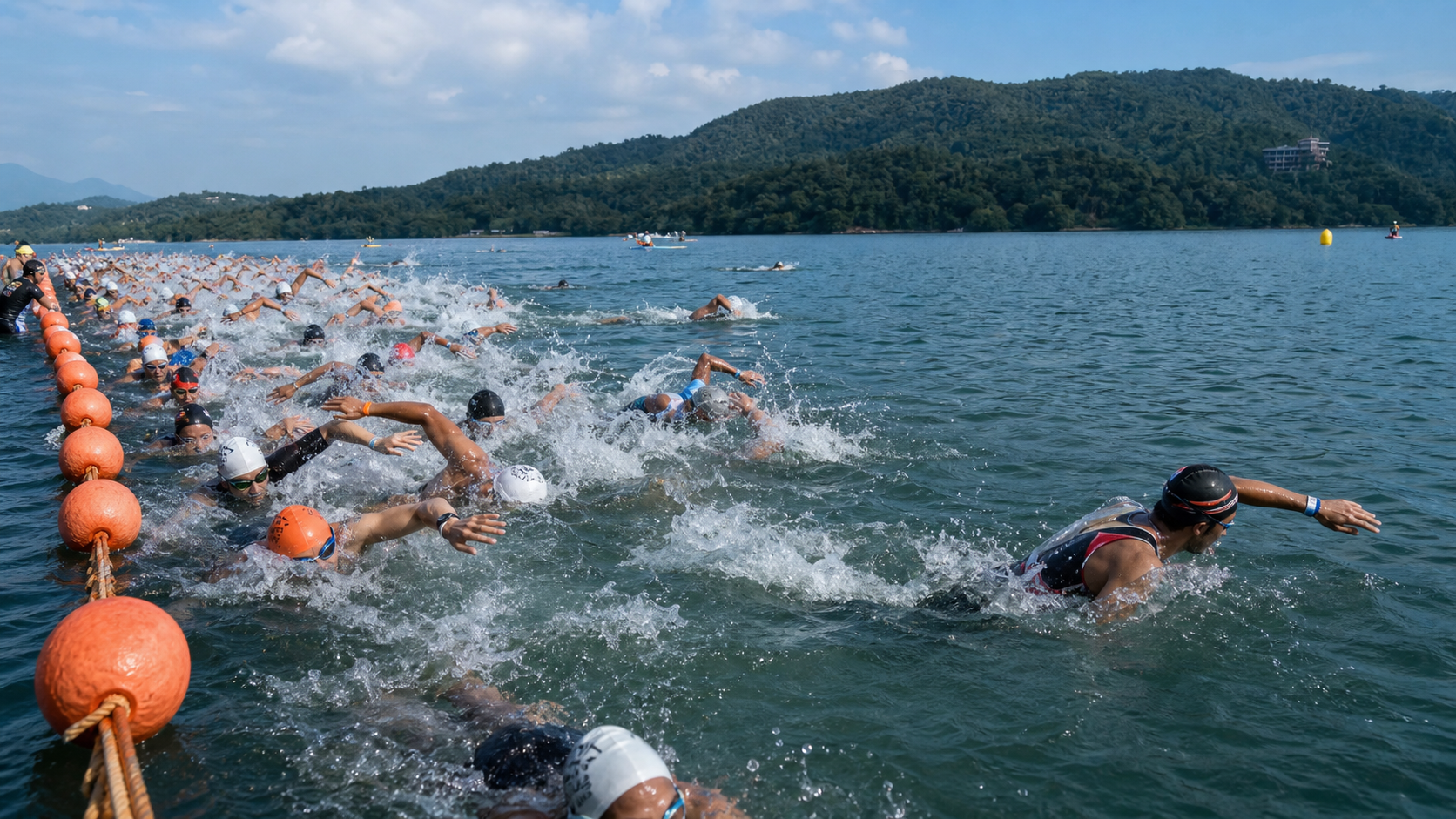
The swim start of a triathlon is the most nerve-wracking moment of the entire race. Dozens or even hundreds of athletes charge into the water simultaneously, forming a chaotic “washing machine.” Finding your position in this melee—without wasting energy or getting injured—is a strategic skill every triathlete must learn. This article will provide an in-depth analysis of the pros and cons of an outside start versus an inside start, helping you make the most informed decision.
Causes of Chaos at the Start
The chaos at the triathlon swim start stems mainly from the following factors:
- Mass entry: All athletes enter the water at once or within a short window, creating extremely high density
- Fighting for the buoy line: The route closest to the buoy line is the shortest, and everyone wants it
- Speed differences: Faster and slower swimmers are mixed together, and slower ones are more likely to be kicked or trampled
- Obstructed vision: With water splashing everywhere, it’s nearly impossible to see the swimmers ahead
At the international triathlon held at Taitung Living Lake and at 51.5K or 113 races across Taiwan, the chaotic start is consistently cited by athletes as one of the biggest challenges.
Outside Start vs. Inside Start: A Comprehensive Comparison
| Factor | Inside Start (near the buoy line) | Outside Start (away from the buoy line) |
|---|---|---|
| Route distance | Shortest, almost entirely along the buoy line | Slightly longer, about 3–8% more distance |
| Collision risk | High, dense crowds | Low, more open space |
| Start speed requirement | High, must maintain a fast early pace | Moderate, can start at your own pace |
| Energy expenditure | High (fighting the crowd, emotional stress) | Moderate |
| Best suited for | Elite or strong swimmers | Mid-pack athletes, first-time participants |
| Turning advantage | Must fight for position, high pressure | Can swing wide early, saving energy |
The advantage of an inside start lies in the shortest route. In an Olympic-distance race of 1500 meters, hugging the buoy line can save 50–120 meters compared to swinging wide. For elite athletes, that distance translates to a time difference of 45 seconds to 1 minute 30 seconds.
However, the cost of an inside start is high-density physical contact. Research shows that the first 200 meters after the start are the peak collision period, with inside-lane swimmers taking an average of 2–4 impacts per minute. These collisions don’t just disrupt your rhythm—they can also knock goggles out of place or cause you to inhale water and choke.
Start Recommendations by Ability Level
Elite athletes (swim segment goal under 20 minutes): An inside start is viable, but it’s recommended to position yourself at the front row of the start line to ensure slower swimmers don’t block you. You need solid pack-swimming training experience and the ability to maintain your rhythm amid the chaos.
Mid-pack athletes (swim segment goal 25–35 minutes): An outside start is recommended, positioning yourself about 5–10 meters from the buoy line. This allows you to maintain your own pace in a less collision-prone environment and gradually edge inward once the crowd thins out (after roughly 300–400 meters).
First-time participants or weaker swimmers: An outside or back-of-the-pack start is strongly recommended—don’t try to fight for position. Finishing the race matters more than getting a fast start; avoid wasting energy or getting injured in the starting chaos.
Techniques for Handling Collisions
Even if you choose an outside start, collisions can still happen. Here are some practical techniques for dealing with them:
- Goggles knocked askew: Stop immediately, press the edge of the goggle with one hand to quickly reseal it—don’t take them off completely and put them back on (that takes too long)
- Getting pushed under water: Stay calm, turn to the side, and use a sidestroke to move out of the crowd, then switch back to freestyle once clear
- Kicked in the face: First check for bleeding or goggle damage; if nothing’s wrong, keep swimming and assess after the race
- Rhythm disrupted: Take two deep breaths, find your stroke rhythm again, and don’t try to immediately accelerate to make up for lost time
Practical Advice
During your preparation, it’s recommended to deliberately schedule “pack-swimming training.” Many triathlon communities in Taiwan (such as training groups recognized by the Chinese Taipei Triathlon Association) regularly hold pack-swimming practice sessions at Taitung Living Lake or Chengcing Lake. Experiencing the collisions and responses of pack swimming firsthand is far more effective than any training done on paper.
Additionally, make sure to confirm the following the day before the race:
- Water depth at the start area (whether it’s a standing or diving start)
- The direction of the first buoy
- The starting position area corresponding to your start number
- Whether your timing chip is properly attached
Conclusion
There is no single right answer for the triathlon swim start—only the choice that best fits your current ability. An outside start may add a few extra meters, but it buys you a steadier rhythm and a lower risk of injury, making it the smarter strategy for most athletes. As your swimming ability gradually improves, you can begin to edge closer to the inside, and by then you’ll be better equipped to handle the challenges of pack swimming.
Related Reading
- Open-Water Triathlon Swim Start Strategy: Crowd Conflict Management and Sight Navigation
- Open-Water Swim Start Strategy: Positioning and Pacing in a Group Start
- Triathlon Swim Segment Group Start Strategy: Position Selection and Handling Physical Contact
- Open-Water Start Melee Strategy: Finding Your Rhythm in the Crowd
[防寒衣體驗] 鐵人魂 三鐵 防寒衣試穿會 於松運 深水游泳池 鯨魚池
8 年前
福隆鐵人團練隨拍
8 年前
新屋團體繞圈賽 | 眾多菁英好手賽道奔馳 | 千瓦女子軍團 | 無敵交管狂獲好評 明年你一定不能錯過 | #公路車
5 年前
CT 喇低賽) 武嶺牽車 才是王道 西進牽車四小時內秘訣 攝手位置 如何判斷 防抽筋小秘訣
7 年前
#東進武嶺 全程實況錄影 5小時半 #夏季KOM #太魯閣 Taiwan KOM Challenge Reality Video Taroko scenery
7 年前
2023桃園團體繞圈賽 / 海鷗繞圈賽 | 全程空拍數據版 | 公路車 | CT Yeh
2 年前
Live) 備戰2019彰化經典百K 賽前攻略 (已完賽請看新影片
7 年前
一日北高常見問題大集合 | 攻略 | 路線 | 訓練 | 補給 | 自行車 單車 | 一日雙城 | 雙塔 | TWB北高360 | 屁股痛
6 年前