Introduction
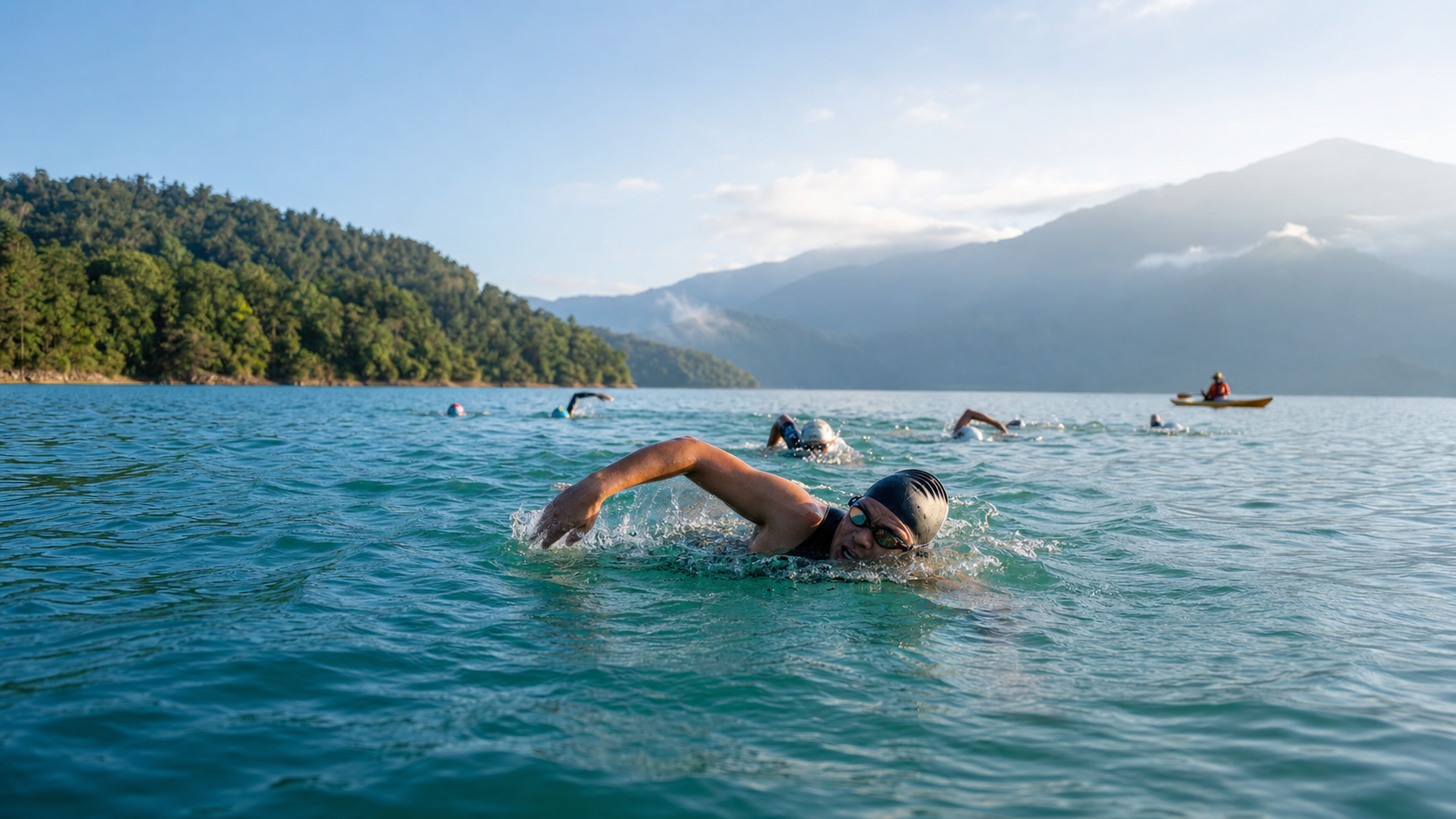
Every autumn, tens of thousands of swimming enthusiasts gather at Sun Moon Lake from all over Taiwan to take part in what is known as “Taiwan’s most beautiful open-water swim.” For many, the 3300-meter crossing far exceeds their usual pool training volume, requiring a systematic preparation plan to complete it safely and enjoyably. This article provides a practical 12-week training plan suitable for participants with basic swimming ability (able to swim 500 meters continuously) who have not yet tackled long-distance challenges.
Characteristics and Challenges of the Sun Moon Lake Swim
The Sun Moon Lake swim typically starts near Guanghua Island and finishes at Shuishe Pier or Ita Thao, covering approximately 3300 meters. Participants should be aware of the following characteristics:
- Water temperature: The event is usually held in September, with water temperatures around 24–27°C, which is within a comfortable range, but even without a wetsuit, prolonged time in the water means you need to watch for body heat loss
- Currents and waves: Sun Moon Lake is relatively calm, but noticeable waves can still form when winds pick up over the lake’s center
- Visibility: The lake water has a light green tint, with underwater visibility of about 1–3 meters
- Altitude: Sun Moon Lake sits at approximately 748 meters above sea level, and some participants may experience mild altitude effects
- Time limit: Officials typically set a 90–120 minute completion window
The 12-Week Training Plan
Phase 1 (Weeks 1–4): Building Base Endurance
Goal: Be able to swim 1500 meters continuously and develop a stable aerobic foundation.
| Week | Sessions per Week | Longest Single Distance | Key Technique |
|---|---|---|---|
| Week 1 | 3 sessions | 800m | Breathing rhythm, consistent breathing patterns |
| Week 2 | 3 sessions | 1000m | Stroke efficiency, flip turns |
| Week 3 | 4 sessions | 1200m | Kick tempo, body rotation |
| Week 4 | 4 sessions | 1500m | Integrated technique; time a 1500m test |
Each session is recommended to include: warm-up (200m easy swim) → main set (technique or distance work) → cool-down (100m easy swim).
Phase 2 (Weeks 5–8): Increasing Distance and Open-Water Adaptation
Goal: Complete 2500 meters in the pool and perform at least 2 open-water practice sessions.
This phase is the most critical transition period. It is recommended to schedule an open-water practice session on a weekend at Liyu Lake or Sun Moon Lake (on a non-event day) to let your body experience a real lake environment.
Key training items:
- Sighting drills: In the pool, practice lifting your head every 6 strokes; in open water, practice swimming 400 meters while aiming at a distant target
- Group-swim simulation: Find 3–5 training partners and swim side by side to get used to the splash from nearby swimmers
- Long, slow distance: Schedule one low-intensity long swim of 2000–2500 meters each week to build both mental and physical endurance
Phase 3 (Weeks 9–12): Peak Training and Tapering
Goal: Complete training sessions close to race distance, then taper in the final 2 weeks to allow full recovery.
- Week 9: Pool 2500m + open water 1500m
- Week 10: Pool 3000m (broken into: 1000m + 2 min rest + 1000m + 2 min rest + 1000m)
- Week 11: Taper week, reduce training volume by 40%, keep frequency but lower distance
- Week 12 (race week): Easy 500–800m swims in the first half of the week; complete rest 2 days before the race
Race-Day Strategy
Before the start: After arriving, do a 5–10 minute in-water warm-up in the designated area to let your body adjust to the water temperature and avoid the cold-water shock that can disrupt your breathing rhythm upon entry.
First 500 meters: This is the segment where it’s easiest to get overexcited. A conservative pace is the wise choice—if it feels easy, that’s the right speed, not a pace you’re struggling to hold.
Middle section (500m–2500m): Find your rhythm and lift your head every 6–8 strokes to check your direction. When you encounter other swimmers, don’t try to force your way past; wait patiently for space to open up.
Final 500 meters: Your energy may dip slightly at this point, and mental pressure will increase. Focus on your stroke rhythm and tell yourself, “I’ve already swum 2800 meters, only 500 to go,” using positive self-talk to keep your momentum.
Practical Tips
Several easily overlooked details during the training period:
- Goggle selection: For open water, goggles with slightly larger lenses (such as the Aqua Sphere Seal) are recommended, as they offer a wider field of view that aids sighting
- Anti-fog and leak prevention: The night before the race, confirm your goggles seal properly; you can apply a thin layer of baby shampoo to the inside of the lenses, shake, and rinse for good anti-fog performance
- Nutrition strategy: 3300 meters doesn’t necessarily require fueling, but if you’re concerned, you can tuck an energy gel under your swim cap as backup
- Sun direction: The Sun Moon Lake swim often takes place in the morning; note whether the sun is shining directly into your eyes and consider using tinted-lens goggles
Conclusion
The Sun Moon Lake swim is not just a physical challenge—it’s an unforgettable life experience. The morning lake surface, the mountain reflections, and the spectacular sight of tens of thousands swimming together are among the most moving chapters of Taiwan’s swimming culture. As long as you prepare diligently with a systematic training plan, you’ll be able to swim from Guanghua Island all the way across on that autumn morning, arriving at the finish with a smile.
Related Reading
- The Complete Guide to the Sun Moon Lake Mass Swim: Preparation and Race-Day Strategy for the 3.3km Lake Crossing
- Sun Moon Lake Mass Swim: A Participant’s Guide to Taiwan’s Largest Water Event
- Sun Moon Lake Mass Swim: A First-Timer’s Journey and On-Site Experience
- The Complete Sun Moon Lake Mass Crossing Guide: Every Detail from Registration to Finishing
半日 小台灣 極限單車路線挑戰實錄
7 年前
Live) 備戰2019彰化經典百K 賽前攻略 (已完賽請看新影片
7 年前
單車 一日北高 ( 雙城 ) 肥宅雙人瘋狂行 紀錄片 REACTO
10 年前
2023桃園團體繞圈賽 / 海鷗繞圈賽 | 全程空拍數據版 | 公路車 | CT Yeh
2 年前
4K 東眼山 x 水蜜桃冰沙 百人單車約騎! 操完再吃冰 多爽快
7 年前
新玉門關 單車挑戰賽 多視角主集團衝刺菁華版 4K #公路車
5 年前
山道猴出沒!? JJSC屏東單車行 Day1 一直催 / 皮卡丘來了!/ 墾丁 旭海 恆春 社頂 / 公路車 / CT Yeh
2 年前
一輪盃環湖挑戰賽 | TIME新車首航 | 一輪帶我飛 | 百萬流量都在場 | 4K畫質 | 公路車 | CT Yeh
3 年前