Introduction
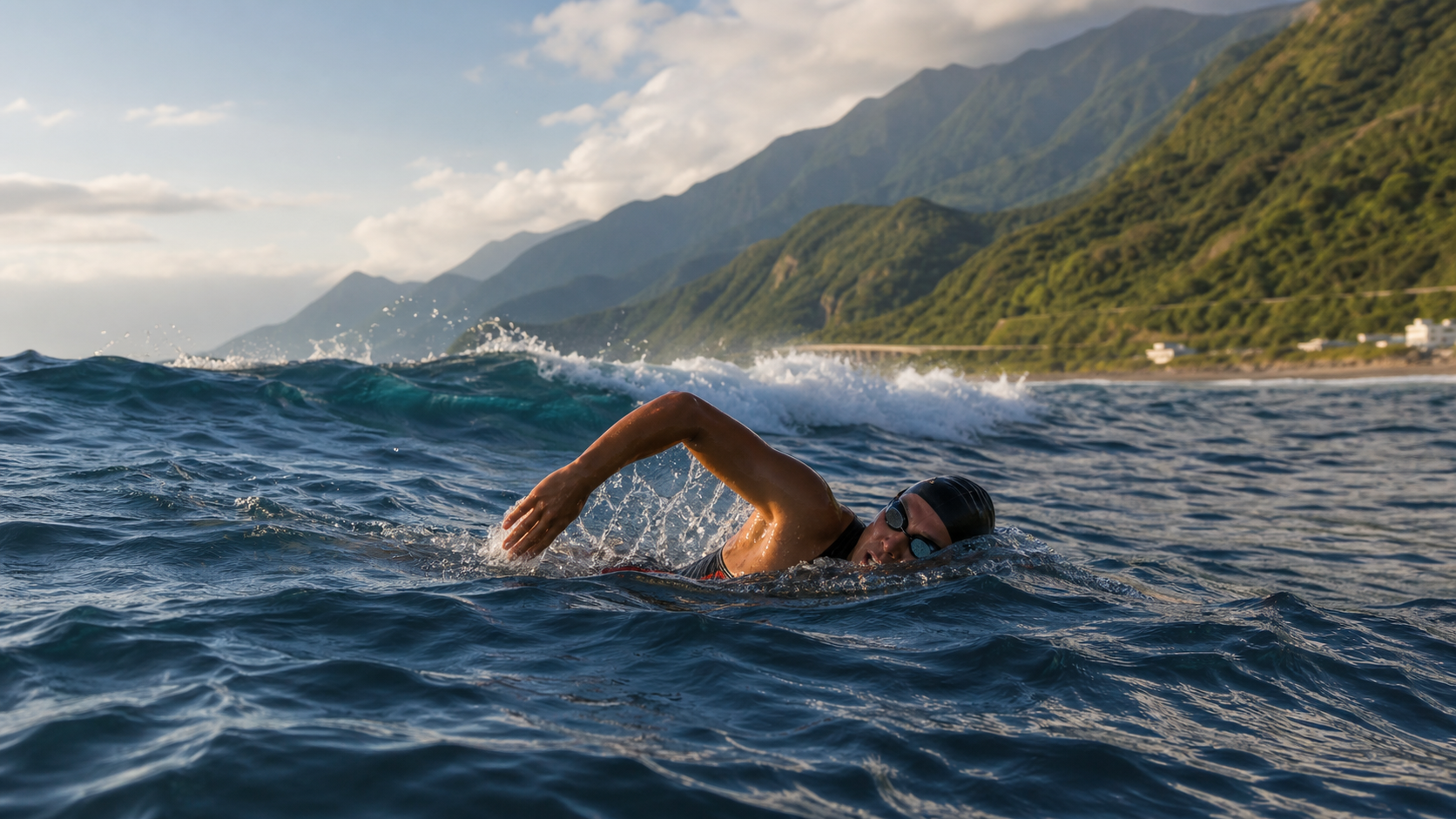
Surrounded by the sea on all sides, Taiwan’s eastern Hualien and Taitung boast stunning Pacific coastlines, attracting many athletes each year to participate in open-water swimming events or triathlons. However, the biggest difference between ocean swimming and lake swimming is the presence of “waves.” Many swimmers with excellent pool times feel lost once they enter a wavy sea, unable to maintain their rhythm and burning through energy quickly. This article will teach you how to “swim with the waves,” turning waves from an enemy into an ally.
Understanding Wave Types
Swimming off Taiwan’s east coast, you may encounter the following wave conditions:
- Swell: Long-period waves with large but relatively regular undulations, ideal for harnessing momentum
- Broken Wave: Crashing surf after entering shallow water, with strong impact that requires quick passage
- Chop: Short-period, irregular fluctuations, common on windy lakes or harbors, and the most difficult to handle
- With-current/Against-current: The influence of ocean current direction, sometimes more important than the waves themselves
Understanding the day’s wave conditions is the first step before entering the water. Spend 3–5 minutes observing from the shore to gauge the wave period (time from crest to crest) and direction, then decide on your swimming strategy.
Key Techniques for Wave Swimming
Harnessing Swell for Momentum
Swell can be effectively utilized. When you feel your body being lifted from behind by a wave, that’s the best moment to accelerate. The specific techniques are as follows:
- Sense the wave crest: Pay attention to the feeling of being pushed upward, indicating a crest is passing
- Accelerate your stroke: At the crest, quickly increase your stroke rate to use the wave’s kinetic energy to move forward
- Decelerate and glide: When you feel your body being pushed into the trough (sinking forward), slightly reduce your stroke rate to conserve energy and let the wave carry you
| Wave Phase | Body Sensation | Recommended Action |
|---|---|---|
| Crest approaching | Feeling of being lifted | Increase stroke rate, accelerate |
| Crest passing | Body at highest point | Maintain high rate, sight forward |
| Trough sinking | Forward sinking sensation | Slow down rate, conserve energy |
| During opposing waves | Increased resistance | Lower body profile, reduce entry angle |
Techniques for Handling Broken Waves
Broken waves typically appear in the start zone (entering from shore) and the finish zone (swimming back to shore). The key to handling broken waves is speed and timing:
- When entering the water: After running to knee depth, choose a gap between two broken waves to quickly dive in and start swimming immediately. Don’t try to stumble forward with high knee lifts—that will drain enormous energy.
- When exiting the water: Once you feel your abdomen touch the bottom, stand up and run immediately rather than continuing to swim; maintain a forward-leaning posture to prevent broken waves from knocking you over from behind.
Strategies for Dealing with Chop
Chop (short-period irregular fluctuations) is the most difficult wave condition to handle, as it cannot be predicted or harnessed like swell. The best strategy for chop is:
- Lower stroke rate, increase stability: Don’t try to maintain a fast tempo; instead, focus on steady, powerful strokes
- Shorten breathing intervals: In chop, breathing position is harder to predict, so breathe every 2–3 strokes rather than your usual every 3–4 strokes
- Reduce head lift height: When sighting, you don’t need to lift your head high—just get your eyes above the water surface
Strategies for Managing Energy Expenditure
The biggest energy killer in wave swimming is often not the stroking itself, but the extra power output used to resist waves and hyperventilation caused by psychological anxiety.
Effective energy management strategies:
- Conservative start: In the start segment with larger waves, deliberately slow down by 15–20%, letting your body adapt to the wave conditions before gradually picking up speed
- Sustained breathing control: Breathe every 3 strokes, maintaining an even rhythm, and don’t skip breaths because of the waves
- Use buoyant positions: When fatigued, briefly adopt the “starfish float” position (lying on your back on the surface), letting the waves push your body while you recover your breathing
- Estimate finish time: For open-water swimming, finish times in wavy conditions are typically 15–25% slower than in a pool, so adjust your mental expectations in advance
Practical Advice
Athletes planning to compete in eastern ocean events are advised to schedule at least 3–4 open-water swimming sessions during their preparation period. The estuary near Shabodan Creek in Hualien City and Taitung’s Living Water Lake (though an artificial lake, it occasionally has chop when windy) are both good practice locations.
Additionally, record the wave condition level (calm / light waves / moderate waves / large waves) and your finish time under each condition in your training log. Such records will help you more accurately assess your pacing strategy on race day.
Conclusion
Wave swimming is the most challenging and most fascinating technical aspect of open-water swimming. When you learn to sense the rhythm of the waves and dance with them, you’ll discover that the resistance in the water is no longer an enemy, but a force you can harness. The Pacific waves off Taiwan’s east coast await your conquest—and your enjoyment.
Related Reading
- Swimming in Waves: Techniques for Harnessing Wave Power and Response Strategies
- Adapting to Waves and Currents in Sea Swimming: Key Techniques for Swimming Along Taiwan’s Coast
- Swimming Techniques in Waves: Crossing the Surf Zone and Using the Backwash
- Wave Swimming Techniques: Dancing with the Waves Instead of Fighting Them
西進武嶺 免費訓練分析服務 Intervals | 練不夠還是練過頭?你哪一種類型選手?AI模型告訴你! | 備戰神器 | 公路車 訓練 | CT Yeh
4 年前
備戰 戀戀197 賽前關門點分析 西濱團練 #公路車 4K高畫質
6 年前
2025 海鷗團體繞圈賽 網路直播 超激烈裁判長視角 / EIPC 李廷威、Waypoint 等眾多高手競爭 / feat. 卡密兒主持 / 海鷗繞圈賽
9 個月前
一起升級!海鷗盃LSD團練...JJSC Zone2招待 騎到手抖 / 公路車 / CT Yeh
1 天前
CT暗黑廚房) 車友必備 宇宙無敵鮮蚵湯 幫助訓練恢復 天然食補 好市多 超肥鮮蚵 破PR
7 年前
#東進武嶺 全程實況錄影 5小時半 #夏季KOM #太魯閣 Taiwan KOM Challenge Reality Video Taroko scenery
7 年前
風櫃嘴 | 全台最多大砲的單車路線 | 尋寶網攝影師告訴你怎麼擺拍起來才好看 | 熱門攝影地點巡禮
6 年前
抖肩舞 台灣x日本交流版 (台灣 vs 前橋) 赤城山登山賽 coincidance
8 年前