Applying Heart Rate Variability (HRV) in Cycling Training: Morning HRV Guides Daily Training Intensity
Introduction
Have you ever experienced this: after climbing Wuling yesterday, you had a hard workout scheduled today, but your legs feel heavy, you’re irritable, and your pedaling feels powerless? This isn’t just a “mental issue”—it’s your body’s autonomic nervous system sounding an alarm. Heart Rate Variability (HRV) is the most sensitive tool for capturing this warning.
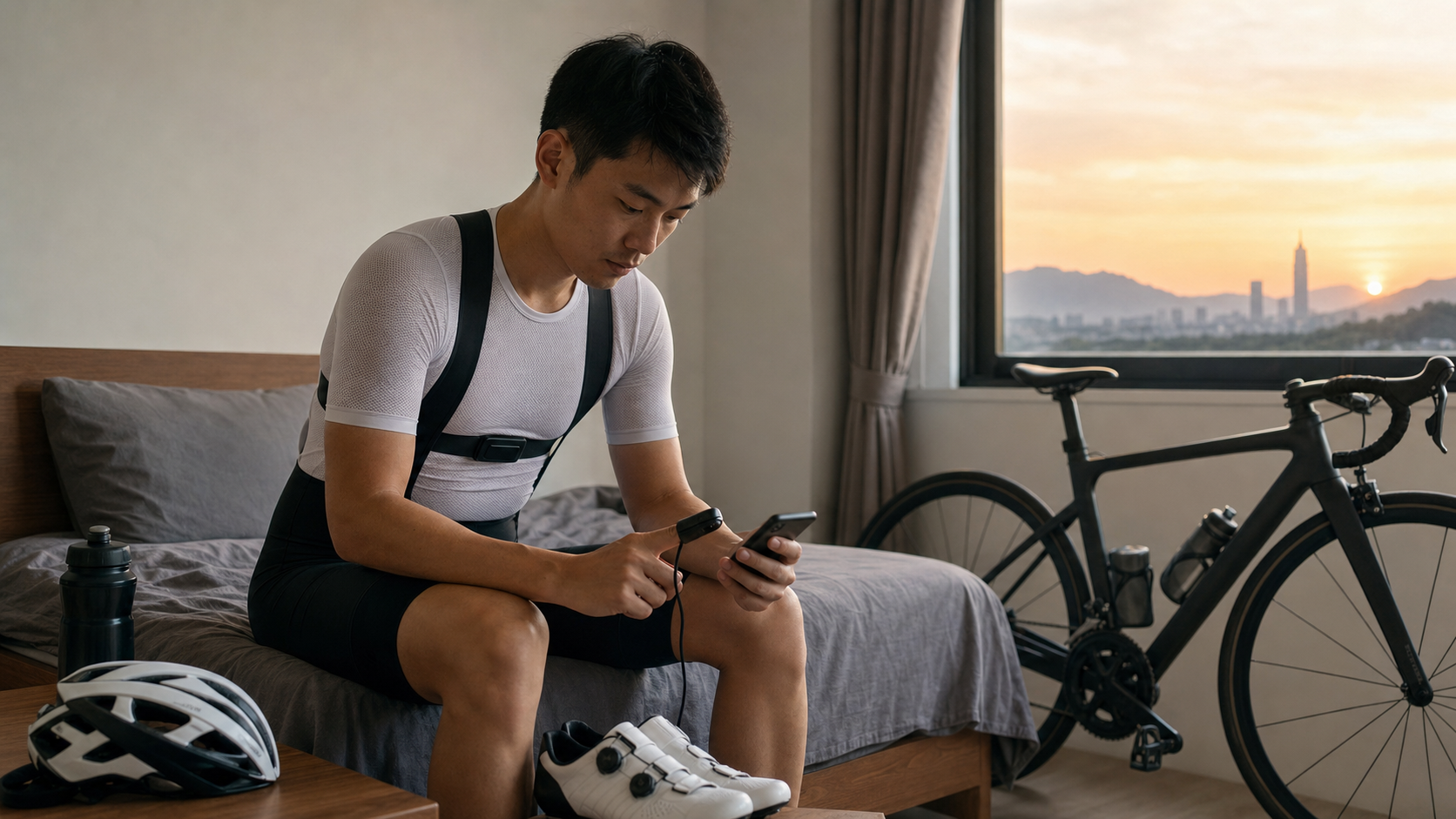
In recent years, HRV monitoring has become almost standard among elite athletes. From UCI professional teams to top competitors in Taiwan’s Formosa 900, more and more people spend 3 minutes each morning measuring HRV, then decide whether to “push hard” or “take it easy” based on the readings. This article will delve into the physiological mechanisms of HRV, measurement methods, and how to use it to build a smarter training plan.
The Physiological Basis of HRV
HRV measures the variation in time intervals between consecutive heartbeats (RR intervals). The heart does not beat as regularly as a metronome; the time between each heartbeat varies subtly due to autonomic nervous system regulation.
- Parasympathetic (vagal) nerve activity: Greater variation in heartbeat intervals → high HRV → good recovery, suitable for high-intensity training
- Sympathetic nerve dominance: Heartbeat intervals become more uniform → low HRV → stressed or fatigued state, recommended low intensity or rest
Commonly used HRV metrics include:
| Metric | Full Name | Meaning |
|---|---|---|
| RMSSD | Root mean square of successive RR differences | Reflects parasympathetic activity, most commonly used |
| SDNN | Standard deviation of all RR intervals | Overall autonomic nervous system health |
| HF | High-frequency power (0.15–0.4 Hz) | Parasympathetic indicator |
| LF/HF ratio | Low-frequency/high-frequency ratio | Sympathetic/parasympathetic balance |
For cyclists, RMSSD is the most practical metric—it reflects recovery status from the previous day’s training in real time and is less affected by measurement posture.
Standard Morning Measurement Protocol
For HRV data to be meaningful, measurement must be standardized. Here is the recommended protocol:
- Fixed time: Measure at the same time each day after waking, preferably before coffee, breakfast, or any activity
- Consistent posture: Supine (lying down) is recommended, or seated but consistent every day; mixing postures creates baseline comparison errors
- Measurement duration: At least 60 seconds of RR recording; common apps recommend 2–3 minutes averaged
- Tool selection: Optical wrist watches (such as Garmin, Apple Watch) are convenient but less accurate than chest straps; the HRV4Training app with camera-based photoplethysmography (rPPG) is a good free option; the Polar H10 chest strap with the Elite HRV app is the highest-accuracy solution
- Establish a personal baseline: The average of the first 14–21 days is your “normal value”; a single reading is meaningless
Measurement Tool Accuracy Comparison
| Tool Type | Representative Product | Accuracy | Convenience | Suitable For |
|---|---|---|---|---|
| ECG chest strap | Polar H10 | ★★★★★ | ★★★ | Elite/research use |
| Optical chest strap | Garmin HRM-Pro | ★★★★ | ★★★★ | Advanced athletes |
| Optical wrist watch | Garmin Fenix 7 | ★★★ | ★★★★★ | General riders |
| Camera rPPG | HRV4Training App | ★★★ | ★★★★★ | Recommended for beginners |
Using HRV Readings to Guide Training Intensity
After establishing a baseline, compare each day’s HRV with your personal average and determine training strategy based on the deviation:
- HRV above average by +1SD or more: Autonomic nervous system super-compensation; suitable for the week’s highest-intensity workouts (such as VO2max intervals, FTP tests)
- HRV within ±1SD of average: Normal state; proceed with moderate-intensity training as planned
- HRV 1–2SD below average: Signs of fatigue; reduce training intensity to Zone 2, extend duration but lower power
- HRV more than 2SD below average: Significant stress/fatigue; switch to active recovery (easy spinning for 30 minutes) or complete rest
Research shows that athletes using HRV-guided training improved VO2max by 8–12% more over 10 weeks compared to a fixed-periodization training group, while also experiencing fewer performance declines caused by overtraining.
Practical Scenarios for Taiwanese Riders
Taiwan’s hot, humid summers, combined with the fact that many riders also carry work-related stress, mean HRV fluctuations are often more dramatic than those of European athletes. Here are several common scenarios:
- Returning to work after a long holiday: Work stress causes HRV to drop sharply; even without cycling-related fatigue, training volume should be reduced
- Low-pressure weather before and after typhoons: Barometric pressure changes can affect some people’s autonomic nervous system, potentially causing abnormal HRV fluctuations
- After a long weekend ride on Route 3: For 48 hours following a continuous 4–5 hour ride, HRV typically remains low; do not force high-intensity workouts
Practical Recommendations
- Use a mobile app (HRV4Training or Elite HRV) to establish a 21-day baseline before referencing the readings
- Import HRV trend charts into Training Peaks or Garmin Connect and compare them side by side with training load (TSS) to identify your personal recovery patterns
- Keep a weekly “HRV diary”: record readings, sleep hours, and perceived stress; after 3 months you will see clear patterns
- Don’t become a slave to HRV—readings are only a reference; combine them with subjective feeling (RPE) for the final decision
Conclusion
HRV monitoring is not a high-tech toy but a practical tool for making training more efficient. Riders in Taiwan pushing themselves on challenging routes like Wuling, Hehuan, and Taroko need to precisely understand their body’s condition. Three minutes of morning measurement each day, combined with data accumulation and analysis, can help you hit the gas at the right moment and bravely set the bike aside when rest is needed—maximizing training benefits.
Related Reading
- Heart Rate Variability (HRV) in Cycling Training Monitoring
- HRV Monitoring in Practice: Using Morning Heart Rate Variability to Decide Today’s Training Intensity
- HRV Heart Rate Variability: Using Data to Decide Whether to Train or Rest Today
- Heart Rate Variability (HRV) Monitoring: Using HRV to Determine Whether to Rest
西進武嶺 免費訓練分析服務 Intervals | 練不夠還是練過頭?你哪一種類型選手?AI模型告訴你! | 備戰神器 | 公路車 訓練 | CT Yeh
4 年前
2026 車錶排行榜!誰是最多車友正在使用?練家子最愛哪款?🏆 (2萬名車友數據) / 公路車 / CT Yeh
5 個月前
單車AI教練!全新 ChatGPT4o 幫你分析訓練成果!排武嶺課表,分析騎車姿勢! 太神了! / 公路車 / CT Yeh / feat. 緯緯
2 年前
Rouvy 元宇宙運動世界! 用VR 騎遍全台灣單車路線 武嶺 中社路 風櫃嘴
5 年前
西進武嶺配速器 3.0更新 / NEW 免功率FTP估算! / 大數據xAI體能模型 / 如何模擬人止關前集團效應 / 配速儲存功能 / AI全台自行車賽事行事曆 / 公路車 / CT Yeh
1 年前
#公路車 #Vo2Max #最大攝氧量 測驗 體驗 | 心肺測試
6 年前
西進武嶺 自製新版AI配速表產生器 x 賽前攻略 抱佛腳! 沒有功率計也可以產生配速表嗎?有什麼其他眉角賽前要注意的呢? | 西進武嶺 / 東進武嶺 KOM 攻略 | 公路車 | CT Yeh
4 年前
FTL 與 SYB 車隊專訪 西進武嶺 實用攻略分享! 2小時 如何練?!你不知道的眉角!新手準備武嶺必看 EP1 | 實力派女車友 | 精華版 | 公路車 | CTYeh
4 年前