Introduction
Imagine two cyclists with identical VO2max values, yet one pulls clearly ahead during a final climb on Wuling. The difference may not lie in “how much oxygen is available,” but in “how efficiently that oxygen is used.” This is the core concept of Gross Efficiency (GE) — it measures the proportion of metabolic energy consumed that is actually converted into mechanical work (pedaling power).
Elite cyclists typically have a GE of 20–25%, while recreational riders may only reach 17–20%. This seemingly small gap translates into enormous energy savings over long-distance rides. This article delves into the measurement methods for GE, the factors that influence it, and how to improve energy conversion rates through training.
The Calculation Principle of Gross Efficiency
The formula for Gross Efficiency is as follows:
GE (%) = Mechanical Work Output (W) ÷ Metabolic Energy Expenditure (W) × 100
Where:
- Mechanical Work Output: The pedaling wattage measured directly by a power meter
- Metabolic Energy Expenditure: The rate of energy expenditure calculated from oxygen uptake (VO2) and the respiratory exchange ratio (RER)
For example: A cyclist rides at 250W, and oxygen uptake indicates a metabolic energy expenditure of 1,100W, so GE = 250 ÷ 1,100 × 100 = 22.7%
This means that of the metabolic energy input, only 22.7% is converted into mechanical work propelling the bike forward, while the remaining 77.3% is dissipated as heat (which is also why cycling causes heavy sweating).
Main Factors Affecting Cycling Efficiency
1. Pedaling Technique and Force Direction
The direction of force application during pedaling is one of the most important factors influencing GE. Ideal pedaling should maintain effective tangential force throughout the full 360° rotation, avoiding resistive forces at the 12 o’clock (top dead center) and 6 o’clock (bottom dead center) positions.
- Pedal Effectiveness Score: Some power meters (such as Garmin Vector, Favero Assioma) can measure the effective force ratio of the left and right legs
- Research shows that even for professional riders, true “circular pedaling” efficiency is not necessarily superior to natural pedaling — deliberate circular pedaling practice is effective in static tests, but may increase cognitive load during high-intensity riding
2. Cadence
The influence of cadence on GE follows a non-linear relationship:
| Cadence (RPM) | GE Trend | Suitable Scenarios |
|---|---|---|
| 50–60 | Moderate (good muscular efficiency, but low mechanical loss) | Short-distance climbing sprints |
| 70–80 | Higher (optimal GE range for most people) | Long-distance sustained riding |
| 90–100 | Decreasing (increased cardiorespiratory load, higher metabolic cost) | Recovery or specific training |
| 100+ | Significantly decreasing | Not recommended for prolonged periods |
Research suggests: Each cyclist’s optimal cadence varies depending on individual muscle fiber composition and training background. The optimal cadence should be found through testing, rather than blindly imitating the high-cadence style of professional riders.
3. Saddle Height and Fore-Aft Position
The impact of saddle setup on GE is often underestimated:
- Saddle too low: The working range of the quadriceps is shortened, reducing work output per pedal stroke
- Saddle too high: Causes posterior pelvic tilt or knee hyperextension near bottom dead center, increasing ineffective movements
- An optimized bike fit can improve GE by 1–2 percentage points
4. Muscle Composition and Training Adaptations
- Slow-twitch fibers (Type I): Strong oxidative capacity, high metabolic efficiency, suitable for long-distance efficiency riding
- Fast-twitch fibers (Type IIa/IIx): High explosive power, but high metabolic cost; prolonged use lowers GE
- Long-term aerobic training can shift Type IIa fibers toward Type I characteristics, improving overall GE
How to Measure GE in Taiwan
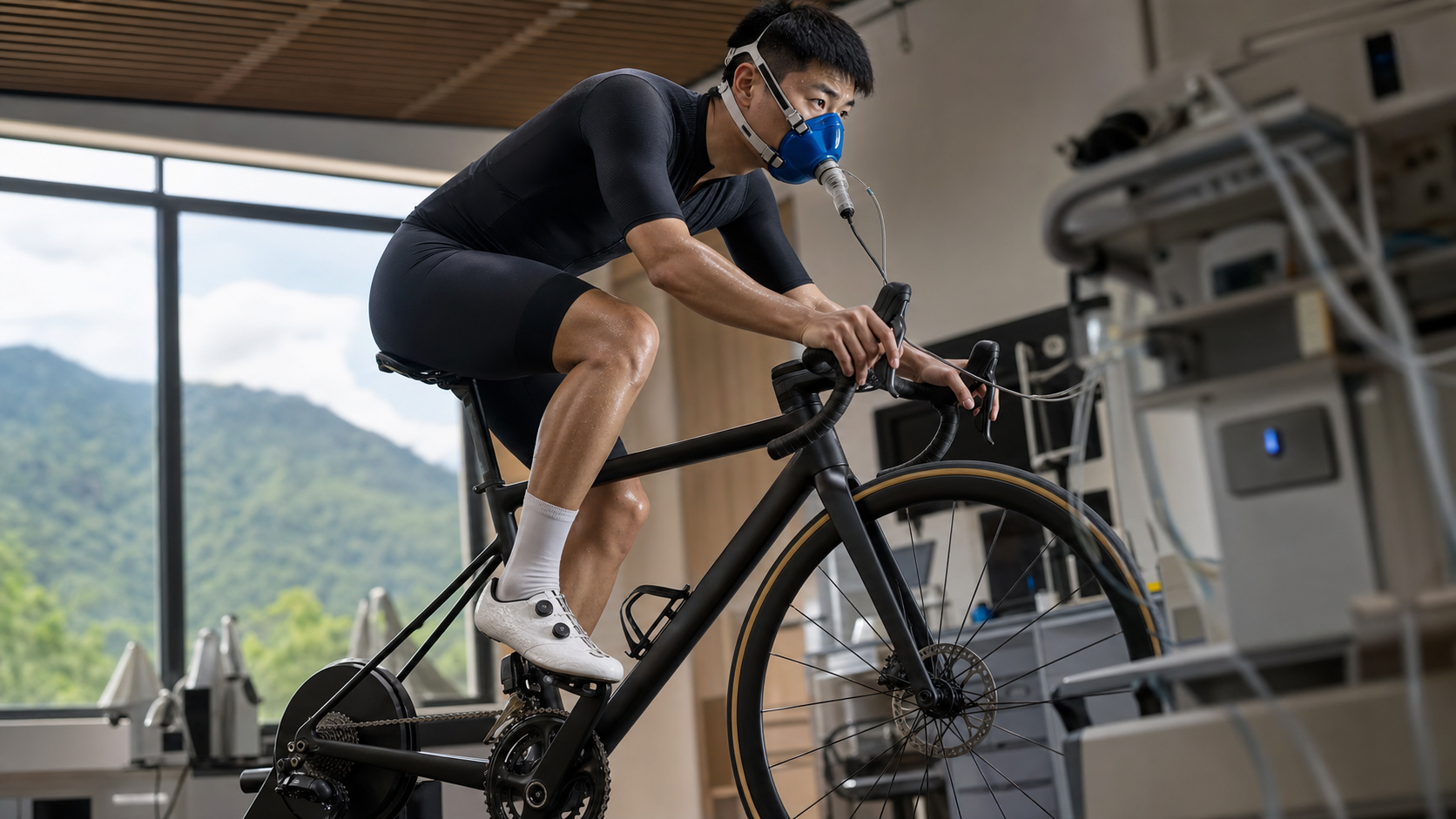
Accurate GE measurement requires a metabolic analyzer (such as the Cosmed K5 portable metabolic analyzer or laboratory-grade stationary equipment) and a precise power meter. Locations in Taiwan where GE measurement is available:
- Graduate Institute of Sports Science, National Taiwan Normal University
- Sports science laboratories at various universities (such as NCKU, NTU, NTSU)
- Certain sports medicine clinics (equipped with VO2max measurement devices)
Costs typically range from NT$2,000–5,000, including a complete metabolic analysis report.
Practical Training Methods to Improve Cycling Efficiency
- Single-leg pedaling drills: 30 seconds per leg, focusing on the arc of effective force application to improve neuromuscular coordination
- Low-cadence, high-torque training (55–65 RPM, 80–90% FTP): Trains muscular efficiency under high load and also aids in muscle fiber type conversion
- Core strengthening: With improved pelvic stability, the energy transfer path during pedaling becomes more direct, reducing energy leakage
- Professional bike fit: The investment in one precise bike fit yields far greater returns than many expensive equipment upgrades
Practical Recommendations
- Before purchasing expensive carbon fiber equipment, invest first in a professional bike fit and pedaling efficiency analysis — this usually offers better value for money
- Use power meters with pedaling efficiency analysis features (Garmin Vector 3, Favero Assioma Duo) to regularly check left-right leg force balance
- Do 5 minutes of single-leg pedaling warm-up before each training session to cultivate correct neuromuscular patterns
- During long-distance rides (such as around-Taiwan routes), deliberately monitor cadence to avoid inefficient pedaling caused by fatigue-induced low cadence
Conclusion
Cycling efficiency is an often-overlooked aspect of advanced cycling training. As the room for improvement in VO2max and FTP gradually narrows, refinements in GE can often provide a new breakthrough. From pedaling technique and saddle height to muscle fiber training, every detail optimized is quietly lowering your energy cost, allowing the same fitness level to produce faster and farther results.
Related Reading
- Cycling Efficiency: The Energy Ledger of Pedaling Mechanics and Muscle Contraction
- Quantifying Cycling Efficiency (GE/PE): How to Become a More Economical Rider
- Training Adaptations in Cycling Efficiency (GE): Research on the Impact of Pedaling Technique on Energy Expenditure
- The Science of Cycling Efficiency: A Comprehensive Benefit Analysis of Pedaling Technique, Aerodynamics, and Equipment
#公路車 #Vo2Max #最大攝氧量 測驗 體驗 | 心肺測試
6 年前
2025 自行車錶排行榜 兩萬車友大數據 / Garmin Bryton 排名會大洗牌嗎? / 全新的碼表前身分析 /公路車 / CT Yeh
1 年前
2026 車錶排行榜!誰是最多車友正在使用?練家子最愛哪款?🏆 (2萬名車友數據) / 公路車 / CT Yeh
5 個月前
如果Pogačar騎西進武嶺可以多快?會破2嗎?各種情況深度推估探討 / 公路車 / CT Yeh
2 年前
全台首發!邁金P715踏板功率計!市場價格撼動者再出招 / 功率對比實測 / FAVERO ASSIOMA 可參考! / 公路車 / CT Yeh
1 年前
西進武嶺 8000名單車友數據分析 PART1 | 從新手到高手數量/瓦數/推力比/FTP推力比/功率計使用率 大解析 | 公路車 | CTYeh
5 年前
#公路車 #Fitting 靠人工智慧APP 幫你調整單車
6 年前
單車AI教練!全新 ChatGPT4o 幫你分析訓練成果!排武嶺課表,分析騎車姿勢! 太神了! / 公路車 / CT Yeh / feat. 緯緯
2 年前