Cycling Aerodynamics: Quantifying the Impact of Riding Position and Equipment on Wind Resistance
Introduction
In cycling, over 80% of resistance comes from aerodynamic drag, not rolling resistance. This is especially significant during flat-road sprints at 40–50 km/h, but aerodynamics remains crucial even on climbs. In Taiwan’s triathlon events (such as the Taitung Living Lake Triathlon and Kona Qualifier races) and time trials, aerodynamic differences often determine gaps of minutes or even tens of minutes in results.
This article quantifies the impact of various position adjustments and equipment upgrades on wind resistance with concrete numbers, helping you make the most effective improvement decisions within a limited budget and time.
The Basic Physics of Air Resistance
The formula for drag force is:
F_drag = 0.5 × ρ × CdA × v²
- ρ: Air density (approximately 1.2 kg/m³ at sea level in Taiwan, approximately 0.9 kg/m³ at Wuling at 3,275m)
- CdA: Drag coefficient (Cd) × frontal area (A), the most critical quantitative metric
- v²: The square of velocity, meaning resistance increases dramatically with speed
Since drag is proportional to the square of velocity, the additional resistance required to accelerate from 40 km/h to 45 km/h is far greater than going from 20 km/h to 25 km/h.
The Impact of Riding Position on CdA
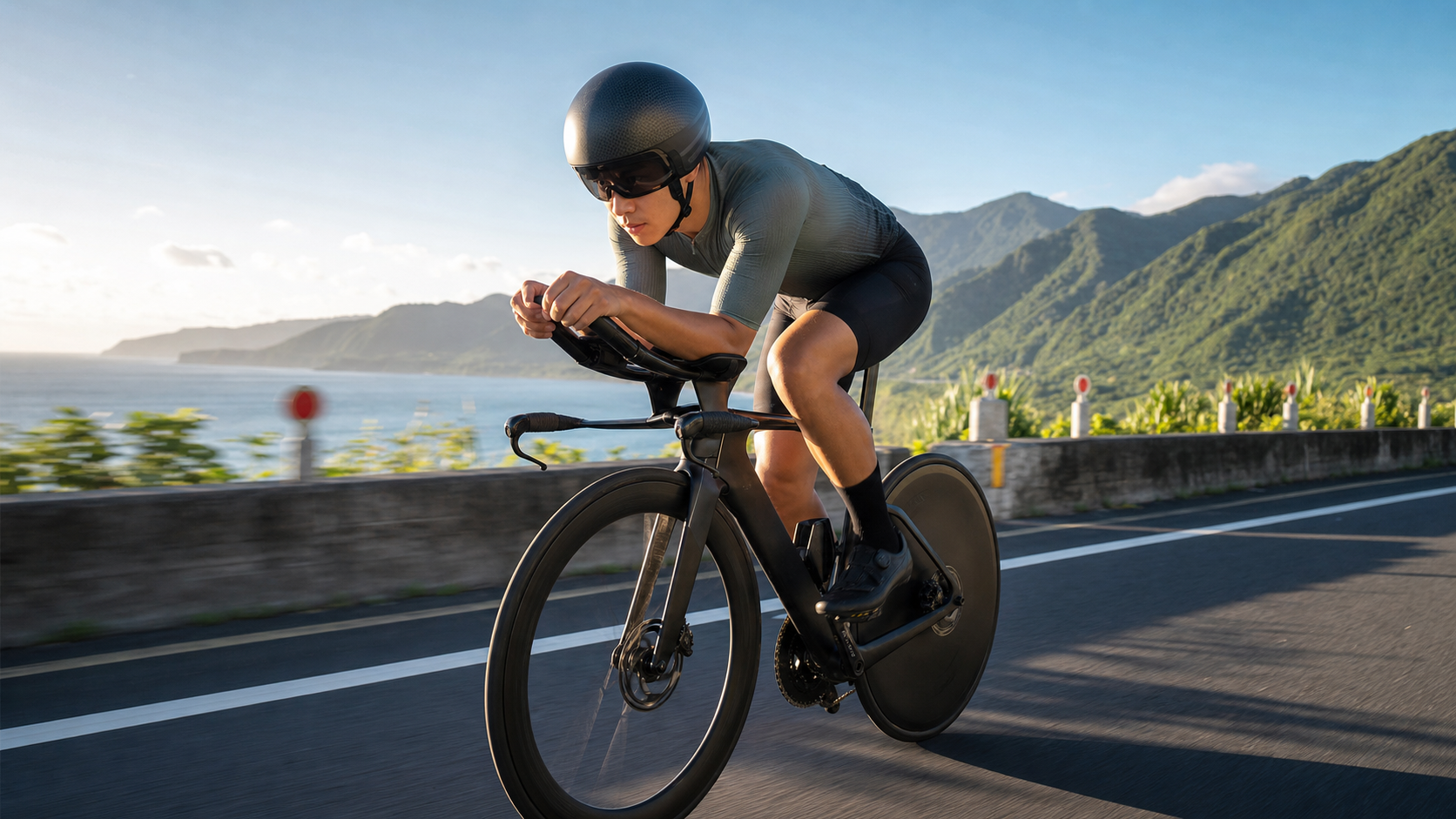
Riding position is the biggest factor affecting CdA, and it costs nothing to adjust:
| Riding Position | Estimated CdA (m²) | Power Saved vs. Upright Position (40 km/h) |
|---|---|---|
| Upright riding (sightseeing position) | 0.40–0.45 | Baseline (worst) |
| Hands on hoods (top position) | 0.32–0.38 | Saves approximately 10–15W |
| Hands on drops | 0.28–0.32 | Saves approximately 20–25W |
| Aero extensions (TT position) | 0.20–0.25 | Saves approximately 40–50W |
| World-class TT position | 0.17–0.20 | Saves approximately 55–65W |
The data shows: switching from the hoods to aero extensions saves watts equivalent to a 20% increase in FTP—position matters far more than equipment upgrades.
Specific Position Adjustment Recommendations
- Head position: Raising the head by 15° increases CdA by roughly the same amount as the difference between wearing a standard helmet and a time trial helmet, so lowering the head yields significant benefits
- Elbow spacing: On TT extensions, narrowing the elbow spacing to shoulder width or slightly narrower reduces chest frontal area
- Torso angle: The more horizontal the torso, the lower the CdA, but excessive forward lean can compromise power output (hip flexion angle)
Quantifying CdA Savings from Equipment Upgrades
The impact of various equipment upgrades on CdA (converted to watt savings at 40 km/h):
| Equipment Item | CdA Savings | Power Saved (40 km/h) | Approximate Cost |
|---|---|---|---|
| TT helmet (vs. standard helmet) | 0.010–0.020 m² | 8–15W | NT$3,000–15,000 |
| Integrated skinsuit | 0.008–0.015 m² | 6–12W | NT$5,000–20,000 |
| Disc wheel (rear, vs. spoked wheel) | 0.003–0.008 m² | 2–6W | NT$15,000–80,000 |
| Deep-section front wheel (80mm vs. 30mm) | 0.002–0.005 m² | 2–4W | NT$10,000–40,000 |
| TT frame (vs. road bike + aero bars) | 0.005–0.015 m² | 4–12W | NT$50,000–300,000+ |
| Internal cable routing (vs. external) | 0.001–0.003 m² | 1–2W | Depends on bike model |
Key takeaway: The CdA savings from position training (free) and a TT helmet (NT$3,000) often outweigh those from a full TT bike upgrade costing hundreds of thousands of dollars.
Taiwan Scenarios: Applications in Triathlon and Time Trials
Scenario 1: Taitung 226km Long-Distance Triathlon
- Bike leg: 180 km, average speed approximately 35–40 km/h
- With a CdA improvement of 0.02 m² (from position adjustment): saves approximately 8–12 minutes across the bike leg
- Priority order: Position > TT helmet > Skinsuit > Disc wheel
Scenario 2: National Time Trial (40 km)
- Every 10W of drag saved improves speed by approximately 0.4 km/h at 40 km/h
- Time improvement over 40 km: saves approximately 45 seconds
Adjustments for Taiwan’s Mountain Courses
- Taiwan is mountainous; climbing speeds drop to 12–20 km/h, where aerodynamic benefits diminish significantly
- Wuling hill climb (speed < 20 km/h): aerodynamic drag accounts for only approximately 30–40% of total resistance, so position/equipment matter far less than on flat roads
- Conclusion: For Taiwan’s climbing races, prioritize improving power-to-weight ratio (W/kg) rather than chasing aerodynamics
Practical Recommendations
- Before investing in expensive equipment, book an aero fitting session first, using measurements to find your personal optimal power/position balance point
- Take a side-on photo of yourself riding, or have someone take one, and use free tools (such as BikeCAD) to estimate the CdA improvement potential of your position
- A TT helmet is the highest value-for-money aerodynamic equipment investment—especially in Taiwan’s hot summer conditions, choose a TT helmet with ventilation design for better heat management
- Note: equipment wind resistance test data is typically measured in wind tunnels at specific yaw angles; real-world wind conditions are more complex, and differences may be larger or smaller
Conclusion
Aerodynamics is a science of numbers, but its first lesson is: the most expensive option is not necessarily the most effective—basic position adjustments often yield the greatest gains. On Taiwan’s triathlon courses and time trials, spending time practicing a low-drag aero position and buying a TT helmet will likely make you faster for less money than purchasing a full TT setup. Every number in wind resistance deserves your serious attention.
Related Reading
- Aerodynamics and Cycling Speed: The Impact of CdA Values, Position Adjustments, and Equipment
- The Biomechanics of Cycling Position: The Science of Reducing Air Resistance
- Cycling Aerodynamics: The Science of Wind Resistance Optimization from Helmet to Riding Position
- The Biomechanical Cost of an Aero Position: The Compromise Between Speed and the Body
風櫃嘴時間 預測西進武嶺時間?13000名車友統計數據分析告訴你 !
5 年前
風櫃嘴 | 全台最多大砲的單車路線 | 尋寶網攝影師告訴你怎麼擺拍起來才好看 | 熱門攝影地點巡禮
6 年前
西進武嶺 免費訓練分析服務 Intervals | 練不夠還是練過頭?你哪一種類型選手?AI模型告訴你! | 備戰神器 | 公路車 訓練 | CT Yeh
4 年前
CT 喇低賽) 單車 比賽總是沒照片? 攝影師的觀點大公開 姿勢就是力量! 請加速1.25倍收看
7 年前
2026台北自行車展 一日隨意逛小紀錄 / 風櫃嘴16分國手的交流 / 踩台居然刷到季軍🥉 USD150 GET! / ! / CT Yeh
4 個月前
一日北高前的西濱集訓 | 跟著11小時軍團 | 300W踩不動的大逆風 | 輪車破風差幾瓦?
6 年前
多機位拍片神器 DJI Action 2 拍出速度張力感 | 類空拍機視角 4陣列麥克風超強降風噪 實測! | 公路車 | CT Yeh
3 年前
半日 小台灣 極限單車路線挑戰實錄
7 年前