The Impact of Marathon Fueling Strategy on Finish Time: The Rhythm of Energy Gel Intake After 30km
Introduction
The “30km wall” is the most notorious hurdle in a marathon. That feeling of your legs suddenly turning to lead, your pace collapsing from 5:30 to 7:00 or even slower in an instant—almost every runner who has finished a full marathon has experienced it.
The main cause of hitting the wall is muscle glycogen depletion. A 70kg male runner’s stored glycogen can support roughly 28–32km of marathon-pace running (depending on intensity). To cover the full 42.195km, you must “extend the fuel supply” through in-race fueling.
The choice of energy gels and the timing of intake directly determine whether you can finish the race—and even whether you can hit your target finish time.
How Energy Gels Are Absorbed
The main ingredients in energy gels are fast-acting carbohydrates (maltodextrin, fructose, etc.), which are absorbed in the gut and converted into glucose that enters the bloodstream. Understanding the absorption mechanism is key to scheduling your intake correctly:
| Gel Type | Main Carb Source | Absorption Rate | Recommended Pairing |
|---|---|---|---|
| Single-glucose type | Maltodextrin | Fast (15–20 min) | With water |
| Multi-carb type | Maltodextrin + Fructose | Moderate (20–30 min) | With water |
| Caffeine type | Contains 50–100mg caffeine | Moderate, but caffeine effect appears after 30–60 min | With plenty of water |
| Gel-type (thick) | High-concentration carbs | Slow (30–45 min) | Must be taken with 200ml+ of water |
Key principle: Energy gels must be taken with water (not sports drinks) to ensure efficient absorption in the gut. Combining gels with sports drinks can create high osmotic pressure, leading to gastrointestinal discomfort.
Full Marathon Fueling Timeline Design
A fueling rhythm recommendation for runners targeting a 3:30–4:30 finish:
Before the race:
- 2–3 hours before the race: normal breakfast (oatmeal, banana, toast)
- 30 minutes before the start: 1 energy gel + 200ml water (to bring blood sugar to its peak at the start)
During the race:
- Around 10km (approx. 55–65 min): 1st energy gel + water at the aid station
- Around 20km (approx. 115–130 min): 2nd energy gel + water at the aid station
- 27–30km (approx. 2:30–2:50): 3rd energy gel (if you have a caffeinated one, use it now)
- Around 35km (approx. 3:10–3:30): 4th energy gel (if your stomach allows) or switch to sports drink
Total: 4–5 energy gels for the entire race (approx. 400–500 kcal of external supplementation).
Special Fueling Challenges After 30km
After 30km, the body is in a state of high fatigue, and fueling faces the following special challenges:
- Slower gut motility: Under fatigue and heat, blood flow to the gut decreases, slowing gel absorption
- Increased nausea: Lactic acid buildup and fatigue can easily trigger nausea, making sweet gels harder to get down
- Higher risk of GI distress: Intestinal mucosal permeability increases after prolonged running
Coping strategies:
- If you can’t swallow gels after 30km, switch to cola (commonly available at aid stations), banana slices, or drink sports drinks directly
- Small amounts, frequent intake: don’t chug too much at once—150–200ml of water per stop is enough
- Sip slowly and hold it in your mouth, allowing some glucose to be absorbed through the oral mucosa, which can also ease nausea
The Importance of Pre-Race Fueling Practice
Race day is not the time to try energy gels for the first time. You must practice during training:
- During 20–25km long runs, take the same brand of energy gels following your race fueling rhythm
- Confirm your gut tolerance, and test different flavors and formulas
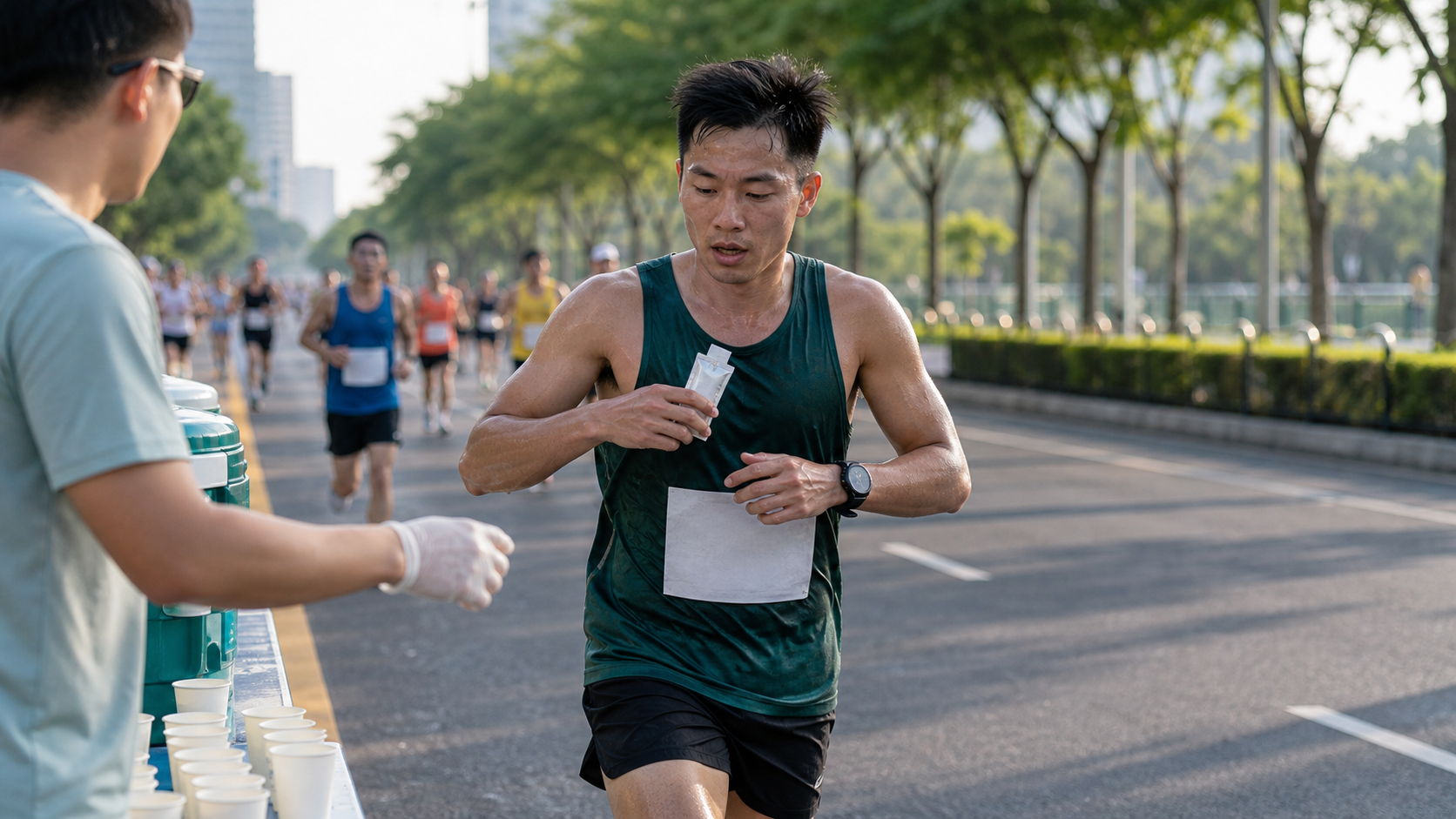
- Practice the smooth sequence of “opening the package, taking the gel, and grabbing water” while running
Commonly available energy gel brands in Taiwan: GU, Maurten, SiS, Honey Stinger, each with different formulas. It’s recommended to pick one and stick with it.
Practical Advice
- Adjust for Taiwan’s climate: Winter marathons in Taiwan are relatively cool, so you can slightly reduce fueling; if you unfortunately encounter a warm winter (25°C+), increase electrolyte intake to prevent hyponatremia
- Maurten gel technology: Maurten uses a sodium alginate hydrogel system that allows high-concentration carbs without irritating the gut—a great option for those sensitive to energy gels, though it’s pricier
- Personalized testing: There is no one-size-fits-all fueling plan—you must test through training to find your optimal strategy
Conclusion
Marathon fueling isn’t as simple as “something is better than nothing”—what you take, when you take it, and how you take it, every detail affects whether your body can keep burning after 30km. A scientific fueling plan, combined with thorough pre-race practice, can turn your final 12km from a painful countdown into a confident surge toward the finish.
Related Reading
西進武嶺 免費訓練分析服務 Intervals | 練不夠還是練過頭?你哪一種類型選手?AI模型告訴你! | 備戰神器 | 公路車 訓練 | CT Yeh
4 年前
CT暗黑廚房) 車友必備 宇宙無敵鮮蚵湯 幫助訓練恢復 天然食補 好市多 超肥鮮蚵 破PR
7 年前
#公路車 #Fitting 靠人工智慧APP 幫你調整單車
6 年前
Live) 備戰2019彰化經典百K 賽前攻略 (已完賽請看新影片
7 年前
#公路車 #西進武嶺 配速配瓦實驗 坡度分析 四小時內攻略 建大盃 NeverStop #西進武嶺攻略
6 年前
水金九不厭五分 10度寒流冷到不願停!feat. 卡卡 / 公路車 / CT Yeh
6 個月前
單車 一日北高 ( 雙城 ) 肥宅雙人瘋狂行 紀錄片 REACTO
10 年前
西進武嶺 自製新版AI配速表產生器 x 賽前攻略 抱佛腳! 沒有功率計也可以產生配速表嗎?有什麼其他眉角賽前要注意的呢? | 西進武嶺 / 東進武嶺 KOM 攻略 | 公路車 | CT Yeh
4 年前