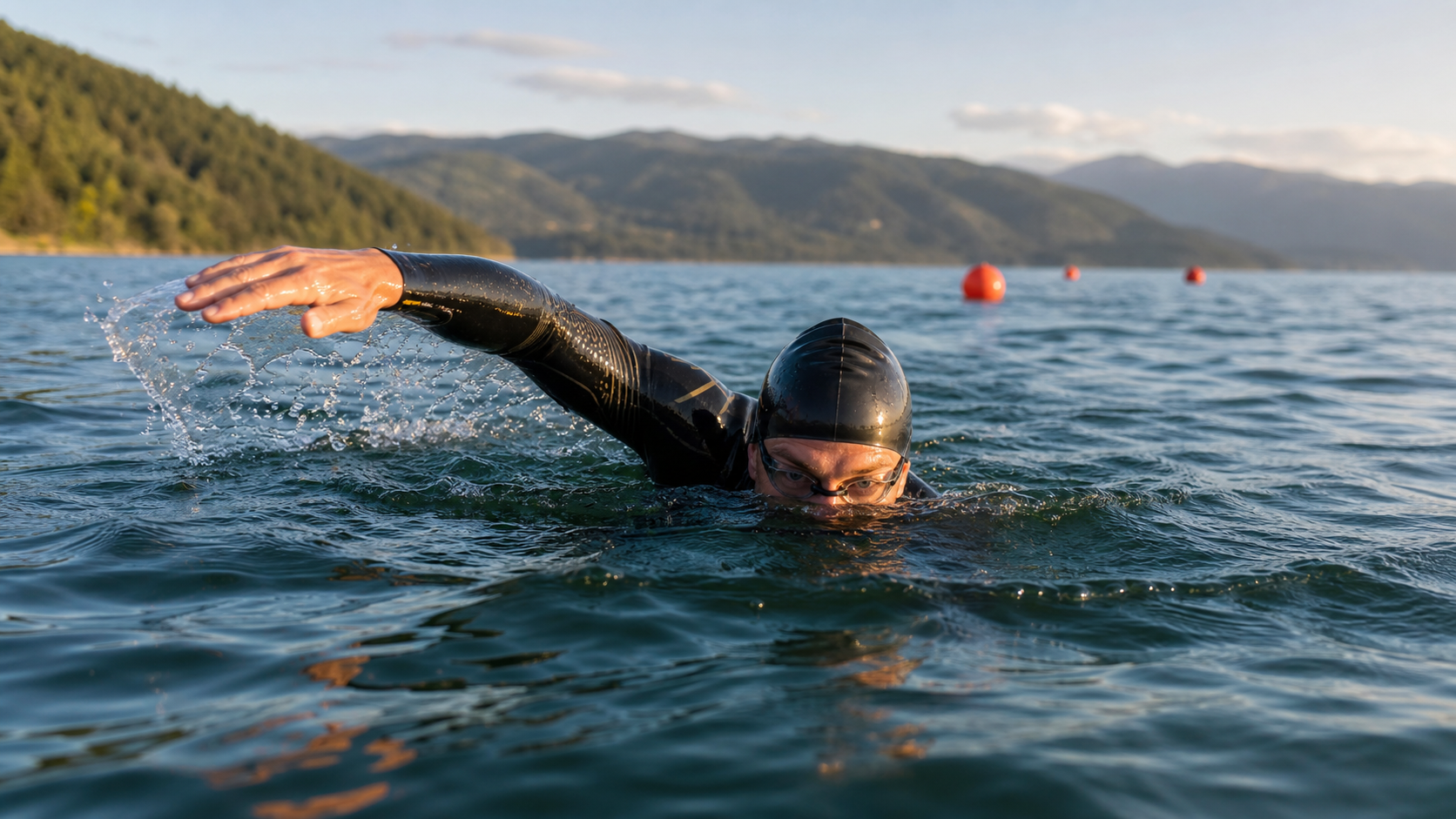
Introduction
In a pool, you can swim in a straight line simply by following the black line on the bottom; but in open water, that “guide line” disappears. Without any navigational aids, a human’s natural drift in the water can reach 3–5 meters off course per 100 meters. Over an Olympic-distance 1,500-meter swim, you might actually cover more than 1,700 meters. Sighting—lifting your head every 6–8 strokes to confirm your direction—is one of the most important skills in open-water swimming, and a key step in evolving from a pool swimmer into an open-water swimmer.
Why Sighting Is So Difficult
Most swimmers encounter the same problem when learning to sight: lifting the head makes the legs sink, destabilizes the entire body position, and disrupts the stroke rhythm. This happens because proper sighting requires keeping the body horizontal while lifting only the eyes above the waterline, rather than raising the entire head.
Common mistakes include:
- Lifting the head too high: The entire face comes out of the water, causing the hips to drop and increasing drag
- Sighting too frequently: Lifting the head every 3–4 strokes severely disrupts stroke rhythm
- Poor timing: Lifting the head on the breathing side while trying to both breathe and sight at the same time, causing chaotic movement
- Poor target selection: Choosing targets that are too far away or too small, making them impossible to find each time
Proper Sighting Technique
The key to mastering sighting lies in separating “looking” and “breathing” into two independent actions:
The Standard Crocodile Lift:
- At the end of the stroke, just before you would breathe, instead of turning your head, look straight ahead with only your eyes and the bridge of your nose above the water (like a crocodile)
- Quickly confirm the direction of your target ahead (buoy, building, mountain peak)
- Immediately return your head to the water, then take a normal side breath on the next stroke
| Technical Point | Correct Approach | Incorrect Approach |
|---|---|---|
| Head height | Eyes and bridge of nose just above water | Entire face or chin out of the water |
| Viewing time | 0.5–1 second, a quick glance | Prolonged pause on the surface to observe |
| Breathing coordination | Side breathe on the stroke after sighting | Breathe and sight simultaneously |
| Body position | Core engaged, legs stay horizontal | Hips sink, legs drop |
Rhythm Training Method: Every 6–8 Strokes
The frequency of sighting should be adjusted based on race conditions, but “every 6–8 strokes” is the golden standard for most open-water situations. Specific training methods:
Pool Training (Building the Habit):
- In the pool, perform a sighting motion every 6 strokes (no need to actually look at anything; the focus is on establishing rhythm)
- Count your strokes silently during practice: “1, 2, 3, 4, 5, 6, look!” until this rhythm becomes automatic
- Advanced drill: Place a colored bucket at the far end of the pool and practice how quickly you can locate the target when lifting your head
Open-Water Training (Applying the Technique):
- Choose a clear venue such as Liyu Lake or Chengcing Lake, and set up a 400-meter out-and-back course
- First lap: Sight every 4 strokes to feel how sighting frequency disrupts your rhythm
- Second lap: Sight every 8 strokes to feel the degree of directional drift
- Third lap: Sight every 6 strokes to find the balance between efficiency and accuracy
Target Selection Strategies for Different Scenarios
A good sighting target should be conspicuous, stable, and positioned in the correct direction:
- Triathlon events: Use the buoys (usually bright orange or yellow) as the primary target, but buoys can be hard to spot in waves; use buildings or mountain peaks on the shore behind the buoys as backup targets
- Sun Moon Lake Swim: Use the pier buildings or mountain silhouettes on the opposite shore as targets—far easier to locate than small floating markers on the water
- Ocean swimming: Use tall buildings or lighthouses on the shore as targets, and avoid using floating objects in the waves as reference points
Practical Advice
Record the “drift distance” from each open-water practice session in your training log—the gap between your actual finish point and the intended straight-line path. Generally speaking, well-trained athletes can keep drift within 3% of the total distance (for example, only 45 meters of drift over 1,500 meters). Tracking this number is the most intuitive way to measure your progress in sighting.
Conclusion
Sighting is a core skill in open-water swimming. Mastering it takes time and deliberate practice, but once it becomes an automatic movement, you will feel more confident and composed in every open-water swim. Next time you train at Liyu Lake or Taitung Living Lake, remember to count your strokes—every 6 to 8 strokes, lift your eyes and look ahead. Your direction and your goal are both right there.
Related Reading
- Open-Water Positioning and Navigation: Visual Correction and Energy-Saving Strategies for Swimming Straight
- Open-Water Navigation Technique: Lifting to Breathe and Target Point Positioning
- Open-Water Swimming Navigation: Lifting to Breathe and Target Locking
- Open-Water Straight-Line Sighting: Lifting Frequency and Minimum-Energy Techniques
CT 喇低賽) 武嶺牽車 才是王道 西進牽車四小時內秘訣 攝手位置 如何判斷 防抽筋小秘訣
7 年前
西進武嶺 免費訓練分析服務 Intervals | 練不夠還是練過頭?你哪一種類型選手?AI模型告訴你! | 備戰神器 | 公路車 訓練 | CT Yeh
4 年前
[教學] Premiere 影片 手震 修正 教學 防抖 單眼 影像 GoPro 穩定 Video Stabilization
8 年前
FTL 與 SYB 車隊專訪 西進武嶺 實用攻略分享! 2小時 如何練?!你不知道的眉角!新手準備武嶺必看 EP1 | 實力派女車友 | 精華版 | 公路車 | CTYeh
4 年前
西進武嶺 自製新版AI配速表產生器 x 賽前攻略 抱佛腳! 沒有功率計也可以產生配速表嗎?有什麼其他眉角賽前要注意的呢? | 西進武嶺 / 東進武嶺 KOM 攻略 | 公路車 | CT Yeh
4 年前
戰略) Zwift Race 如何咬在第一集團 如何評估自己要開多少推力 (請開1.5倍速看)
7 年前
教學) 如何做出專業 慢動作 影片 Slow Motion 120fps GoPro 7 ActionCam AX700 A99II
7 年前
一起升級!海鷗盃LSD團練...JJSC Zone2招待 騎到手抖 / 公路車 / CT Yeh
2 天前