Introduction
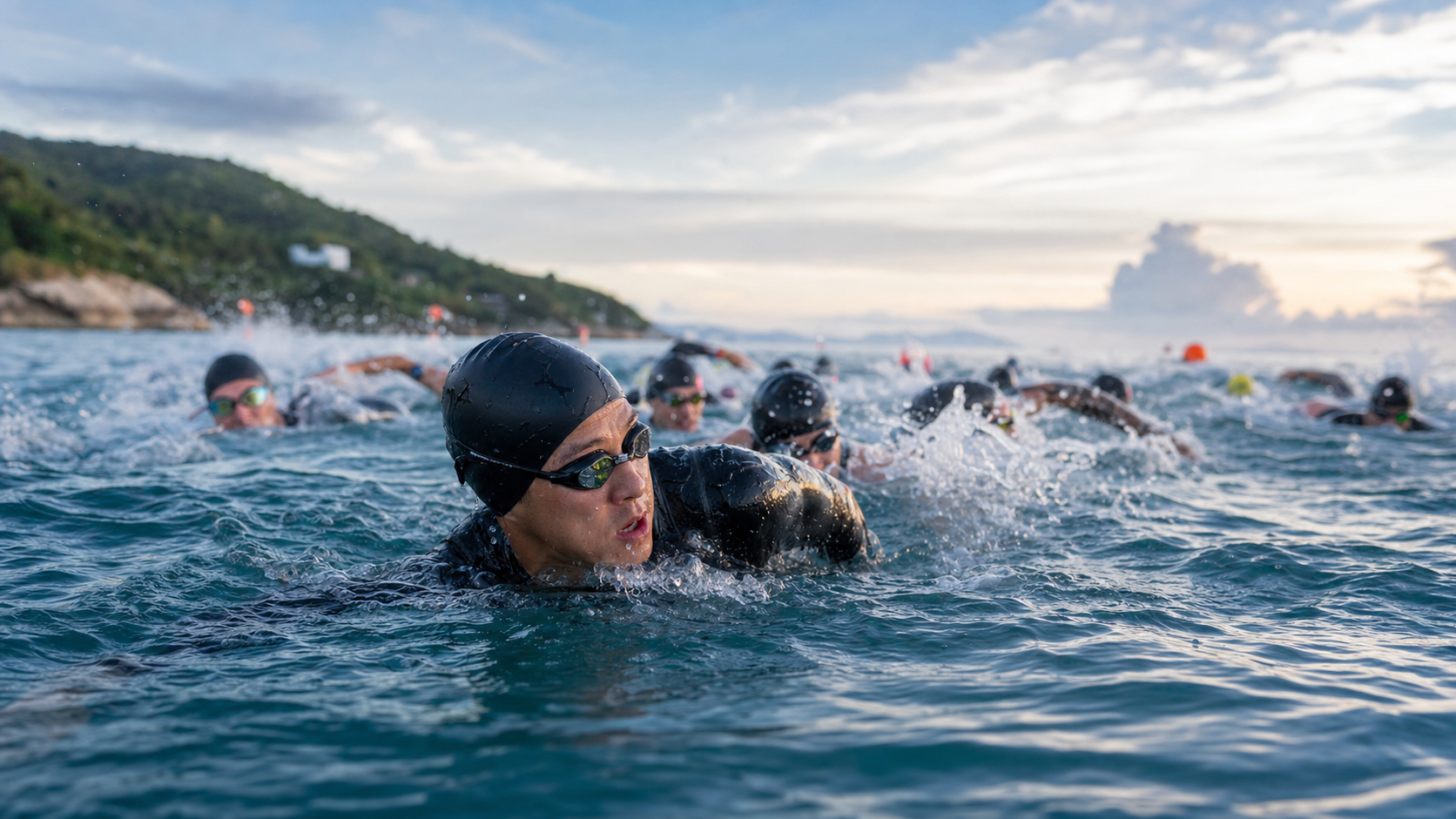
“Got kicked! My goggles are filling with water! Someone is pressing down on me!” These situations are extremely common in the first few hundred meters after a triathlon start and often catch many athletes off guard, causing them to lose their rhythm and affecting their overall performance. However, pack swimming conflicts are an inevitable part of open water competitive swimming. Learning to face them calmly and recover quickly is a skill that every serious triathlete needs to cultivate.
Types and Timing of Pack Swimming Conflicts
Physical conflicts in open water competitions mainly occur at the following points:
- First 300 meters after the start: The crowd is densest, and collisions are most frequent.
- Buoy turns: All athletes shorten the route simultaneously, causing the most severe crowding.
- Transition zones with uneven swimming speeds: Fast and slow swimmers cross paths around 500–1000 meters.
Common conflict types and their impact on swimming:
| Conflict Type | Primary Impact | Danger Level |
|---|---|---|
| Kicked in the foot | Rhythm is disrupted | Low |
| Kicked in the face | Goggles shift, brief pain | Medium |
| Pressed underwater (head forced under) | Drinking water, psychological panic | Medium-High |
| Ankle grabbed | Sudden speed drop, struggle consumes energy | Medium |
| Swimming into someone’s armpit | Pinched, unable to move | Medium |
Calm Response Techniques for Various Conflicts
Kicked in the Foot or Body
This is the most common situation, usually caused by a swimmer in front kicking their foot into your arm or shoulder. Response method:
- Do nothing: Keep swimming. Most minor collisions require no reaction.
- If the collision disrupts your rhythm, take two deep breaths and re-count your stroke rhythm (“1-2-3, breathe, 1-2-3, breathe”) to regain your rhythm.
Goggles Kicked Askew or Filling with Water
This is the situation many athletes fear most, but the solution is simpler than imagined:
- First, roll onto your back to get your face out of the water (no need to stop completely; backstroke allows continued forward movement)
- Use your index finger and thumb of one hand to gently press the edge of the goggles and quickly reseal them (do not remove the goggles completely)
- Exhale to one side to clear water from the lens (exhale forcefully into the lens; water will be expelled by the airflow)
- Roll back to front crawl and continue moving forward
The entire process takes about 5–10 seconds. If practiced repeatedly, you may not even need to stop completely.
Pressed Underwater (Head Forced Under by Another’s Hands or Feet)
This is the most panic-inducing situation, but staying calm is key:
- Do not struggle in the water: Struggling only consumes more energy and may cause you to inhale more water.
- Dive down forcefully: Swim down in the direction of the pressure for 1–2 seconds, moving away from the person pressing on you rather than trying to push up.
- Breathe upon surfacing: Take 2–3 large breaths first, restore oxygen, then assess whether you need to move again.
Ankle Grabbed
This is usually caused by a swimmer behind you accidentally grabbing your foot. Solution:
- Quickly perform a strong frog kick (one time is enough); this usually allows you to shake off the other person.
- Do not try to manually free yourself (your hands are in front, making it difficult to pull backward).
- Immediately accelerate after shaking them off to increase distance from the swimmer behind.
Psychological Response: Anger is the Most Expensive Waste of Energy
The greatest harm from pack swimming conflicts is often not physical but psychological. After being kicked or pressed underwater, adrenaline secretion increases, easily triggering anger or panic, leading to a spike in heart rate and rapid breathing, consuming a large amount of energy.
Effective psychological response strategies:
- Accept in advance: Tell yourself before the race that “conflicts are normal, and I am prepared to handle them,” reducing emotional reactions when incidents occur.
- Labeling: When a conflict occurs, say to yourself “this is just a collision, not a big deal,” quickly moving out of the emotional state.
- Focus on the next action: Direct your attention to “what is my next stroke,” rather than “what just happened.”
Pack Swimming Training: Making Conflicts Familiar
The best way to handle pack swimming conflicts is to simulate them during training. Recommended:
- Schedule one pack swimming practice session with 3–5 people per month (such activities are common in triathlon communities across Taiwan)
- Deliberately maintain a tight formation during practice to adapt to the feeling of physical contact with others.
- Practice continuing to swim without stopping after being hit, directly performing the goggles repair action.
Practical Advice
Ensuring the seal of your goggles before the race is a basic skill—push the edge of the lens slightly with your finger at home to confirm there are no leaks. At the same time, choose slightly larger-sized goggles (such as toilet-bowl style goggles Mask Goggles), which offer a higher margin for error when resealing after being hit.
Conclusion
Pack swimming conflicts are an inevitable part of open water competition, but they can be fully managed. Every time you practice handling conflicts during training, you are cultivating the most important “emotional management” ability for race day. When you can remain calm in the moment of being kicked or pressed and continue to stroke, you have already surpassed many athletes.
Related Reading
- Pack Swimming: Swimming in a Crowd: Strategies for Following and Being Kicked
- Open Water Crowd Management: Calm Responses to Hand and Foot Collisions in Pack Swimming
- Open Water Triathlon Swimming Start Strategy: Handling Crowd Conflicts and Positioning Techniques
- Overcoming Fear in Triathlon Swimming: Mental Preparation for Your First Race Pack Swim
[教學] Premiere 影片 手震 修正 教學 防抖 單眼 影像 GoPro 穩定 Video Stabilization
8 年前
Never Stop 西進武嶺 前後雙機 完整全程錄影 訓練台 實境
8 年前
#PUSHBIKE 原來這麼好玩! 小朋友 滑步車 初體驗 超可愛
6 年前
CT 喇低賽) 武嶺牽車 才是王道 西進牽車四小時內秘訣 攝手位置 如何判斷 防抽筋小秘訣
7 年前
2016/05/13 單車 冷水坑下滑
10 年前
一日北高/長距離團騎 常見問題補充篇 / 組團或跟團的眉角 / 壯車友容易被瘦車友慢性拉爆 / 原來屁股痛可能是這個原因...? / 風場配速法 / 公路車 / CT Yeh
2 年前
下次拍照前要查清楚啦🤣 #cycling
7 個月前
摔! 2023環花東365 Day2 / 絕美縱谷風光 / 集團摔車 / 公路車 / CT Yeh
3 年前