Quick Cardiorespiratory Transition After Triathlon Swimming: Adjusting Breathing Rhythm from Water to Land
Introduction
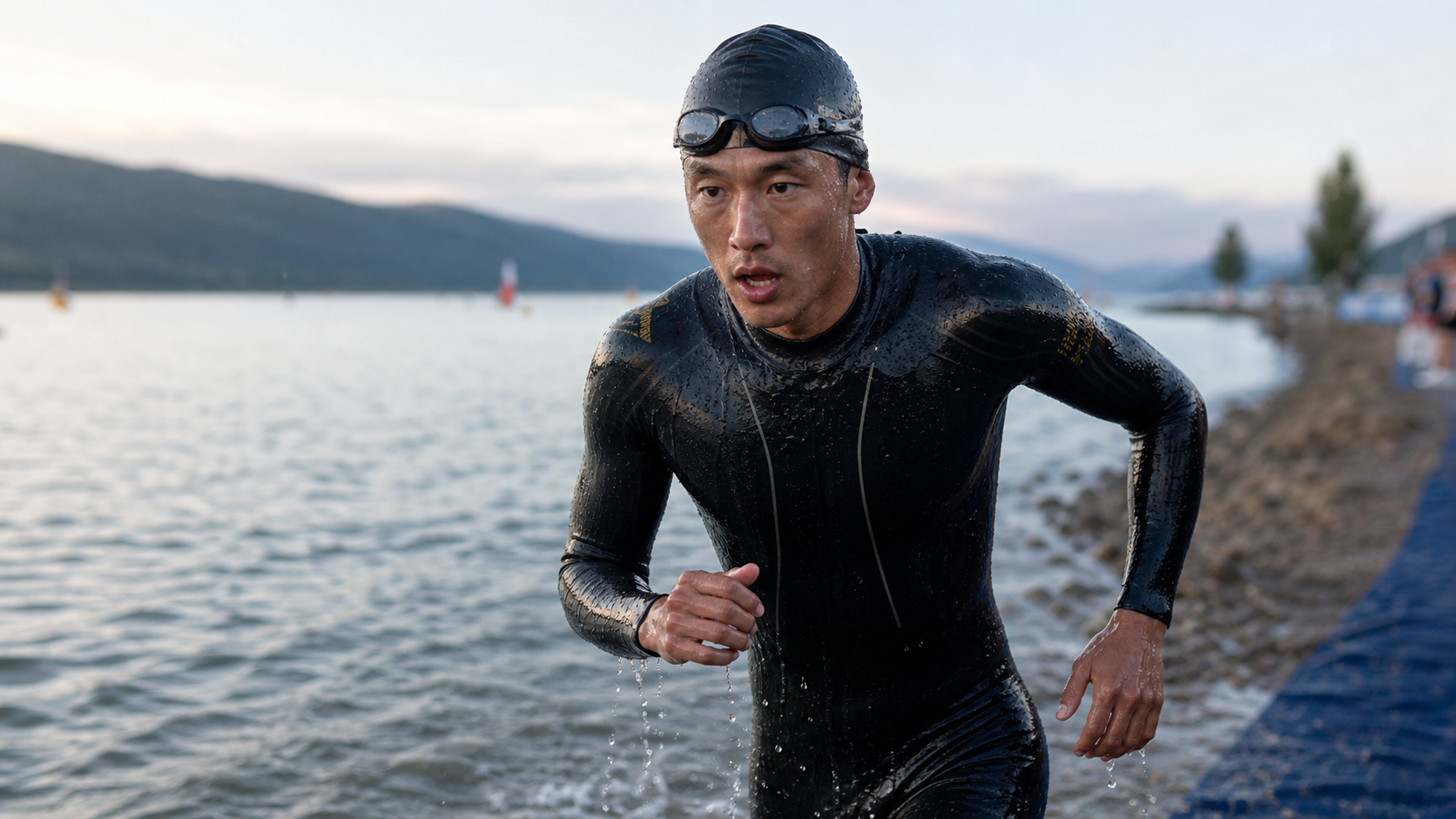
In a triathlon, the minute after finishing the swim and exiting the water is one of the moments of greatest physiological stress in the entire race. Shifting from a horizontal prone position to upright running abruptly changes how the heart pumps blood, and combined with the transition from aquatic to terrestrial breathing rhythms, many athletes experience dizziness, breathlessness, or even temporary leg weakness during this transition. These reactions are normal physiological responses, but if you understand and practice how to handle them in advance, you can minimize this chaotic period.
The Physiological Transition Mechanism from Water to Land
While swimming, the body is horizontal in the water, and the heart works relatively efficiently: water pressure assists venous return, and blood does not need to fight gravity to flow back from the lower limbs to the heart. Breathing during freestyle swimming is a coordinated movement driven by large muscle groups, with the breathing rhythm tightly linked to stroke rate.
Once you stand up after exiting the water, everything changes:
- Increased venous return pressure: Gravity causes blood to pool in the lower limbs, requiring the heart to pump harder, and heart rate may temporarily drop (an effect known as “orthostatic hypotension”), causing some people to feel dizzy
- Changed breathing muscle work patterns: Shifting from the rapid, coordinated breathing of swimming to independent, deep breathing on land
- Legs shift from assistance to primary support: During swimming, the legs mainly kick; after exiting the water, they suddenly need to support full body weight and run, requiring the muscles to re-adapt
- Temperature effects: If you’ve just come out of cold water, skin blood vessels constrict rapidly, and blood is redistributed to the core, which can also cause a temporary sense of imbalance
| Physiological Response | Typical Duration | Coping Strategy |
|---|---|---|
| Unstable heart rate | 30–60 seconds | Stabilize breathing rhythm |
| Dizziness | 10–30 seconds | Lower your head and lean forward; avoid looking up quickly |
| Heavy legs | 60–120 seconds | Normal phenomenon; keep running and it will resolve |
| Rapid breathing | 60–90 seconds | Actively exhale deeply (exhale > inhale) |
Techniques for Quickly Stabilizing Breathing
The key to rapidly restoring breathing rhythm after exiting the water lies in “active exhalation” rather than “active inhalation”:
Method: 4-2 Breathing
- First 30 seconds after exiting the water: one breathing cycle every 4 steps (inhale for 2 steps, exhale for 2 steps), slightly slower than normal running breathing
- Focus on complete exhalation to fully expel carbon dioxide-laden air from the lungs
- Don’t try to “take a deep breath”—the urge to inhale at this moment often feels more urgent than actual need; it’s a sensory deception, not true oxygen deprivation
Another effective technique is to lower your head immediately upon exiting the water: for the first 5–10 meters after exiting, run with a slight forward lean to keep your head closer to the level of your heart, reducing the effects of orthostatic hypotension. Stand fully upright only after reaching the transition area.
Training Methods: Simulating the Transition
The most effective way to train is to deliberately practice “rapid recovery on land after swimming” during your workouts:
Training 1: Run Immediately After Swimming
After swimming 800 meters in the pool, exit the pool immediately (no rest) and run 400–800 meters in running shoes. Observe how many seconds it takes for your heart rate and breathing to return to a stable state. Goal: fully stabilized within 90 seconds.
Training 2: Brick Training
Schedule one combined swim + bike session per week (brick training). After completing the planned swim distance, complete your transition and mount the bike within 60–90 seconds. The feeling during the first 5 minutes of riding will help you assess your body’s recovery status during the transition.
Training 3: Heart Rate Monitoring
If you have a waterproof heart rate monitor, keep monitoring your heart rate after finishing the swim. Ideally, your heart rate should drop to the aerobic cycling zone (typically 65–75% of maximum heart rate) within 2 minutes of exiting the water. If your heart rate remains above this after 2 minutes, it indicates your swim pace was too fast, or your breathing management during the transition needs improvement.
Special Considerations for Taiwan Races
In triathlon events held in Taiwan, T1 is typically located 100–400 meters from the swim finish. Athletes need to run from the finish to the transition area, and this stretch itself is a valuable “transition buffer zone.” Using this running time to actively adjust your breathing is more efficient than waiting until you reach the transition area to start dealing with it.
At Taitung’s Living Lake, the distance from the swim exit to the transition area is approximately 200 meters, while at the mini-triathlon held at Hualien’s Guangfu Farm, the swim exit connects directly to the transition area. Understand the course layout of your race venue and simulate the same distance and transition pace in training.
Practical Recommendations
After each complete brick training session, it is recommended to record the following data:
- Swim segment completion time and heart rate upon exiting the water
- T1 completion time
- Average heart rate during the first 5 minutes of cycling
- Subjective feeling (scale of 1–10, with 10 being completely unaffected by the swim)
As your training volume increases, these numbers will show a clear trend of improvement, giving you greater confidence in handling the transition on race day.
Conclusion
The transition from swimming to land is one of the most unique physiological challenges in a triathlon. That 60–90 seconds of chaos doesn’t mean something is wrong with your body—it’s simply your cardiorespiratory system and muscles undergoing a rapid “system switch.” Through practice, you can make this switch increasingly smooth, until one day, the moment you exit the water, you’ll feel completely at ease, naturally running toward the transition area to take on the cycling leg.
Related Reading
- Transition Run After Triathlon Swim: Body Switching from Water to Bike
- Triathlon T1 Heart Rate Recovery Techniques: Breathing Regulation After Coming Out of the Sea
- Body Recovery After Triathlon Swim: How to Quickly Restore Heart Rate in T1
- Triathlon Swim Exit and T1 Transition Speed Optimization: The Critical 120 Seconds from Water to Cycling
2023桃園團體繞圈賽 / 海鷗繞圈賽 | 全程空拍數據版 | 公路車 | CT Yeh
2 年前
[防寒衣體驗] 鐵人魂 三鐵 防寒衣試穿會 於松運 深水游泳池 鯨魚池
8 年前
西進武嶺 免費訓練分析服務 Intervals | 練不夠還是練過頭?你哪一種類型選手?AI模型告訴你! | 備戰神器 | 公路車 訓練 | CT Yeh
4 年前
一起升級!海鷗盃LSD團練...JJSC Zone2招待 騎到手抖 / 公路車 / CT Yeh
1 天前
CT暗黑廚房) 車友必備 宇宙無敵鮮蚵湯 幫助訓練恢復 天然食補 好市多 超肥鮮蚵 破PR
7 年前
下雨天就是要改車 #ceramicspeed #bike
1 年前
JE22 百里任務體驗,心跳不能過150,三小時內有可能...? 沒有天時地利難度有多高? / 公路車 / CT Yeh
1 年前
CT 喇低賽) 武嶺牽車 才是王道 西進牽車四小時內秘訣 攝手位置 如何判斷 防抽筋小秘訣
7 年前