Introduction
Every year, drowning incidents occur in Taiwan due to improper swimming, with open water accidents accounting for a far higher proportion than those in swimming pools. However, with adequate safety knowledge and adherence to regulations, open water swimming is a safe and enjoyable activity. This article compiles the safety regulations for Taiwan’s major open water venues, lifeguard deployment standards, and the buddy swim requirements that amateur swimmers should understand, helping you enjoy the freedom of swimming within a safe framework.
Taiwan’s Regulatory Framework for Open Water Swimming
The management of open water swimming in Taiwan is overseen by multiple authorities, varying by the nature of the venue:
- Reservoirs (e.g., Feitsui Reservoir, Tsengwen Reservoir): Swimming is prohibited in most reservoirs; violations may be fined under the Water Act
- Lakes (e.g., Sun Moon Lake, Carp Lake): Subject to regulations set by each county/city government; some areas are open to swimming, while others are prohibited
- Coasts: Governed by the management rules of each county/city’s beach resort, with designated swimming zones and restricted zones
- Artificial water bodies (e.g., Taitung Living Lake): Managed uniformly by the competent authority, typically with clear opening hours and regulations
Key Principle: Any water body not explicitly designated as open is considered a no-swimming zone. Entering without authorization may result in administrative penalties and, more importantly, poses safety risks.
Safety Deployment Standards for Major Open Water Venues
| Venue | Lifeguard Deployment | Opening Hours | Swim Buoy Requirement | Minimum Buddy Requirement |
|---|---|---|---|---|
| Carp Lake (Hualien) | Yes (designated areas) | Seasonal, typically 08:00–17:00 | Recommended | 2 or more people recommended |
| Taitung Living Lake | Yes (fixed during events) | Per management authority announcement | Required (event regulations) | Buddy required |
| Chengcing Lake (Kaohsiung) | Yes in some areas | Per park opening hours | Recommended | 2 or more people recommended |
| Sun Moon Lake (Swim Crossing Event) | Large number of lifeguards (event day) | Event day only | Official buoys provided | Official group control in place |
| General beach resorts | Yes (designated hours) | Per venue regulations | Recommended | 2 or more people recommended |
Limitations of Lifeguards: Even at venues with lifeguard deployment, their service range is typically limited to a certain distance (generally within 50–100 meters). Swimming beyond that range is equivalent to being unprotected.
Buddy Swim Regulations and Best Practices
“Never swim alone” is the first principle in all open water safety guidelines. This is not just a rule—it is a fundamental concept of risk management:
What constitutes a qualified buddy arrangement?
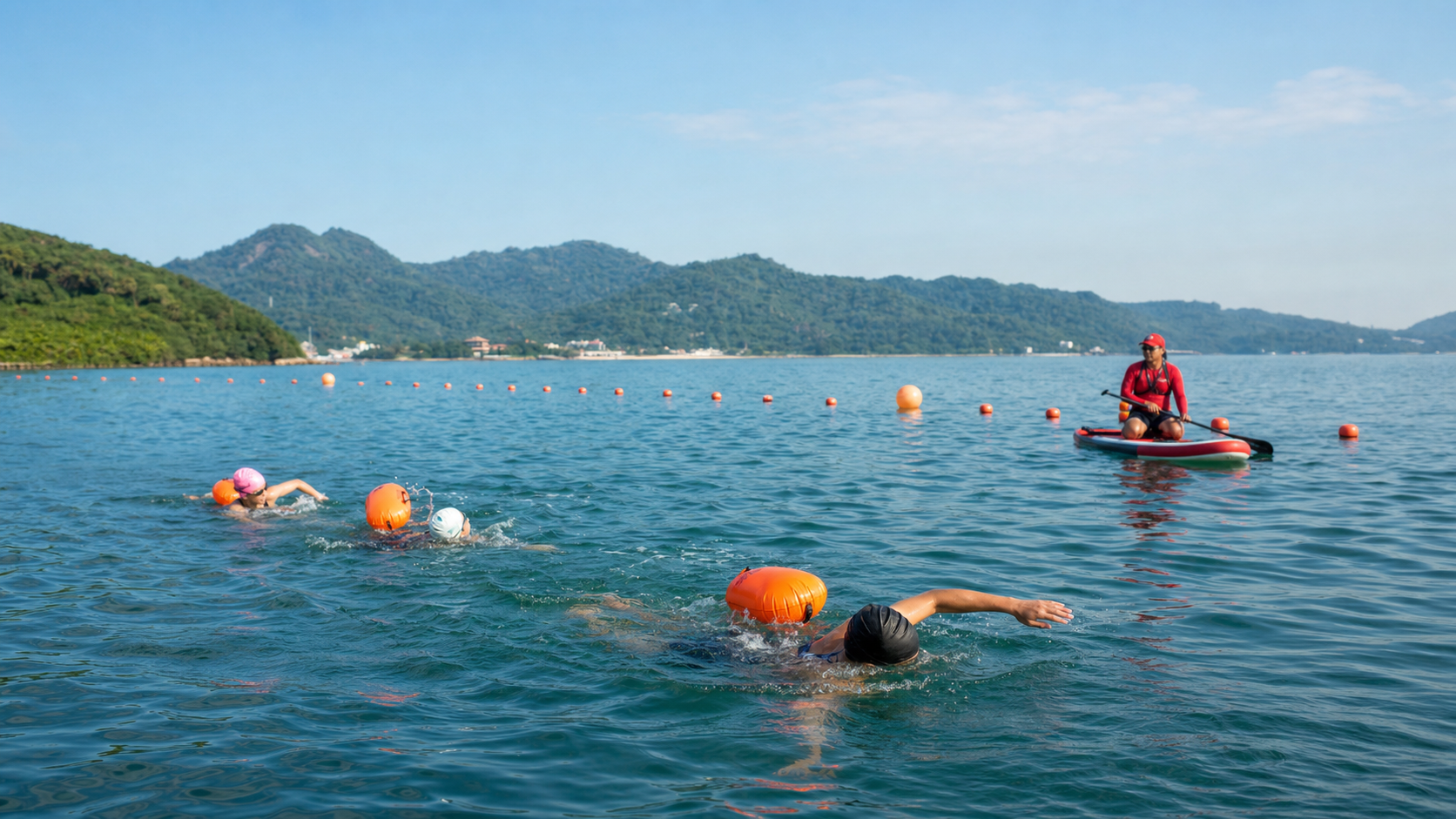
- At least one buddy accompanying from shore or on a kayak/SUP
- The buddy should understand emergency rescue procedures and ideally possess basic first aid knowledge
- The buddy maintains visual contact with the swimmer, keeping track of the swimmer’s position at all times
- Both parties agree on emergency signals in advance (e.g., waving indicates normal, continuous waving indicates distress)
The Importance of Open Water Swim Buoys:
Swim buoys have become standard safety equipment for open water swimming in recent years. They serve the following functions:
- Increase the swimmer’s visibility in the water (bright colors, detectable by shore personnel and boats)
- Provide additional buoyancy support in emergencies (can be grabbed for flotation when fatigued)
- Can store small items (phone, emergency whistle, energy supplies)
Taiwan currently has no mandatory requirement for amateur swimmers to carry a swim buoy, but most open water safety guidelines strongly recommend wearing one. Priced at approximately NT$500–1,500, it is the most cost-effective safety investment.
Emergency Response Procedures
When swimming in open water, understanding emergency response procedures is crucial:
Self-Rescue:
- If you feel exhausted or disoriented, immediately roll onto your back and float to conserve energy while waiting for rescue
- Use a whistle or wave your arms to attract attention from shore
- Do not attempt to swim toward the farthest shore—head for the nearest point where you can get out
Witnessing Someone Else Drowning:
- Shout for help and alert everyone on shore
- Call 119 and report the location (using GPS coordinates or prominent landmarks)
- If a life ring or floating object is available, throw it to the drowning person
- Unless you have received water rescue training, do not enter the water to save them (a rescuer who runs out of strength can lead to an even greater tragedy)
Practical Advice
Before participating in open water swimming activities, it is recommended to:
- Check the latest open water regulations for your destination (via county/city government websites or by calling the management authority)
- Check the day’s weather forecast, and avoid swimming in strong winds, thunderstorms, or low-visibility conditions
- Inform family or friends of your swimming location and expected return time
- Carry a waterproof phone pouch (to hold your phone) to maintain emergency contact capability
Conclusion
The safety of open water swimming is built on adequate knowledge, respect for regulations, and careful preparation. Taiwan’s open water venues are progressively improving their safety management, and as swimmers, we also have the responsibility to follow the rules and protect ourselves. Safe swimming is the foundation for enjoying the pleasures of open water over the long term.
Related Reading
- Open Water Swimming Safety Guidelines: An Overview of Legal Swimming Areas in Taiwan
- Open Water Swimming Safety Rules: Buddy System, Reading Currents, and Emergency Response
- Open Water Swimming Regulations in Taiwan: Which Waters Are Legal to Swim In
- Complete Guide to Open Water Race Rules and Essential Gear
備戰 戀戀197 賽前關門點分析 西濱團練 #公路車 4K高畫質
6 年前
2025 海鷗團體繞圈賽 網路直播 超激烈裁判長視角 / EIPC 李廷威、Waypoint 等眾多高手競爭 / feat. 卡密兒主持 / 海鷗繞圈賽
9 個月前
2023桃園團體繞圈賽 / 海鷗繞圈賽 | 全程空拍數據版 | 公路車 | CT Yeh
2 年前
2023桃園團體繞圈賽/環台賽等級拍攝/賽事精華/ 10人一隊缺一不可!50隊廝殺大場面 / 第三屆 海鷗繞圈賽 /公路車/CT Yeh
2 年前
元宇宙運動 ! RouvyAR 虛擬實境約騎! 台灣路段開箱 帶你日月潭環潭一圈 | 團騎競賽參加教學 | 常見小問題整理 三人共享一年不用一千 | 公路車 | 訓練台 | CTYeh
5 年前
虎豹潭!日本老師來台一日約騎 台灣車友熱情招待私房路線 / CT Yeh
21 天前
大武山20%魔王陡坡【JJSC南台灣遊騎Day2】!屁股真的要裂開了...凡士林抹滿也沒用?神秘金教堂還有超便宜夜市
3 個月前
一起升級!海鷗盃LSD團練...JJSC Zone2招待 騎到手抖 / 公路車 / CT Yeh
2 天前