Introduction
In cycling or running races, the importance of reading the course is well known—taking the shortest route is the most fundamental racing strategy. However, many swimmers in open-water races expend significant effort swimming 10–15% farther than necessary without realizing it. These “wasted distances” not only drain extra energy but also translate directly into lost time. This article will teach you how to read the course before a race and execute a shortest-distance swimming strategy during it.
Typical Course Designs in Open-Water Races
Open-water races typically mark the course with turn buoys, and athletes must round all buoys to complete the designated route. Common course designs include the following:
| Course Shape | Characteristics | Common Events |
|---|---|---|
| Out-and-back | Simple, only one turning point | Sun Moon Lake swim segments |
| Triangle | Two turns, requires judging two directions | Olympic triathlon, Taitung Living Lake |
| Rectangle | Three turns, more complex course | Long-distance triathlon, 51.5K |
| L-shaped | One 90-degree turn | Some ocean swim races |
Different course shapes place different demands on course reading, but the core principle remains the same: always swim the shortest path to the next buoy, rather than blindly swimming straight ahead.
Reading the Course Before the Race
Spending 10–15 minutes reading the course before the race starts is something any serious athlete should do.
Step 1: Confirm all buoy positions from shore
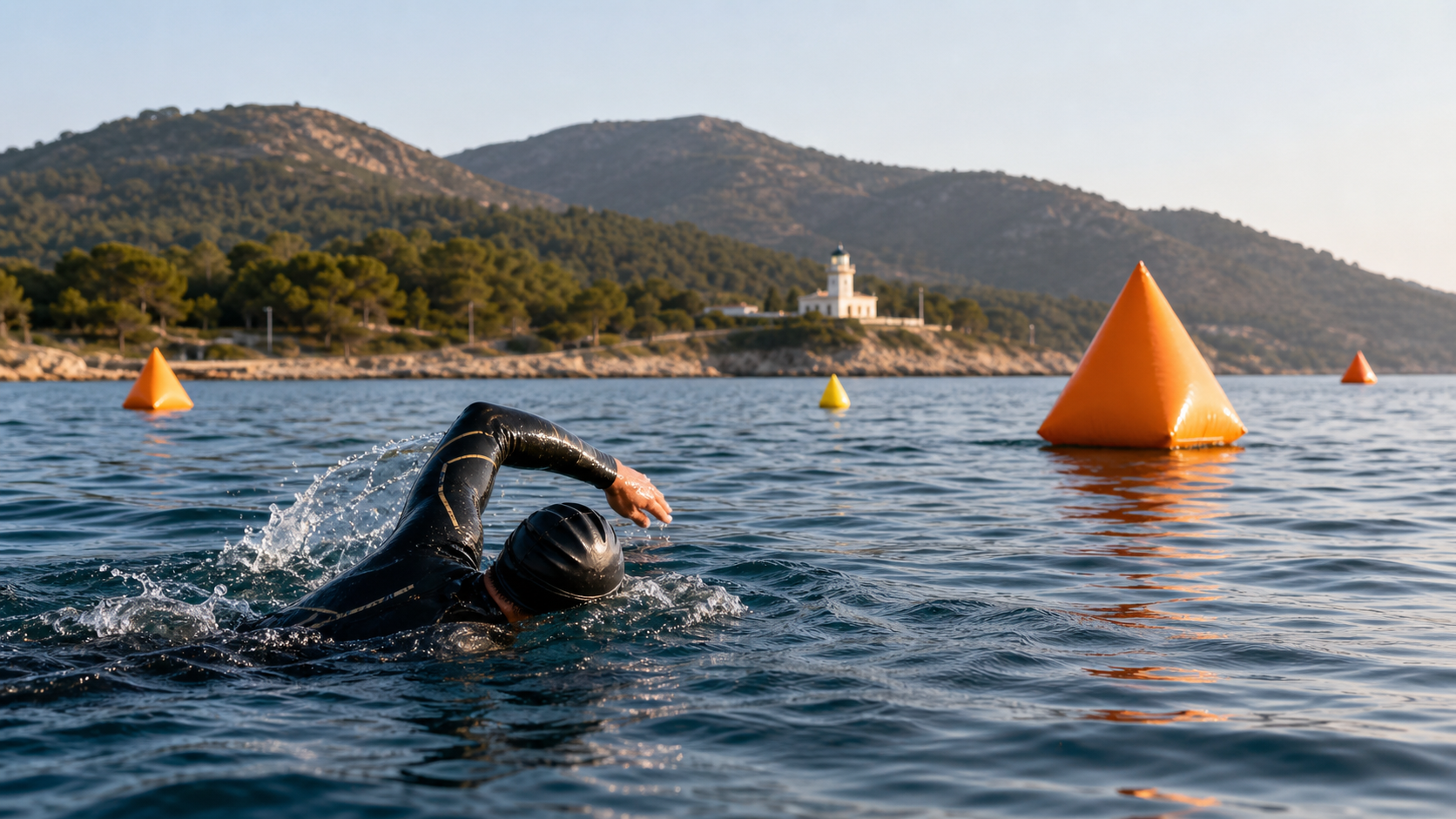
Find the highest vantage point (such as a raised platform or a shore slope) and confirm the positions and colors of all course buoys. Many events use different colored buoys to distinguish course markers (yellow) from turn markers (orange/red).
Step 2: Identify “alignment targets” on shore
For each straight segment, find fixed shore landmarks (buildings, hilltops, lighthouses, distinctive trees) located behind or near the buoy. These “alignment targets” are easier to spot in waves than the buoys themselves and serve as more reliable navigation references.
Step 3: Assess current or water flow direction
Observe whether there is noticeable water movement near the shore (the direction of surface foam or floating debris). If there is a strong cross-current, the shortest-distance route is not swimming straight toward the buoy but rather aiming “upstream” so the current helps correct your line.
Step 4: Plan your turn strategy
Around turn buoys, crowd density is highest and the risk of collision is greatest. Decide in advance:
- Whether to take the inside line at the buoy (shortest distance but most crowded)
- Or to swing wide on the outside (slightly longer distance but fewer people)
The Math Behind the Shortest-Distance Route
Using a triangular course as an example (the most common triathlon swim segment design), the sides of the triangle are usually not equal. Swimmers tend to “swim straight” along each side, but the correct strategy is actually more complex:
- Cutting the corner at turns: Begin cutting into the turning arc 5–10 meters before reaching the turn buoy, rather than swimming right up to the buoy and then turning. This shortens the turning arc and saves 3–8 meters.
- Current correction: If there is a cross-current, aim 10–15 degrees upstream so your actual path stays close to a straight line (even if your swimming direction looks angled).
- Avoiding an S-shaped route: Many athletes create an S-shaped route due to lateral drift, which can increase actual distance by 5–10%. Lifting your head to sight every 6 strokes is the best way to prevent this.
Practical Application in Taiwan Events
Taitung Living Lake Triathlon Swim Segment:
The water surface at Living Lake is relatively calm, sighting conditions are good, and the buoys are clearly visible. Athletes can take full advantage of this by precisely confirming their position on every sighting and taking an aggressive line hugging the buoy line. However, crowd density is higher at the turns, so athletes in the middle or back of the pack are advised to swing slightly wider to maintain a smooth swimming rhythm.
Sun Moon Lake Swim:
The Sun Moon Lake course is relatively simple (essentially a straight line), but the lake is vast, and sighting requires relying on architectural landmarks on the opposite shore rather than buoys. Morning mist may reduce visibility, so be sure to confirm the positions of the main landmarks before starting, and select one backup landmark on each side of the course.
Ocean swim events in Hualien or Taitung:
Ocean environments require factoring in currents. Along Taiwan’s east coast, the alongshore current can reach 0.5–1 knot (0.25–0.5 m/s) in summer. For competitive athletes, understanding and using (or fighting) this current can make a significant difference.
Practical Advice
The best way to build a “course-reading habit” is to evaluate your route efficiency against your GPS swim track after every open-water training session:
- Calculate the “actual distance / theoretical shortest distance” ratio (target: below 1.10, meaning no more than 10% wasted)
- Identify the segments with the most deviation and specifically improve your sighting frequency there
- Record how you pass turn buoys and assess whether it can be optimized
The Open Water Swimming modes on waterproof sports watches such as Garmin and Suunto, as well as Strava’s swim track feature, provide detailed route data and are excellent tools for route-efficiency analysis.
Conclusion
Reading the course in open-water racing is an art that combines physical intuition, environmental observation, and tactical planning. Every extra 10 minutes spent reading the course before a race can translate into 30 seconds to 2 minutes of time saved during it. Taiwan’s rich array of open-water events, from Sun Moon Lake to Taitung Living Lake, offers an excellent stage for practicing course reading. The next time you stand at the starting line, look up first, map the entire course in your mind, and then enter the water with the smartest route.
Related Reading
備戰 戀戀197 賽前關門點分析 西濱團練 #公路車 4K高畫質
6 年前
2023桃園團體繞圈賽 / 海鷗繞圈賽 | 全程空拍數據版 | 公路車 | CT Yeh
2 年前
CT 喇低賽) 武嶺牽車 才是王道 西進牽車四小時內秘訣 攝手位置 如何判斷 防抽筋小秘訣
7 年前
2025 海鷗團體繞圈賽 網路直播 超激烈裁判長視角 / EIPC 李廷威、Waypoint 等眾多高手競爭 / feat. 卡密兒主持 / 海鷗繞圈賽
9 個月前
西進武嶺 免費訓練分析服務 Intervals | 練不夠還是練過頭?你哪一種類型選手?AI模型告訴你! | 備戰神器 | 公路車 訓練 | CT Yeh
4 年前
單車 梅山36灣 坡度介紹 路段介紹 空拍 (相關遊記影片,請參考說明或我的頻道喔,歡迎訂閱)
6 年前
崇越盃武嶺冠軍高手 賽前JJSC 群峰會精華!對應大數據分析,會有落差嗎?/ feat. JJSC中部公路車約騎 /公路車 / CT Yeh
2 年前
戀戀197 競賽組 | 50頁投影片心得報告 | 賽後檢討 攻略 #公路車
6 年前