Group Long-Distance Riding Paceline Techniques: Proper Drafting and Leading Skills That Save 20% of Your Energy
文章導覽
Introduction
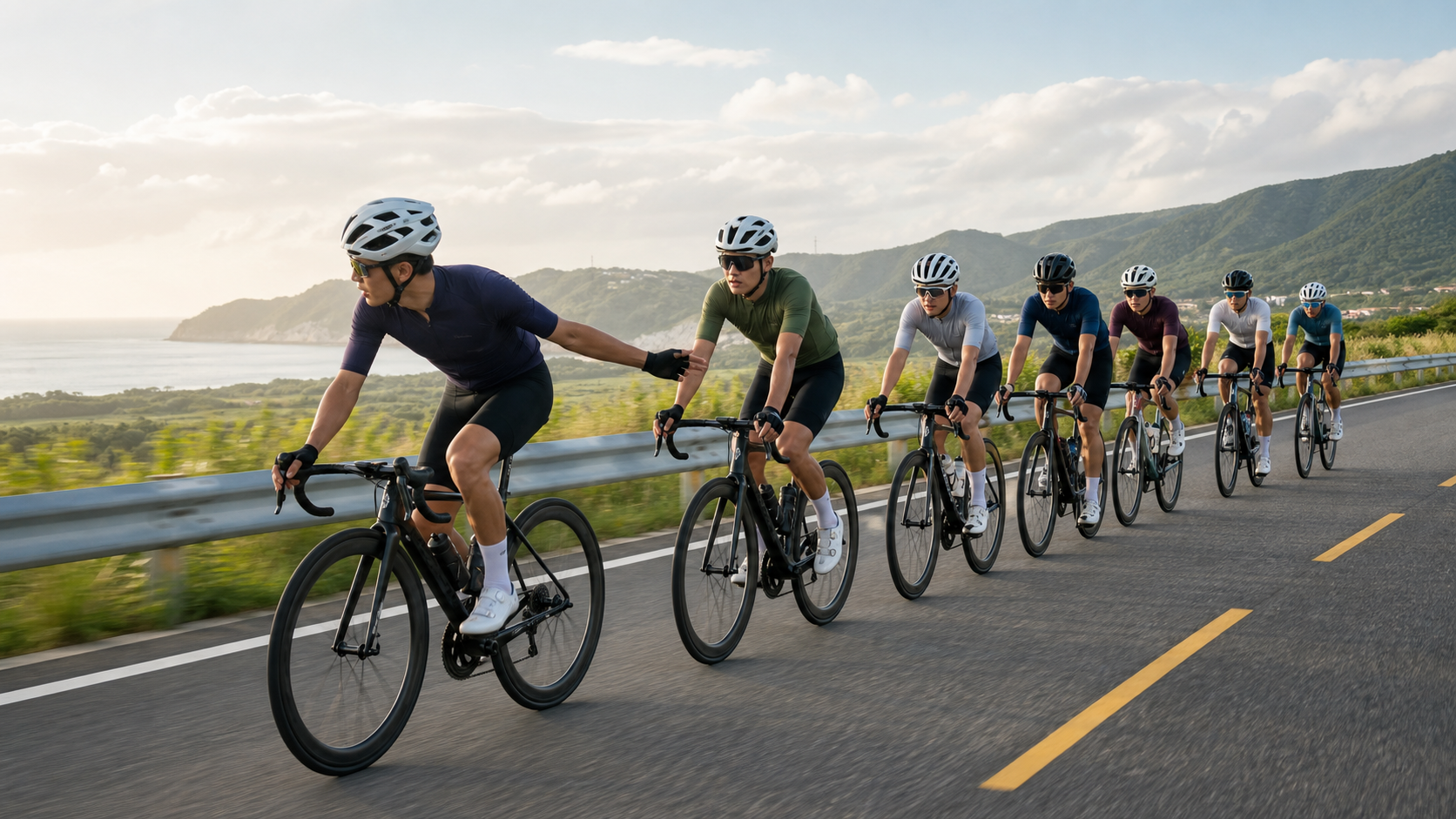
In long-distance road cycling in Taiwan, “drafting” is one of the most discussed—and most misunderstood—techniques. Many beginner riders assume that “riding close to the rider ahead is drafting,” but being too close increases danger; others, due to inconsistent technique, maintain an “overly safe distance” and completely miss out on the slipstream benefit.
Proper paceline technique, combined with good communication habits, can help a 6–8 rider group save an average of 15–25% of energy expenditure over a 100km ride. For amateur riders with limited weekly training volume, this difference can directly translate into the outcome between “finishing 200km” and “blowing up at 160km.”
The Aerodynamic Fundamentals of Paceline Riding
At speeds above 30km/h, air resistance is the biggest factor hindering forward motion, accounting for 70–90% of total resistance. Riding behind the rider ahead allows you to use the “slipstream” pushed open by the front rider to reduce your exposed frontal area:
| Following Distance | Estimated Drag Reduction | Safety Level |
|---|---|---|
| 0.5–1m (close following) | 25–35% | Requires high skill, high risk of emergency braking |
| 1–2m (standard following) | 15–25% | Suitable for trained riders |
| 2–3m (safe following) | 8–15% | Beginner-friendly, enough room for emergency response |
| 5m or more | Almost no benefit | — |
The benefit of offset following (slight wheel overlap):
Many professional teams use “slightly offset following”—positioning the front wheel slightly to the right-rear of the rider ahead (about 0.3–0.5m offset), enjoying the drafting benefit while gaining better visibility and braking space.
Standard Paceline Communication System
A safe paceline system requires the entire group to establish consistent communication habits:
Hand signals (common practices in Taiwan):
- Road hazard: Point to the ground to indicate potholes, gravel, or manhole covers (everyone should pass this signal back)
- Braking ahead: Palm facing backward, hand waving up and down
- Turn indication: Traditional left/right hand pointing, should be accompanied by verbal calls
- Slow down/Stop: Arm raised vertically upward
Verbal commands (should be loud and clear when riding in Taiwan):
- “Car!” or “Car coming!”: Oncoming or side traffic
- “Stop!”: Emergency stop ahead
- “Change!” (or “Pull off!”): The current leader is rotating to the back of the group
- “Slow!”: Slowing down needed ahead
Standard Rotation Procedure for Taking the Lead
Double paceline (suitable for 6+ riders on wider roads):
- The two lead riders pull for about 1–2 minutes (adjust based on fitness; in long-distance riding, no one should pull for more than 5 minutes)
- The left lead rider gently moves to the right, allowing the rider behind to move forward and take over
- The original lead rider slows down and drifts to the back of the group
- The entire group maintains a steady speed during the rotation—no accelerating and no hard braking
Single paceline (suitable for 4 or fewer riders or narrower roads):
- After completing the pull, the lead rider slows down and shifts slightly to the right
- Riders behind fill the gap in sequence
- The original lead rider smoothly joins the back of the group
Common issues in Taiwan:
- “Accelerating to fill the gap” during rotation: Don’t suddenly accelerate after the front rider pulls off; let the group compress naturally
- The leader pulling too fast: In long-distance riding, the leader should set the pace based on “the speed the slowest rider in the group can sustain”
Safety Considerations for Road Paceline Riding in Taiwan
Taiwan’s roads present some special situations that require extra attention:
- Sharp corners: Taiwan’s mountain roads have many curves; increase following distance before entering a corner and never rotate positions mid-corner
- Road surface quality: Some sections of Taiwan’s roads are rough or have protruding expansion joints; the lead rider should proactively warn loudly or with hand signals, not silently ride through
- Taiwan’s driving culture: Some Taiwanese drivers are unfamiliar with paceline riding; the group should stay on the outside of the lane and yield when vehicles approach from behind
Practical Advice
- Progression for beginners learning to draft: First practice the feeling of drafting on flat ground at a slower speed (20km/h), then gradually shorten the distance; don’t start learning on mountain descents or high-speed sections
- Don’t stare at the rear wheel of the rider ahead: Keep your eyes on the rider’s back (at height level), using peripheral vision to sense the position of the front wheel, allowing you to anticipate speed changes earlier
- Integrating into Taiwan’s cycling culture: Joining a local road cycling club (such as county/city cycling associations) or participating in road cycling training camps is the fastest way to learn paceline technique, with direct demonstrations and corrections
- Energy distribution strategy for long-distance paceline riding: Pulling at the front consumes more energy while drafting allows recovery; use this characteristic—weaker riders can shorten their pull time (e.g., everyone pulls for 2 minutes, weaker riders pull for 1 minute) to maintain overall speed
Conclusion
Paceline technique is the closest thing to “art” in road cycling. It requires awareness of the air, trust in your teammates, and intense focus on road conditions.
On Taiwan’s magnificent roads, a well-coordinated riding group moves like a school of fish in water, like a formation of geese in the sky, transcending individual limits through collective intelligence. This is the highest level of long-distance paceline riding.
Related Reading
- The Science of Wind Resistance: A Complete Analysis of Drafting Technique and Group Riding Efficiency
- Road Bike Group Riding Techniques: Safe and Energy-Saving Drafting Skills
- Team Paceline and Breakaway Tactics: Why Drafting Saves Energy, Formation Principles, and Etiquette and Safety for Amateur Group Rides
- Positioning Strategy in Group Race Sprints: Timing for Drafting and Choosing the Moment to Attack