The Impact of High-Temperature Environments on Cycling Power Output: Power Decay Rate per 1°C Rise in Core Body Temperature
Introduction
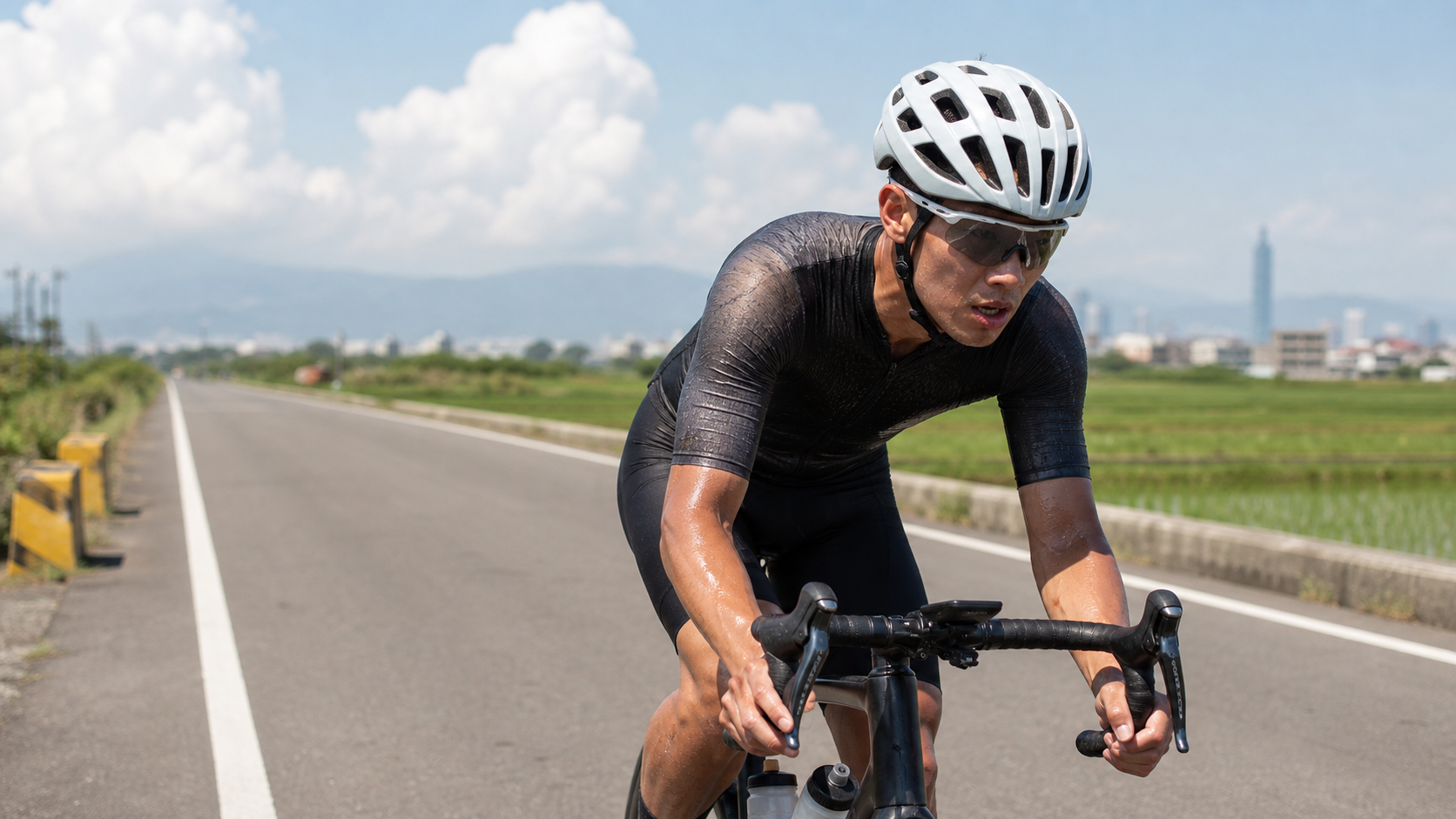
On a July midday on Taiwan’s western plains, with the temperature at 36°C and humidity at 80%, you set off following your usual power targets, only to find that within 30 minutes, your heart rate is 15 bpm higher than expected, while your power meter shows only 85% of your usual output. This is not your imagination, nor is it a matter of willpower—high-temperature environments have a quantifiable and predictable decay effect on cycling power output, and understanding the mechanism is essential for developing effective countermeasures.
Taiwan’s unique subtropical climate (summer daily average temperatures of 30–35°C, humidity often exceeding 70%) makes heat stress management an unavoidable issue for local cyclists. This article will delve into the physiological mechanisms of heat stress, as well as evidence-based cooling and acclimatization strategies.
Physiological Stress Mechanisms in High-Temperature Environments
When ambient temperature rises, the core challenge facing the human body is maintaining core body temperature within a safe range (37–38°C) while continuing to supply the blood flow required for muscular exercise. This creates a “competition”:
- Increased skin blood flow: Heat dissipation demands cause peripheral vasodilation, with skin blood flow increasing from 0.5 L/min at rest to 7–8 L/min
- Compensatory increase in heart rate: To maintain cardiac output (blood flow), heart rate must increase (known as “cardiac drift”)
- Competition for muscle blood flow: Skin and muscles compete for cardiac output, with muscle blood flow and oxygen supply relatively reduced
- Accelerated dehydration: Sweating for heat dissipation reduces blood volume, further compressing stroke volume
The net effect of this system: the same power output requires higher metabolic cost, or the same metabolic cost can only produce lower power.
Quantifying the Relationship Between Core Temperature Rise and Power Decay
Sports science research has established a quantitative relationship between core body temperature and aerobic power output:
| Core Body Temperature | Power Decay vs. Normal (37°C) | Perceived Sensation |
|---|---|---|
| 37.0°C | Baseline (0%) | Normal, comfortable |
| 37.5°C | Approximately −2–3% | Slightly warm |
| 38.0°C | Approximately −5–7% | Moderate heat sensation |
| 38.5°C | Approximately −8–10% | Noticeable discomfort |
| 39.0°C | Approximately −12–15% | Strong fatigue |
| 39.5°C | Approximately −18–25% | Danger zone |
| 40.0°C+ | Exercise ceases | Pre-heatstroke signs |
Research by Gonzalez-Alonso et al. (1999) reveals that for every 1°C rise in core body temperature, aerobic power output decreases by approximately 5–10% (depending on individual differences and training status). For a cyclist with an FTP of 250W, a rise in core temperature from 37°C to 39°C means a power capacity reduction of approximately 25–50W.
The Multiplier Effect of Humidity
Taiwan’s high-temperature challenge lies not only in air temperature, but also in the fact that high humidity significantly impairs the body’s primary heat dissipation mechanism—sweat evaporation.
Evaporative heat dissipation efficiency = f (water vapor pressure difference between skin and air)
| Humidity (Relative) | Evaporative Heat Dissipation Efficiency | Rate of Core Temperature Rise |
|---|---|---|
| 30% | 100% (baseline) | Slow |
| 50% | Approximately 70% | Moderate |
| 70% | Approximately 45% | Fast |
| 90% | Approximately 15–20% | Very fast |
| >95% | Nearly ineffective | Dangerous |
Wet-bulb globe temperature (WBGT) is a more accurate heat stress indicator than air temperature alone, integrating air temperature, humidity, and radiant heat. When WBGT > 28°C, the risk of heatstroke during high-intensity riding increases significantly (Taiwan’s summer afternoon WBGT often reaches 30–33°C).
The Science of Heat Acclimatization
Taiwanese cyclists have a natural advantage: long-term training in hot environments can trigger heat acclimatization, enabling the body to perform better at the same temperature:
Physiological changes from heat acclimatization (typically after 10–14 days of full heat exposure):
- Plasma volume increases by 5–15%: Improves stroke volume, reducing cardiac drift
- Lower sweating threshold: Sweating begins earlier, improving heat dissipation efficiency
- Lower sweat electrolyte concentration: Reduces sodium loss, lowering the risk of electrolyte depletion
- Slower rate of core temperature rise: Core temperature increases more slowly at the same intensity
Research shows that full heat acclimatization can recover approximately 40–60% of the power decay losses experienced in hot environments.
Practical Strategies for Reducing Heat Stress
Pre-cooling
- Ice vest: Wear an ice vest for 10–20 minutes before departure to lower skin temperature and delay the rise in core body temperature
- Cold fluid pre-loading: Consuming 500mL of ice water (4°C) before riding can lower core body temperature by approximately 0.3–0.5°C, lasting about 20 minutes
- Cold water immersion: Immersing the lower limbs in 15–20°C cold water for 15 minutes is a simple and effective pre-ride cooling method
Hydration Strategies During Riding
- Supplement 500–900 mL per hour (depending on sweat rate, which can reach up to 1,200 mL/hr in Taiwan’s summer)
- Add appropriate electrolytes (sodium 500–1,000 mg/L) to prevent hyponatremia
- Drink cold fluids during riding (providing both psychological and physiological cooling benefits)
Training Time Selection
| Time Slot | Taiwan Summer Temperature | Recommended Intensity |
|---|---|---|
| Early morning 5:30–7:30 | 26–30°C | Suitable for both high-intensity and long-distance rides |
| Morning 7:30–10:00 | 28–33°C | Moderate intensity, pay attention to hydration |
| Noon to 3:00 PM | 33–38°C | Low intensity or indoor trainer |
| Late afternoon 4:30–7:00 | 30–35°C | Moderate intensity, but radiant heat has subsided |
| Night indoor trainer | Room temperature ≤ 25°C | Best for high-intensity training |
Practical Recommendations
- During summer riding in Taiwan, use heart rate or RPE as the primary pacing metric rather than fixed power targets—accept that power will naturally decline in high heat
- Purchase a thermo-hygrometer and check WBGT before departure; move high-intensity training indoors to a trainer when WBGT exceeds 28°C
- When planning long rides, avoid the high-temperature window of 10 AM to 4 PM on the western plains
- Incorporate 3–4 hot-environment rides per week into your training plan (even short ones) to continuously reinforce heat acclimatization
Conclusion
Taiwan’s summer heat and humidity are a real challenge every cyclist must face, not a psychological obstacle to be overcome. Accepting the fact that power naturally decays in hot environments, and adopting scientific pre-cooling, hydration, and training time strategies, allows you to maintain training effectiveness while protecting your health. Heat acclimatization itself is part of training—the heat adaptation accumulated by Taiwanese cyclists through years of training in a subtropical environment often becomes a competitive advantage in overseas high-temperature races.
Related Reading
- Heat Acclimatization and Cycling Performance: Physiological Adaptation to Taiwan’s Summer High-Temperature Training
- Cycling Heat Acclimatization Training: Coping Strategies for Taiwan’s Summer High Temperatures
- Temperature Correction for Cycling Training: Methods for Adjusting Power in Hot-Weather Rides
- Heat Acclimatization Training: Physiological Strategies to Improve Cycling Performance in Taiwan’s Summer
單車 一日北高 ( 雙城 ) 肥宅雙人瘋狂行 紀錄片 REACTO
10 年前
#公路車 #Fitting 靠人工智慧APP 幫你調整單車
6 年前
大武山後門26%歡樂陡坡!JJSC南台灣單車行Day2 / 被颱風追著跑 / 公路車 / CT Yeh
2 年前
5 ℃ 櫻花之旅 / 75萬單車直接雨中洗車.../ 平菁街 / 北迴歸小隊 / 公路車 / CT Yeh
5 個月前
2026 車錶排行榜!誰是最多車友正在使用?練家子最愛哪款?🏆 (2萬名車友數據) / 公路車 / CT Yeh
5 個月前
2025 自行車錶排行榜 兩萬車友大數據 / Garmin Bryton 排名會大洗牌嗎? / 全新的碼表前身分析 /公路車 / CT Yeh
1 年前
2023自行車展!與環台賽選手一同表演賽 / 全自動AI Fitting?/ TIME新車發表/神秘充電桌等 精華分享 VLOG | CT Yeh | 公路車
3 年前
半日 小台灣 極限單車路線挑戰實錄
7 年前