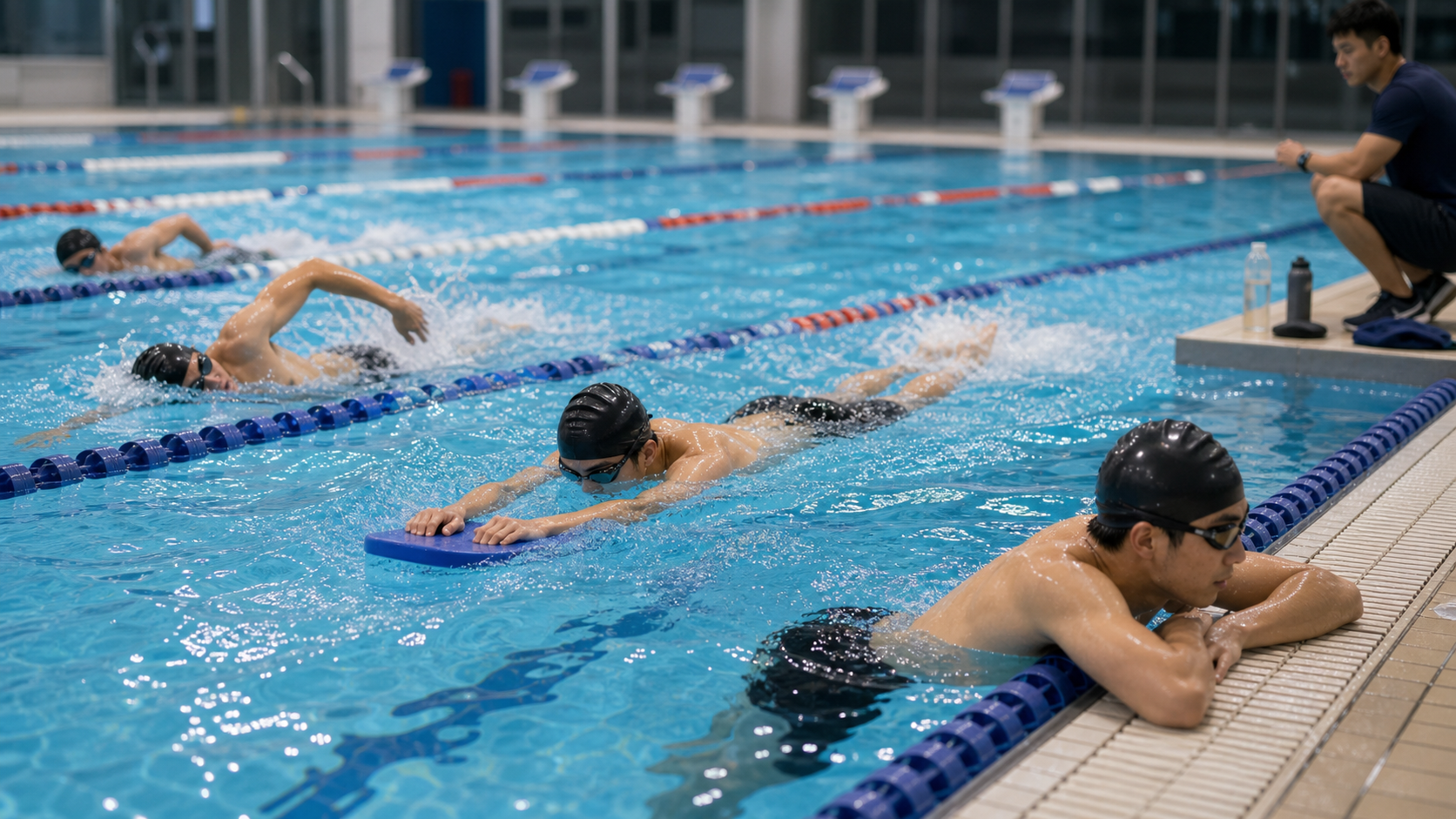
Introduction
Have you ever spent the first few hundred meters just “warming the engine,” only to finally feel smooth in the second half—right when you’re already tired? Or finished a swim session with no idea what you actually trained that day? Both symptoms point to the same root cause: a training session without structure.
A well-designed swim workout isn’t a random pile of distances—it’s built from four phases with clear functions: Warm-up → Drill Set → Main Set → Cool-down. Each phase serves a specific physiological purpose, and skipping any one of them reduces the overall training benefit.
Phase One: Warm-up
The Physiological Purpose of the Warm-up
The core goal of a warm-up isn’t simply “getting the body hot.” It is to:
- Raise the temperature of core muscle groups, improving muscle elasticity and nerve conduction speed
- Gradually increase heart rate and breathing frequency in preparation for the aerobic demands of the main set
- Activate shoulder, hip, and ankle mobility needed for swimming
- Establish “feel for the water” for the day—sensing catch pressure in the hands and body buoyancy
Warm-up Design Principles
- Duration: 15–20% of total session volume (for a 2500m session, roughly 400–500m of warm-up)
- Intensity: Z1–Z2 (very easy, should be able to hold a conversation)
- Stroke variety: Rotate through freestyle, backstroke, and breaststroke to activate different muscle groups
- Don’t chase speed: Some swimmers habitually swim fast during warm-up—this is a mistake
Warm-up Example
200m freestyle (Z1, focus on the “catch” feel as the hand enters the water)
100m backstroke (activates the posterior chain)
100m breaststroke (hip and ankle opening movements)
4×25m kick drill (with kickboard, feel the propulsion from the ankles)
Phase Two: Drill Set
The Purpose of the Drill Set
Many swimmers assume technique drills don’t produce noticeable results, so they skip straight to the main set. This is a serious mistake. Embedding a drill set into every session offers real benefits:
- Reinforces neuromuscular memory so correct movement patterns become automatic
- Consolidates technique before fatigue sets in, preventing swimmers from grinding through the main set with poor form
- Improves feel for the water and spatial awareness, which pays off significantly for long-term speed gains
Common Drill Exercises
| Drill Name | Primary Purpose | Suggested Distance |
|---|---|---|
| High Elbow Catch | Increases catch surface area | 4×50m |
| One-Arm Drill | Corrects hand entry angle | 4×25m per arm |
| Stroke Count Swimming | Reduces drag, improves efficiency | 4×50m |
| Side Kick Drill | Corrects body rotation range | 4×25m |
| Eyes-Closed Straight-Line Swim | Improves head position and symmetry | 2×25m |
| Kickboard Kicking | Strengthens leg propulsion | 4×50m |
Drill Set Design Principles
- Pick only 1–2 technical focus points per session—don’t try to fix everything at once
- Allow full recovery between drill reps (longer rest than the main set)
- The drill set is not timed for speed—only for movement quality
Phase Three: Main Set
The Core Role of the Main Set
The main set is where the “real training purpose” of the session lives, accounting for 50–60% of total volume. Its design varies dramatically depending on the day’s training goal:
Goal 1: Build Aerobic Endurance
- Format: Long continuous swim (1000m–2000m)
- Intensity: Z2 (can talk, feels effortful but not breathless)
- Rest: None needed, swim it straight through
Goal 2: Raise Lactate Threshold
- Format: Middle-distance repeats (3–5×400m or 6–8×200m)
- Intensity: Z3 (can only manage short phrases, heart rate clearly elevated)
- Rest: 30–50% of the interval distance’s time
Goal 3: Increase Top-End Speed
- Format: Short sprints (10–16×50m or 8×75m)
- Intensity: Z5 (all-out effort, unable to talk)
- Rest: 60–90 seconds of full recovery
Common Main Set Design Mistakes
- No target pace set: Swimming “fast when it feels fast, slow when it feels tired” provides no consistent training stimulus
- Inconsistent rest intervals: Sometimes 30 seconds, sometimes 2 minutes—the body never receives a consistent training signal
- Repeating the same main set every time: The body adapts to a fixed stimulus and progress stalls
Phase Four: Cool-down
Why the Cool-down Can’t Be Skipped
Most swimmers climb straight out of the pool after finishing the main set, skipping the cool-down entirely. This habit leads to:
- Lactate accumulating in the muscles, causing more severe soreness the next day
- The cardiovascular system halting abruptly from high-intensity work, which can trigger mild dizziness
- Muscles ending the session under high tension, raising long-term injury risk
Cool-down Design Principles
- Distance: 10–15% of total session volume (roughly 200–300m for a 2500m session)
- Intensity: Z1 (very easy—easy enough to chat with the swimmer in the next lane)
- Stroke: Breaststroke or backstroke recommended (both make it easier to relax muscles at low intensity)
- Time: Even when pressed for time, reserve at least 5 minutes for cool-down
Complete Sample Session (2500m)
| Phase | Content | Distance | Intensity |
|---|---|---|---|
| Warm-up | 200m freestyle + 100m backstroke + 4×25m kick | 400m | Z1 |
| Drill Set | 4×50m high elbow catch + 4×50m stroke count | 400m | Drill |
| Main Set | 5×200m Z3 threshold swim, 60s rest between reps | 1000m | Z3 |
| Speed Addition | 4×50m Z4–Z5 sprint, 90s rest between reps | 200m | Z4 |
| Cool-down | Easy 500m breaststroke | 500m | Z1 |
Practical Tips
- Mentally rehearse the session before you start, so you’re clear on the purpose and pace of every set
- Bring a waterproof stopwatch or swim watch—confirming interval times in real time is key to tracking progress
- Stay flexible with the plan—if you’re already struggling by the third repeat of the main set, it’s better to cut the number of reps than to lower the intensity standard
- Log the gap between “actually completed” and “planned session”—these gaps often reveal your training weaknesses
Conclusion
A well-designed session makes every minute in the water count. The warm-up prepares the body for the challenge ahead, the drill set ensures movement quality, the main set drives physiological adaptation, and the cool-down lets the body recover from the stress. All four phases matter—once structured training becomes a habit, you’ll find a clear sense of direction every time you get in the water, and your progress will noticeably accelerate.
Related Reading
西進武嶺 免費訓練分析服務 Intervals | 練不夠還是練過頭?你哪一種類型選手?AI模型告訴你! | 備戰神器 | 公路車 訓練 | CT Yeh
4 年前
滑雪新手們慘摔學習全紀錄(請開字幕),滑雪好好玩 | Snowboard + Ski | 岩原 スキー場 | 滑雪APP使用 | GoPro Max
6 年前
一起升級!海鷗盃LSD團練...JJSC Zone2招待 騎到手抖 / 公路車 / CT Yeh
1 天前
一日北高/長距離團騎 常見問題補充篇 / 組團或跟團的眉角 / 壯車友容易被瘦車友慢性拉爆 / 原來屁股痛可能是這個原因...? / 風場配速法 / 公路車 / CT Yeh
2 年前
FTL 與 SYB 車隊專訪 西進武嶺 實用攻略分享! 2小時 如何練?!你不知道的眉角!新手準備武嶺必看 EP1 | 實力派女車友 | 精華版 | 公路車 | CTYeh
4 年前
西進武嶺 自製新版AI配速表產生器 x 賽前攻略 抱佛腳! 沒有功率計也可以產生配速表嗎?有什麼其他眉角賽前要注意的呢? | 西進武嶺 / 東進武嶺 KOM 攻略 | 公路車 | CT Yeh
4 年前
Nepest NOVA 碳條輪組:輕量、空力、舒適一次滿足!/ 公路車 / CT Yeh
7 個月前
單車AI教練!全新 ChatGPT4o 幫你分析訓練成果!排武嶺課表,分析騎車姿勢! 太神了! / 公路車 / CT Yeh / feat. 緯緯
2 年前