Introduction
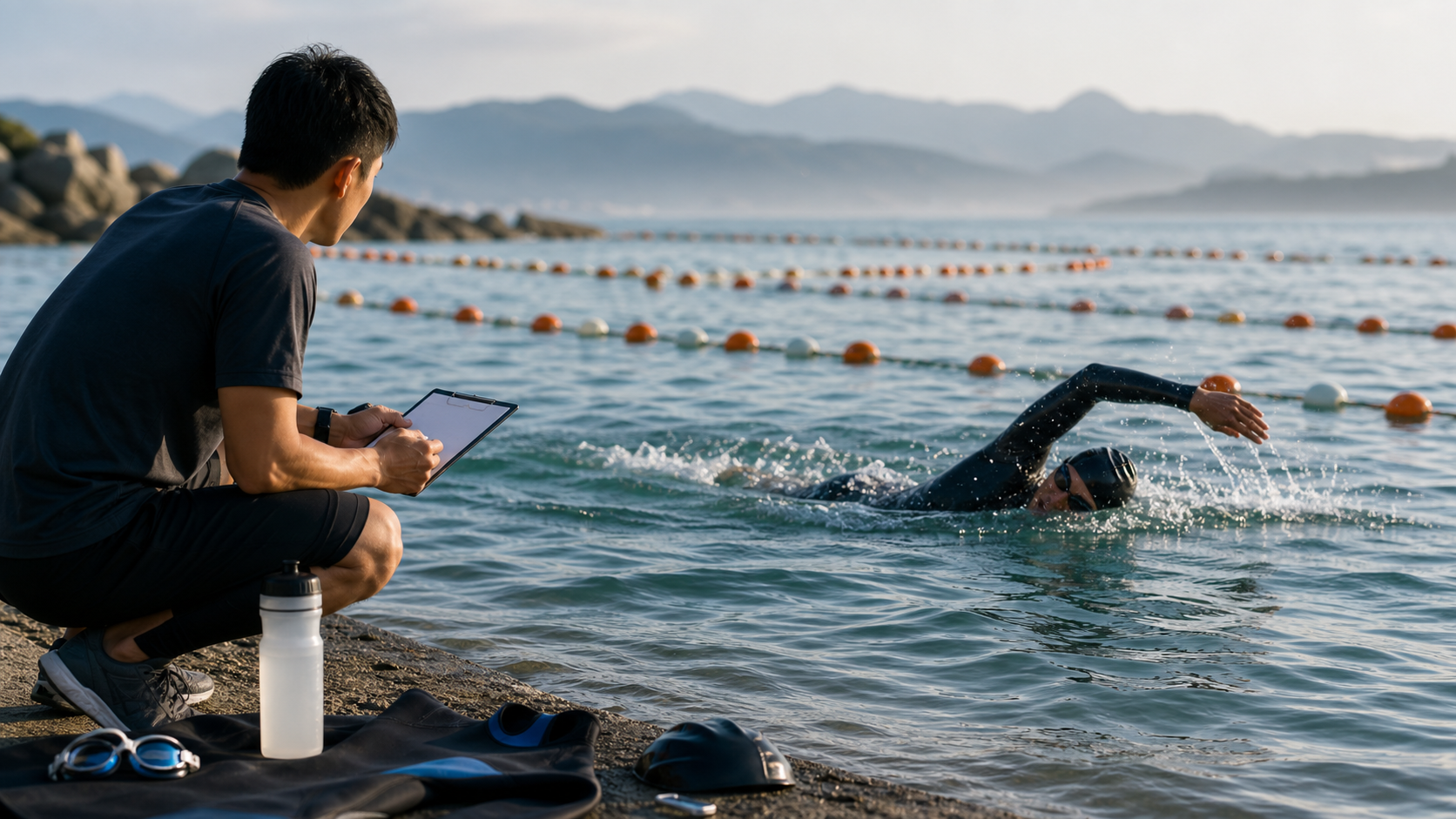
The swim leg of a triathlon differs fundamentally from pure swimming events: in a triathlon, swimming is only the first segment—after finishing, you still need to bike and run. This means the core goal of triathlon swimming is not “swimming the fastest,” but rather “completing the swim leg with minimal energy expenditure and a steady heart rate, then quickly transitioning to cycling mode upon exiting the water.”
This article provides different swim training plans for three major triathlon distances:
- Sprint distance: 750m swim
- Olympic distance: 1500m (or 1900m) swim
- Half Iron (70.3): 1900m swim
- Full Iron (140.6): 3800m swim
Key Differences Between Triathlon Swimming and Pure Swimming
Before designing a triathlon swim training plan, it’s essential to understand the fundamental differences between open water swimming and pool training:
| Comparison Item | Pool Swimming | Open Water (Triathlon) |
|---|---|---|
| Turns | Flip turns every 25/50m | No turns required |
| Navigation | Lane lines | Need to lift head to sight buoys (Sighting) |
| Water Conditions | Still and clean | Possible waves, currents |
| Start | From pool edge or starting block | In-water start or running into the water from shore |
| Nearby Swimmers | Fixed lanes | Crowded group swimming, collision risk |
| Attire | Regular swimwear | Usually a wetsuit (adds buoyancy) |
These differences mean triathlon swim training must include the following specialized drills: sighting practice, open water pacing stability training, and mental preparation for swimming in a crowd.
Training Plans by Distance
Sprint Distance (750m) Preparation: 8-Week Plan
Goal: After 8 weeks, be able to complete 1000m or more at a comfortable intensity (training volume exceeding race distance by 30%)
Weekly Schedule (3 sessions):
- Monday (Technique Day): 200m warm-up + 300m technique drills + 500m aerobic swim = 1000m
- Wednesday (Interval Day): 300m warm-up + 8×50m (threshold intensity) + 200m cool-down = 900m
- Saturday (Long Swim Day): 200m warm-up + 600–1000m continuous swim + 200m cool-down = 1000–1400m
Key Drill: During the last 200m of Saturday’s long swim, practice “sighting”—lift your head every 10 strokes to check direction, then resume swimming with your head down.
Olympic Distance (1500m) Preparation: 12-Week Plan
Weekly Training Volume Goal: 3000–5000m (split across 3–4 sessions)
Schedule Structure (3-day version):
| Training Day | Training Content | Distance | Intensity Target |
|---|---|---|---|
| Tuesday | Technique + aerobic endurance | 2000m | Z1–Z2 |
| Thursday | Intervals (8×100m) | 2200m | Z3–Z4 |
| Sunday | Long swim (including sighting) | 2500m | Z2 |
Key Session: Timed 1500m swim (once every 4 weeks), set race-day target pace and assess progress.
Half Iron (1900m) Preparation: 16-Week Plan
The challenge of the Half Iron swim lies in the distance being long enough (requiring an aerobic base), but on race day you still need to complete a 90km bike and 21km run afterward, so you cannot go all out.
Weekly Schedule (3–4 sessions, totaling 5000–7000m):
- Weeks 1–6: Build aerobic base, 5000m per week, longest single session 2000m
- Weeks 7–12: Add threshold training, 6000m per week, longest single session 2500m
- Weeks 13–15: Simulate race intensity, 7000m per week, longest single session 3000m
- Week 16: Pre-race taper, 3000m per week, maintaining feel for speed
Half Iron-Specific Drill: “Brick workout swim version”—immediately after swimming, get on the bike trainer to experience the adaptation time of your cardiorespiratory system transitioning from water to cycling.
Full Iron (3800m) Preparation: 20-Week Plan
The training focus for Full Iron swimming is endurance and efficiency. A 3800m race typically takes 60–90 minutes, requiring systematic aerobic endurance development.
Weekly Schedule (4–5 sessions, totaling 8000–12000m):
- Weeks 1–8: Aerobic base phase, longest single session reaching 3000m
- Weeks 9–14: Endurance development phase, longest single session reaching 4000m (exceeding race distance)
- Weeks 15–18: Race simulation, timed 3800m swim at race pace
- Weeks 19–20: Pre-race taper, maintaining swim feel while reducing training volume to 50%
Open Water Specialized Skill Training
Sighting (lifting head to spot buoys) practice:
- Lift your head every 8–12 strokes (too frequent will disrupt rhythm)
- Coordinate the head lift with your breathing rhythm (don’t take an extra breath just to sight)
- Pool practice: on each 25m swim, practice lifting your head to check ahead during the final 5m
Race start simulation:
- At least once per week, do a “start sprint” session: stand at the edge of the lane, simulate the first 50m fast swim after the race start
- Helps your body adapt to the high heart rate state at the beginning of a race
Practical Tips
- Try swimming in open water at least once 3–4 weeks before the race to familiarize yourself with the natural water environment in advance
- Train in a wetsuit at least 2–3 times to adapt to the “different swimming feel” caused by increased buoyancy
- Triathlon swim pace should be 10–15% slower than your pure swimming target speed to save energy for the bike and run legs
- Stop all high-intensity training one week before the race; instead, do 20–30 minutes of easy technique swimming each session
Conclusion
Success in triathlon swimming is not about swimming the fastest, but about “completing the swim leg most steadily with minimal energy, and entering T1 transition area in the best condition.” A solid 12–20 week preparation plan, regular open water practice, and a clear understanding of your own pacing are the core competitive advantages of a triathlete swimmer.
Related Reading
- Complete Beginner’s Guide to Triathlon: A Triathlon Training Plan from Zero
- Sprint Triathlon Swim Preparation: Pacing and Strategy for 750 Meters
- Time Management for Triathlon Swim Training: Prioritizing Swimming in Triathlon Training
- Olympic Distance Triathlon Swim Strategy: Full-Effort Pacing for 1500 Meters
西進武嶺 免費訓練分析服務 Intervals | 練不夠還是練過頭?你哪一種類型選手?AI模型告訴你! | 備戰神器 | 公路車 訓練 | CT Yeh
4 年前
2019 夏季KOM 5小 完賽心得 準備攻略 東進武嶺 夏季登山王之路 Taiwan KOM Challenge
7 年前
Live) 備戰2019彰化經典百K 賽前攻略 (已完賽請看新影片
7 年前
半日 小台灣 極限單車路線挑戰實錄
7 年前
[防寒衣體驗] 鐵人魂 三鐵 防寒衣試穿會 於松運 深水游泳池 鯨魚池
8 年前
2023桃園團體繞圈賽 / 海鷗繞圈賽 | 全程空拍數據版 | 公路車 | CT Yeh
2 年前
一日北高前的高裝檢 | 北高 360 | 挑戰11小時的裝備 | 一日雙塔 | 補給
6 年前
一日北高常見問題大集合 | 攻略 | 路線 | 訓練 | 補給 | 自行車 單車 | 一日雙城 | 雙塔 | TWB北高360 | 屁股痛
6 年前