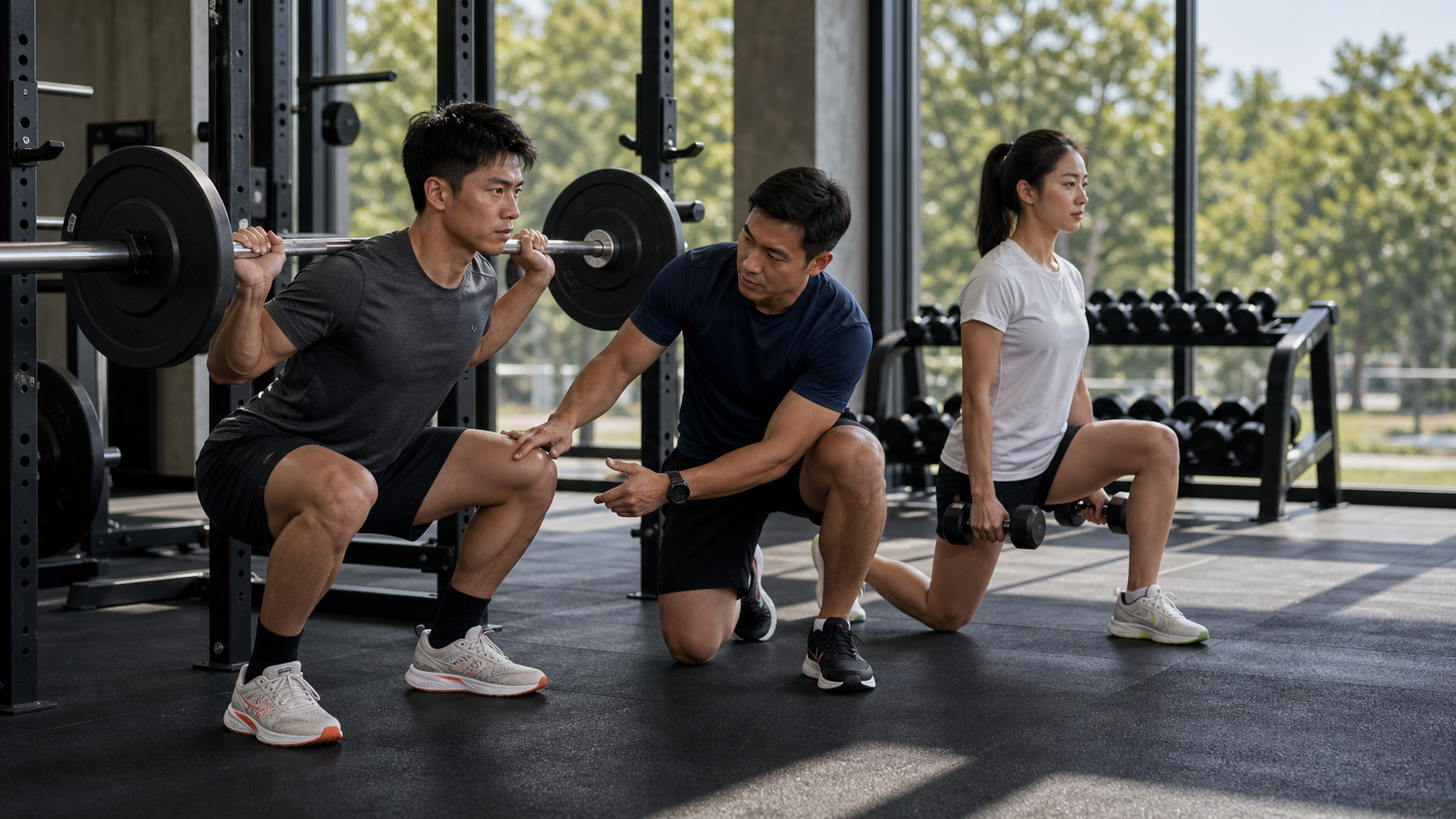
Introduction
The quadriceps, composed of four muscles—the rectus femoris, vastus lateralis, vastus medialis, and vastus intermedius—are among the most critical lower-limb muscle groups in running. During the shock absorption phase after each foot strike, the quadriceps perform eccentric contractions to absorb impact forces; during the propulsion phase, they perform concentric contractions to generate forward drive.
Among road runners in Taiwan, “runner’s knee” (patellofemoral pain syndrome) is one of the most common sports injuries, and quadriceps weakness or muscle imbalance is often the primary cause. When the vastus medialis oblique (VMO) is weaker relative to the vastus lateralis, it can cause lateral patellar tracking, leading to pain during running. Therefore, targeted quadriceps training is not just about improving running performance—it is a crucial investment in injury prevention.
This article will detail the two classic movements—squats and lunges—and explain how to design them with running-specific adaptations based on the demands of the sport.
Squats: Key Points for the Runner’s Version
The squat is the king of quadriceps training, but a runner’s squat training needs to be adjusted to match the biomechanics of running.
Key differences for runner-specific squats:
During running, each foot strike involves a knee flexion angle of approximately 20–40 degrees, with the center of gravity shifting toward a single leg. Therefore, in addition to standard squats, runners should emphasize medium-depth squats (parallel or slightly higher) as well as single-leg variations.
Standard squat execution points:
- Feet shoulder-width apart or slightly wider, toes turned out slightly (about 15–30 degrees)
- Keep the spine neutral, chest up and head looking forward—do not look down at the floor
- Knees track in line with the toes, avoiding inward collapse
- Sit the hips back and down as if sitting into a chair
- Lower until the thighs are parallel to the ground or slightly below, keeping the heels planted
- On the way up, drive through the glutes and fully extend the hips
Squat variations runners should prioritize:
- Bulgarian Split Squat: With the rear foot elevated on a bench or chair, perform a single-leg squat with the front leg. This closely mimics the single-leg support load of running and is one of the most running-specific training movements.
- Goblet Squat: Hold a kettlebell with both hands against the chest, forcing the torso to stay upright. This is ideal for simultaneously training the core and quadriceps.
- Pause Squat: Pause for 2–3 seconds at the bottom position to eliminate the stretch reflex and build pure strength output.
| Squat Variation | Training Focus | Running Relevance | Suitable Level |
|---|---|---|---|
| Standard Squat | Bilateral leg strength | Overall lower-body power | All runners |
| Bulgarian Split Squat | Single-leg strength, stability | Running propulsion and landing | Intermediate to advanced |
| Goblet Squat (Kettlebell) | Quadriceps-dominant | Downhill running shock absorption | Beginner to intermediate |
| Pause Squat | Eccentric strength | Landing shock absorption efficiency | Intermediate to advanced |
| Single-Leg Squat | Single-leg strength, proprioception | Running balance control | Advanced |
Lunges: The Dynamic Running-Specific Training
Lunge variations are closer to the running movement pattern than squats because they involve more sagittal-plane (front-to-back) motion and single-leg support training.
Lunge execution points:
- Step forward with a large stride, bending the front knee to approximately 90 degrees, with the rear knee lightly touching the ground
- The front knee should not extend past the toes (a slight overhang may be acceptable depending on individual anatomy, but the center of gravity should remain over the midfoot)
- Keep the torso upright or slightly forward-leaning with the core engaged
- Drive through the front foot’s glutes to return to the starting position
Lunge variations runners must practice:
- Walking Lunge: Continuously step forward in a walking pattern, mimicking the alternating gait of running while also training coordination.
- Reverse Lunge: Step backward instead of forward. This places less stress on the knee than a forward lunge, making it suitable for runners with knee issues.
- Lateral Lunge: Step out to the side, training the adductors and gluteus medius to strengthen lateral stability.
- Jump Lunge: Explosively jump and switch legs from the bottom of the lunge position, training power—suitable for advanced runners.
Eccentric Training: The Key to Protecting Against Downhill Running
Downhill running places 2–3 times more eccentric load on the quadriceps than flat running, which is exactly why many runners experience anterior thigh soreness or even injury after downhill sections. Eccentric training can significantly improve quadriceps eccentric strength and endurance.
Runner-specific eccentric squat training:
- Lower (eccentric phase) slowly over 4–6 seconds
- Rise (concentric phase) at normal speed
- Use lighter loads; bodyweight is sufficient in the early stages
- Begin intensifying eccentric training 4–6 weeks before race day
Practical Recommendations
Quadriceps training program design must account for weekly running volume:
- High-volume weeks (80 km or more): Reduce squat load to 60–70% of 1RM, focusing on maintenance work with an emphasis on movement quality.
- Moderate-volume weeks (40–60 km): Perform more complete strength sessions with 3–4 sets of 8–12 repetitions.
- Light training weeks: Prioritize functional movements like Bulgarian split squats to maintain neuromuscular efficiency.
- 2 weeks before race day: Significantly reduce load and sets, with the principle of avoiding fatigue.
- Post-training recovery: Delayed onset muscle soreness (DOMS) in the quadriceps after squat training may last 24–72 hours; allow sufficient recovery time before long runs.
Conclusion
Quadriceps training designed for runners is not about chasing thigh size—it is about building sufficient strength to handle the cumulative impact of long-distance running. With consistent practice of squat and lunge variations just 2 times per week, you will noticeably feel easier downhill running, reduced knee pain, and improved overall running efficiency within 3 months. Strength training for runners, ultimately, is about helping you run farther, faster, and with fewer injuries.
Related Reading
- How Squats and Lunges Help Runners Build Strength
- Runner’s Hip Flexor Training: Key Muscles for Preventing Running Injuries
- Strength Training Program for Road Runners: How Squats and Deadlifts Improve Running Performance
- Quadriceps and Hip Extension Training: Unlocking Full Power Through the Pedal Stroke
一日北高/長距離團騎 常見問題補充篇 / 組團或跟團的眉角 / 壯車友容易被瘦車友慢性拉爆 / 原來屁股痛可能是這個原因...? / 風場配速法 / 公路車 / CT Yeh
2 年前
實景訓練台) 彰化經典百K 高強度喵團 90分鐘 跟著一起練功 2019 Indoor workout Changhua Classic 100 Taiwan
7 年前
一日北高常見問題大集合 | 攻略 | 路線 | 訓練 | 補給 | 自行車 單車 | 一日雙城 | 雙塔 | TWB北高360 | 屁股痛
6 年前
iPhone內建一秒變長腿🤣 車友必備#cycling
2 年前
白沙屯媽祖進香在家走!UREVO 坡度自調走步機 / 可連接訓練遊戲APP MyWhoosh / 邊看直播邊走起來 / CT Yeh
11 個月前
西進武嶺 免費訓練分析服務 Intervals | 練不夠還是練過頭?你哪一種類型選手?AI模型告訴你! | 備戰神器 | 公路車 訓練 | CT Yeh
4 年前
#PUSHBIKE 原來這麼好玩! 小朋友 滑步車 初體驗 超可愛
6 年前
元宇宙單車運動!智騎 X7 Pro 智能訓練台 ThinkRider 居家線上練功
5 年前