Runner's Calf Training: Injury Prevention Effects of Calf Raise Strengthening and Ankle Stability
Introduction
Many runners never consider calf training a priority until an injury forces them to stop. It often takes Achilles tendinopathy or plantar fasciitis to make them pay attention to this “last mile” muscle group. In fact, with every foot strike, the calf complex (gastrocnemius + soleus) must absorb 6–8 times body weight in impact force, making it one of the most heavily loaded muscles in the body.
Among marathon and ultramarathon runners in Taiwan, Achilles tendon-related issues are among the most common chronic injuries, and effective prevention strategies are already backed by science: progressive eccentric calf training (Eccentric Heel Drop Protocol) has been shown to effectively improve tendinopathy, as confirmed by multiple randomized controlled trials.
This article will detail the correct execution of heel raise training, methods for ankle stability training, and how to build a systematic calf strengthening program.
Heel Raise Training: A Complete Progression from Basic to Advanced
The heel raise (calf raise) looks simple, but achieving injury prevention and improved running economy requires proper execution and progressive overload.
Basic Heel Raise (Double Leg Standing):
- Stand on flat ground, feet shoulder-width apart
- Slowly rise onto your toes, holding at the top (full gastrocnemius contraction) for 1 second
- Lower slowly (2–3 seconds) with full eccentric control
- Recommended: 3 sets × 20–30 reps
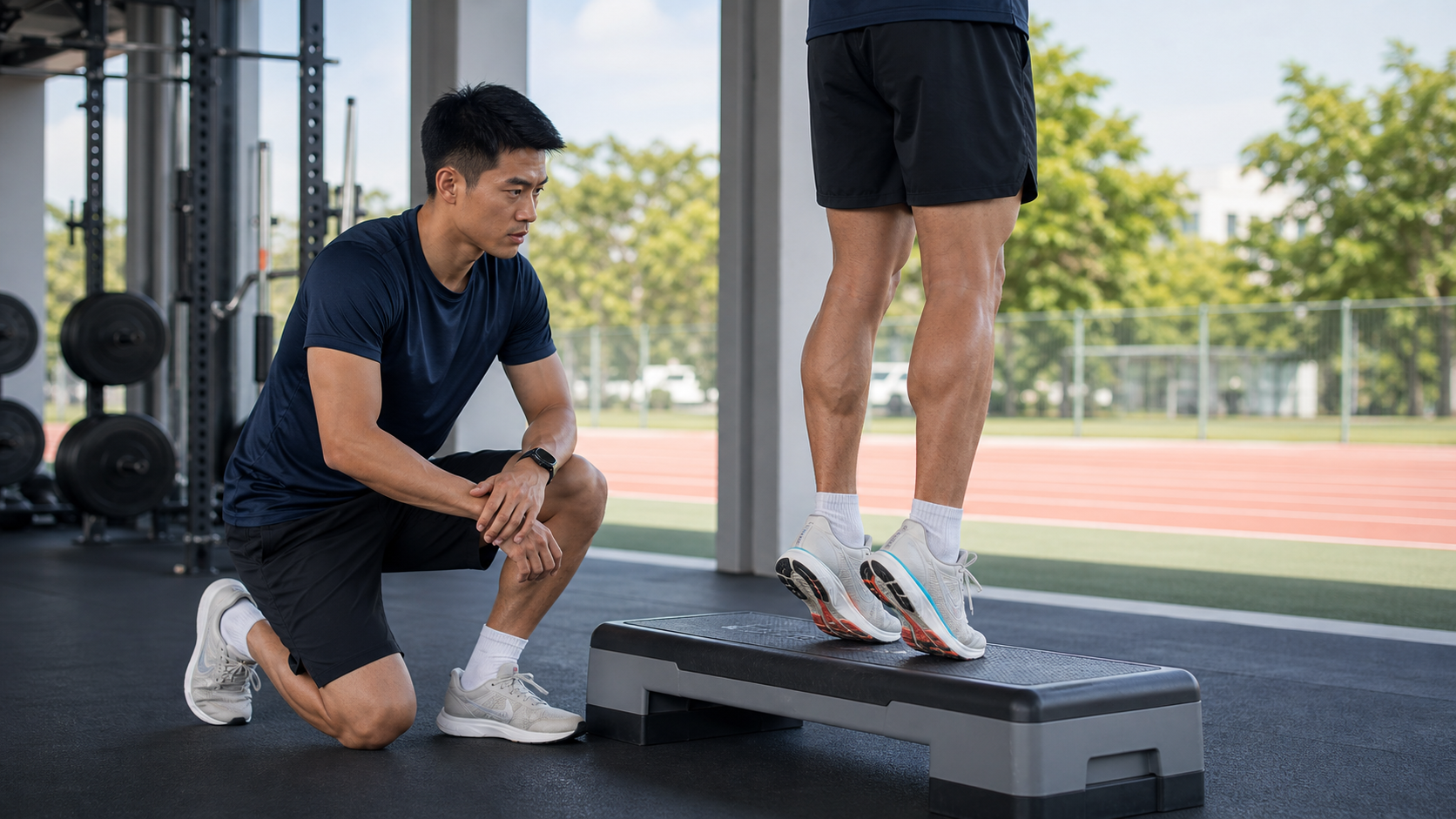
Advanced Heel Raise (Step Edge):
- Stand on the edge of a step with your heels hanging off
- Rise onto your toes with both feet
- Lower slowly until your heels drop below the step (increasing the eccentric stretch range)
- The eccentric stretch effect of this movement is 2 times greater than flat-ground heel raises
Single-Leg Heel Raise (The Most Critical Running-Specific Exercise):
Running is an alternating single-leg activity, so double-leg heel raises have limited transfer to running. Progressing from double-leg to single-leg heel raises is essential to address the single-leg demands of running.
| Exercise | Load Type | Primary Benefit | Recommended Reps |
|---|---|---|---|
| Double-leg flat-ground heel raise | Concentric + Eccentric | Foundational strength | 3×20–30 |
| Double-leg step heel raise | Eccentric emphasis | Tendon strengthening | 3×15–20 |
| Single-leg step heel raise | Eccentric emphasis | Running specificity | 3×12–15 |
| Jump rope | Power | Elastic energy storage | 3×1 minute |
| Bound jumps | Power | Calf explosive power | 3×10 |
Alfredson Eccentric Heel Drop Protocol:
An evidence-based treatment protocol for Achilles tendinopathy: perform 2 times daily, 3 sets × 15 reps each, with both a straight-knee position (targeting the gastrocnemius) and a bent-knee position (targeting the soleus). Adhering to this for 12 weeks can effectively improve tendon symptoms. Even without injury, this protocol is one of the most effective calf injury prevention routines.
Ankle Stability Training: The Key to Preventing Rolling Injuries
Insufficient ankle stability is a primary cause of ankle rolling injuries in runners on uneven terrain or trails. The peroneal muscles on the lateral ankle are the first line of defense against ankle inversion, and strengthening these muscles can significantly reduce the risk of ankle sprains.
Ankle Stability Exercises:
-
Resistance Band Ankle Training:
- Loop a resistance band around the forefoot and pull it inward
- Perform eversion (pressing the foot outward) against the band’s resistance
- 3 sets × 15 reps (each side), targeting the peroneal muscles
-
Single-Leg Balance:
- Stand on one leg with the other foot slightly lifted, starting with 20 seconds
- Progression: close your eyes (increasing proprioceptive challenge)
- Further progression: stand on an unstable surface (folded towel, balance pad)
-
Alphabet Exercise:
- Stand on one leg and “write” A–Z in the air with the other ankle
- Trains multi-directional ankle control
- Suitable for both post-injury rehabilitation and preventive training
Arch Strengthening:
Weakness in the intrinsic foot muscles can cause the arch to collapse during running, increasing the risk of plantar fasciitis. The short foot exercise is the most effective intrinsic foot strengthening movement:
- Seated position, foot flat on the floor
- Attempt to “draw” the ball of the big toe and the heel toward each other without curling the toes
- Feel the arch lift, hold for 5–10 seconds, 3 sets × 10 reps per side
Practical Recommendations
An integrated approach to calf training:
- Weekly frequency: Calf muscles and tendons recover quickly, so heel raises can be performed 3–4 times per week
- Progress from double-leg to single-leg: Only advance to single-leg versions after comfortably completing 3×20 double-leg heel raises
- Strengthen before increasing mileage: When planning to increase training volume or start race preparation, begin calf strengthening 4–6 weeks in advance to give tendons adequate time to adapt
- Preparation before minimalist footwear: If you plan to try zero-drop running shoes, calf training is essential preparation—start 8–12 weeks in advance
- Post-run icing and massage: After long runs, apply 10 minutes of ice massage to the calves to reduce microtrauma accumulation
Conclusion
Calf training is often the most neglected component of a runner’s strength program, yet it offers one of the highest returns on investment. A systematic heel raise routine performed 3 times per week, combined with ankle stability exercises, can effectively reduce the incidence of Achilles tendinopathy and plantar fasciitis—helping you spend less time on forced rest and more time on steady progress in your pursuit of a PB. Strong calves are a fundamental investment every runner deserves to make.
Related Reading
- Calf and Ankle Strengthening: The Most Overlooked Weight-Bearing Component for Runners
- Calf and Ankle Strengthening for Runners: Preventing Achilles Tendon Issues
- Ankle Strengthening for Road Runners: A Complete Plan for Sprain Prevention and Propulsion
- Conservative Treatment and Return-to-Running Criteria for Achilles Tendinopathy
西進武嶺 免費訓練分析服務 Intervals | 練不夠還是練過頭?你哪一種類型選手?AI模型告訴你! | 備戰神器 | 公路車 訓練 | CT Yeh
4 年前
[教學] Premiere 影片 手震 修正 教學 防抖 單眼 影像 GoPro 穩定 Video Stabilization
8 年前
CT 喇低賽) 武嶺牽車 才是王道 西進牽車四小時內秘訣 攝手位置 如何判斷 防抽筋小秘訣
7 年前
西進武嶺 自製新版AI配速表產生器 x 賽前攻略 抱佛腳! 沒有功率計也可以產生配速表嗎?有什麼其他眉角賽前要注意的呢? | 西進武嶺 / 東進武嶺 KOM 攻略 | 公路車 | CT Yeh
4 年前
#公路車 #Fitting 靠人工智慧APP 幫你調整單車
6 年前
FTL 與 SYB 車隊專訪 西進武嶺 實用攻略分享! 2小時 如何練?!你不知道的眉角!新手準備武嶺必看 EP1 | 實力派女車友 | 精華版 | 公路車 | CTYeh
4 年前
Never Stop 西進武嶺 前後雙機 完整全程錄影 訓練台 實境
8 年前
西進武嶺配速器 3.0更新 / NEW 免功率FTP估算! / 大數據xAI體能模型 / 如何模擬人止關前集團效應 / 配速儲存功能 / AI全台自行車賽事行事曆 / 公路車 / CT Yeh
1 年前