Introduction
When runners discuss ways to “run faster,” they usually only think about improving aerobic capacity (more mileage, interval training), while overlooking the significant impact that plyometric training has on running speed. Plyometric training—which involves jump-based exercises that rapidly stretch muscles followed by immediate contraction—has been extensively proven by research to effectively improve running economy and maximum speed.
Running propulsion comes not only from active muscle contraction but also from the elastic storage and release of energy in tendons. With every footstrike, tendons such as the Achilles tendon and patellar tendon act like springs, storing elastic potential energy; upon push-off, this energy is released, providing “free” propulsion. The more efficient this mechanism (the Stretch-Shortening Cycle, SSC), the less energy running requires. Jump training is the most effective means of improving SSC efficiency.
Three Key Mechanisms by Which Plyometric Training Affects Running
- Improved Neuromuscular Efficiency: Jump training teaches the nervous system to recruit motor units more rapidly, reducing the time required for the same force output—which translates to faster ground contact and push-off times in running
- Increased Tendon Stiffness: Appropriate jump training increases tendon stiffness, allowing for more effective storage and release of elastic energy, thereby lowering metabolic cost
- Greater Engagement of Fast-Twitch Muscle Fibers: Explosive movements train fast-twitch fibers (Type II) to participate more effectively in running propulsion, enabling improvements in both cadence and stride length
| Jump Training Type | Primary Benefit | Transfer to Running | Difficulty |
|---|---|---|---|
| Vertical Jump | SSC efficiency, vertical power | Propulsion, stride length | Beginner |
| Jump Rope | Landing stiffness, cadence | Cadence improvement | Beginner |
| Box Jump | Power, confidence | Stride length and power | Intermediate |
| Depth Jump | Reactive strength, SSC | Landing efficiency | Advanced |
| Hurdle Hop | Continuous power | Cadence and stride integration | Advanced |
| Single Leg Hop | Running-specific power | Most direct transfer to running | Advanced |
Jump Training Exercises for Runners
Beginner Phase (Weeks 1–4): Building Foundational Elasticity
1. Double-Leg Vertical Jump:
- Stand with both feet, slightly squat, then jump up with maximal effort
- Absorb the impact upon landing, then jump again immediately (minimize ground contact time)
- 3 sets × 10 reps, 90 seconds rest between sets
- Focus: Land lightly and quickly, avoid heavy stomping
2. Jump Rope:
- The safest introductory plyometric exercise, while also improving landing frequency (corresponding to cadence)
- Start with 1–2 minutes per session, gradually increase to 3 × 2 minutes
- Progression: Try double-leg jumps → alternating single-leg jumps (closer to the running gait)
Intermediate Phase (Weeks 5–8): Increasing Difficulty and Specificity
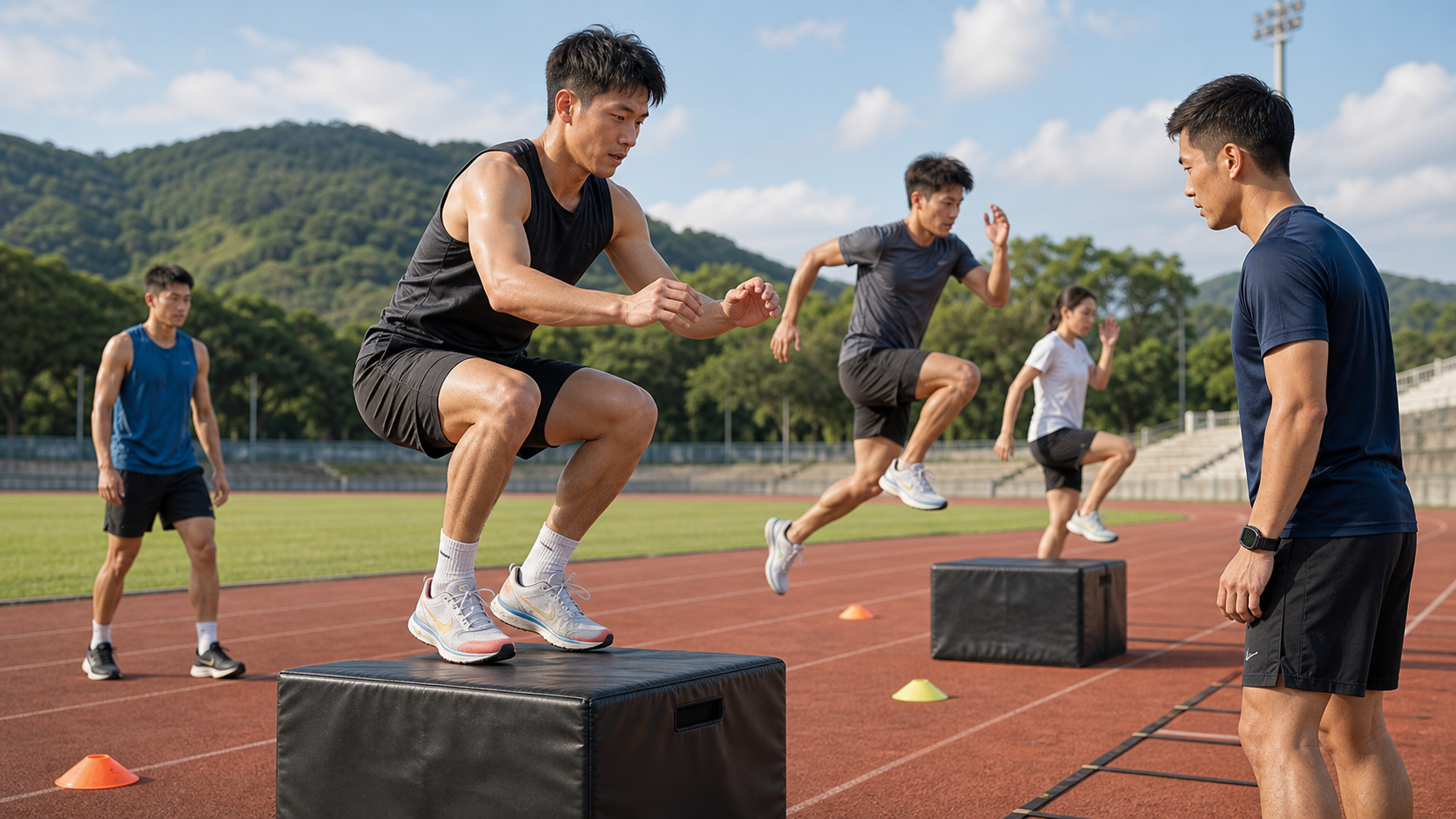
3. Box Jump:
- Stand in front of a box (30–60 cm high), jump forcefully onto the box surface, land softly (bend knees to absorb)
- Step down from the box (do not jump down) to avoid unnecessary eccentric loading and injury
- 3 sets × 6–8 reps, with full rest (2–3 minutes)
- Trains power output and confidence
4. Continuous Hurdle Hop:
- Set up 5–8 low hurdles (30–45 cm high), hop over them continuously with both feet
- Emphasize quickly re-jumping after landing to minimize ground contact time
- 3 sets, with full rest between sets
- Water bottles lined up in a row can substitute for actual hurdles
Advanced Phase (Week 9 onward): Running-Specific Power
5. Single Leg Hop:
- Hop continuously in place or forward on one leg
- Most closely matches the power demands of running, as every step involves single-leg push-off
- 3 sets × 8 reps (per leg), ensuring symmetrical power output between both legs
6. Hill Sprint:
- Strictly speaking, this is sprint training, but it combines power with running specificity
- Sprint all-out up a 20–30 meter incline, walk down to recover, 6–8 repetitions
Program Integration and Training Frequency
Jump training places high impact on the musculoskeletal system and requires adequate recovery time.
Recommended Frequency: 1–2 times per week
- Initial phase: once per week to avoid excessive impact leading to injury
- After adaptation: can increase to twice per week, but allow at least 48 hours of recovery between sessions
Program Scheduling Principles:
- Perform jump training before running sessions (in a fresh state) to maintain movement quality
- Or on easy aerobic days, not on high-intensity running days
- Stop jump training in the final 2 weeks before a race to allow the nervous system to fully recover
Practical Recommendations
- Establish a strength foundation first: Before starting jump training, it is recommended to complete 6–8 weeks of basic squat and lunge training to ensure the lower limbs have sufficient shock-absorbing capacity
- Landing quality matters more than height: Landing control on every jump is more important than jump height; knees should track over the toes and not cave inward upon landing
- Start with low volume: When first introducing jump training, keep total jump count to no more than 60–80 per session, then gradually increase
- Listen to your body: Knee or ankle joint pain after jump training (as opposed to normal muscle soreness) is a signal to stop
- Consistency matters more than intensity: One high-quality jump training session per week sustained over 12 weeks far outperforms occasional heavy sessions
Conclusion
Jump training is a high-yield training method for runners seeking to improve speed, efficiency, and athletic capability. Through systematic plyometric training, you are not just making your legs stronger—you are training the entire neuromuscular system’s reaction speed and elastic energy utilization efficiency. Start with once-weekly jump rope and vertical jumps, progressively add box jumps and single-leg hops, and within 3 months you will feel more springy strides, easier maintenance of faster paces, and more powerful explosive strength in your final sprint.
Related Reading
- Plyometric Training for Runners: The Impact of Jump Rope and Bounding on Pace
- What Runners Must Know: Plyometric Training to Boost Power and Efficiency
- The Effectiveness of Plyometrics in Improving Road Running Performance
- Applying Plyometrics in Road Running: A Guide to Improving Elastic Tendon Strength
西進武嶺 免費訓練分析服務 Intervals | 練不夠還是練過頭?你哪一種類型選手?AI模型告訴你! | 備戰神器 | 公路車 訓練 | CT Yeh
4 年前
多機位拍片神器 DJI Action 2 拍出速度張力感 | 類空拍機視角 4陣列麥克風超強降風噪 實測! | 公路車 | CT Yeh
3 年前
戰略) Zwift Race 如何咬在第一集團 如何評估自己要開多少推力 (請開1.5倍速看)
7 年前
西進武嶺配速器 3.0更新 / NEW 免功率FTP估算! / 大數據xAI體能模型 / 如何模擬人止關前集團效應 / 配速儲存功能 / AI全台自行車賽事行事曆 / 公路車 / CT Yeh
1 年前
白沙屯媽祖進香在家走!UREVO 坡度自調走步機 / 可連接訓練遊戲APP MyWhoosh / 邊看直播邊走起來 / CT Yeh
11 個月前
[教學] Premiere 影片 手震 修正 教學 防抖 單眼 影像 GoPro 穩定 Video Stabilization
8 年前
#公路車 #Fitting 靠人工智慧APP 幫你調整單車
6 年前
Fitting訓練兩用功率車 ! Thinkrider ST900 完整實測!/ 坡度升降 / 鄰居測試/ smart bike/公路車/ CT Yeh
2 年前