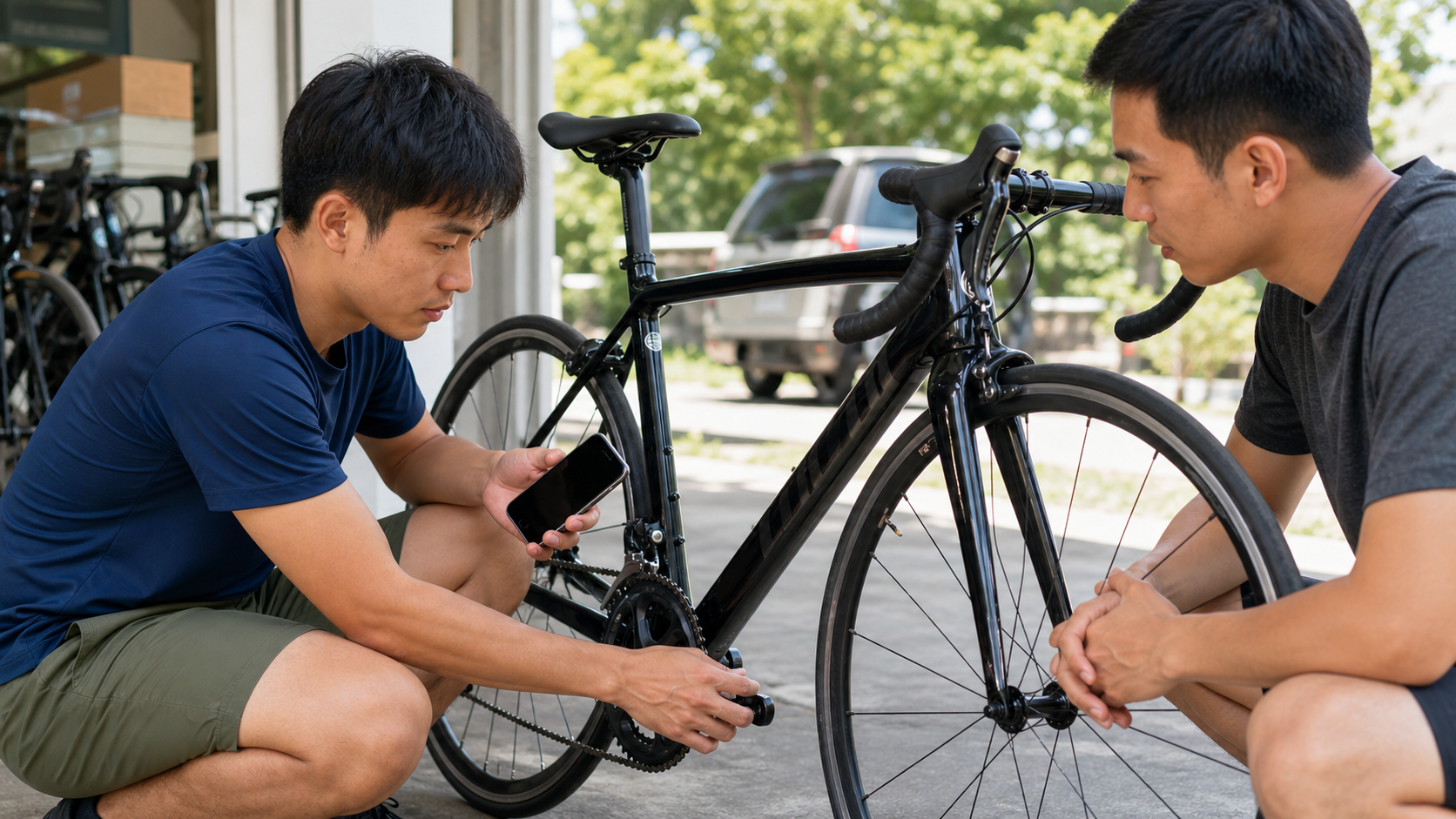
Introduction
Taiwan’s second-hand bike market is very active. Every day, a large number of used bikes change hands on Shopee, the Facebook group “Bicycle Buy & Sell,” and the PTT Bicycle board. For beginners, the used market offers a chance to buy a quality bike at half, or even a third, of the price of a new one; for veterans, it’s an important channel for upgrading components or clearing out old bikes.
But the used market also has plenty of “landmines”: excessively worn drivetrains, invisible frame cracks, and e-bike batteries with hidden mileage. This article provides a complete process to give you the knowledge to tell the good used bikes from the bad.
Comparison of Main Sources for Used Bikes
| Platform | Pros | Risk Points | Best For |
|---|---|---|---|
| Shopee | Rating system, 7-day return period, easy price comparison | Photo enhancement, exaggerated descriptions | Complete bikes, components |
| Facebook Groups | Personal touch, can discuss details | No rating system, easier to be scammed | Mid-to-high-end complete bikes |
| PTT Bicycle Board | Many experienced riders, good judgment | Older user demographic | Racing bikes, rare parts |
| Physical used-bike shops | Can inspect and test ride | Slightly higher prices | Those unsure of their needs |
| Friends and family | Known service history | Limited selection | Any type |
Four Core Tips for Choosing a Bike Online
1. Look at Photo Details, Not Overall Aesthetics
An honest seller will proactively take photos of:
- Close-ups of the chain and cassette (to show wear)
- The head tube and frame joints (for scratches or cracks)
- Tire sidewalls (for cracking or wear indicators)
- The frame serial number (to confirm it’s not stolen)
If the seller only has a few long-distance shots, or angles that deliberately avoid the drivetrain, that’s a warning sign that warrants further questioning.
2. Cross-Check Market Prices
Before making an offer, do your homework:
- Search for the same model on Shopee and look at the actual “sold” prices (not just the seller’s asking price)
- Use the search function in Facebook groups to enter the model name and check pricing discussions from the past three months
- Look up the manufacturer’s official price for that model. Used bikes are typically priced at 80%, 70%, and so on, of the new price. Anything above 80% of the new price needs a special reason (e.g., brand new or barely ridden)
3. A Checklist of Questions for the Seller
Proactively asking the following questions not only gets you information, but also lets you gauge the seller’s sincerity by how detailed their answers are:
- Year of purchase and the price paid at the time
- Approximate mileage (even better if there’s a cyclocomputer record)
- Whether it has ever been crashed or involved in a collision
- When the chain was last replaced
- Maintenance records (even better if they have kept shop receipts)
4. Beware of These Warning Signs
Be especially cautious or walk away entirely in these situations:
- “Must sell urgently” but the seller can’t explain why
- Price is significantly below market value (what are the odds you’ve really found a steal?)
- Only accepts bank transfer, refuses to meet in person
- Cannot provide a serial number for verification
The Complete On-Site Inspection Process
Once you’ve arranged to meet, don’t just “take a look” and hand over the money. Conduct a systematic inspection:
- Visual check: Carefully inspect the head tube, frame joints, and chainstays for cracks or unusual dents (be extra careful with carbon frames)
- Drivetrain: Turn the pedals by hand and listen for unusual noises; check if shifting is smooth; check for excessive chain stretch
- Tires and rims: Check tire wear, spin the wheels to see if there’s any side-to-side wobble (hub/rim deformation)
- Brakes: Pull the brake levers to confirm braking power; check if the brake pads still have thickness
- Test ride: This is the most crucial step. It’s a reasonable request, and an honest seller won’t refuse. Ride a short distance to get a feel for the bike’s overall condition.
The Art of Negotiation
Haggling is part of Taiwan’s used-market culture, but it should be done with skill:
- Base your offer on specific issues rather than making a lowball offer out of nowhere. For example: “The tires need replacing, which will cost about NT$600. Can you come down a bit on the price?”
- Don’t underestimate the seller’s emotional attachment: Many people are reluctant to part with their beloved bikes. Pressing the price too low can leave a bad impression and may even make them decide not to sell at all.
- Cash is your best bargaining chip: Bring cash, and many sellers will be willing to give a little more ground.
Conclusion
The essence of the used-bike market lies in “reading people”—ultimately, you’re not just trusting the bike, but the person selling it to you. A seller who is willing to answer questions in detail, proactively disclose flaws, and support a test ride is usually a safe person to deal with, regardless of the bike’s price point. Go into the market with a discerning eye and patience, and you’re sure to find a great bike worthy of your trust.
Related Reading
單車 一日北高 ( 雙城 ) 肥宅雙人瘋狂行 紀錄片 REACTO
10 年前
日本自助單車旅,茨城絕景路線/ 新手也可以體驗 / 4K空拍絕景 / 機票省錢大法 / 單車友善旅館 / 國家級霞之浦180K自行車道 / feat. 緯緯 / CT Yeh
1 年前
2026台北自行車展 一日隨意逛小紀錄 / 風櫃嘴16分國手的交流 / 踩台居然刷到季軍🥉 USD150 GET! / ! / CT Yeh
4 個月前
車隊介紹) 台北 一年開團365天 車隊 Apollo Ride 晨騎 好選擇 ( 陽明山 風櫃嘴 冷水坑 平等里 聖人 關渡 大稻埕 ) 找人騎車
7 年前
多到選擇障礙... 換個單車把帶想一個小時 / BTP / 編織&軟木特有材質超吸睛! / 公路車 / CT Yeh
1 年前
#公路車 #Fitting 靠人工智慧APP 幫你調整單車
6 年前
高雄綠園道鐵路自行車道 / 外地人能輕鬆駕馭 還是整路崩潰? / 2025 全線開通 春節實地探索一次!(附GPS連結)/ 公路車 / CT Yeh
1 年前
太平山單車員工旅遊 | 這樣玩CP值最高!| 公路車
5 年前