Balance Training for Runners: The Running Stability Benefits of Single-Leg Stance and Bosu Ball Training
Introduction
Running is a series of dynamic single-leg landings—each stride is a brief moment of single-leg balance. From this perspective, the importance of balance to running is obvious, yet in Taiwan’s running community, balance training remains one of the most undervalued training components.
Proprioception is the body’s ability to perceive its own position and movement, relying on sensory receptors (mechanoreceptors) distributed across muscles, tendons, joints, and skin. When a runner lands on uneven ground, steps on a rock, or takes a bump, the proprioceptive system must detect displacement and activate the correct muscle responses within milliseconds to prevent sprains or falls.
The environments Taiwanese road runners frequent are highly varied—from the flat asphalt paths of Taipei’s Daan Forest Park, to the stone-paved trails of Yangmingshan, to the mountain trails of ultramarathon events—with vastly different proprioceptive demands. Balance training is the foundational investment for preparing for these challenges.
The Progressive System of Single-Leg Stance Training
Single-leg stance is the most basic yet most effective starting point for balance training, requiring no equipment and doable anywhere, anytime.
Four-Stage Progressive System:
Stage 1: Single-Leg Stance with Eyes Open
- Stand on one leg, with the other foot lifted off the ground
- Goal: Maintain a stable stance for 30–60 seconds without swaying
- Assessment: If you cannot hold for 20 seconds, your proprioceptive training is clearly insufficient
Stage 2: Single-Leg Stance with Eyes Closed
- Closing the eyes removes visual assistance, greatly increasing the proprioceptive challenge
- Goal: Maintain a stable stance for 15–30 seconds
- Closing the eyes forces the nervous system to rely entirely on muscle and joint receptors, doubling the training effect
Stage 3: Single-Leg Stance on an Unstable Surface
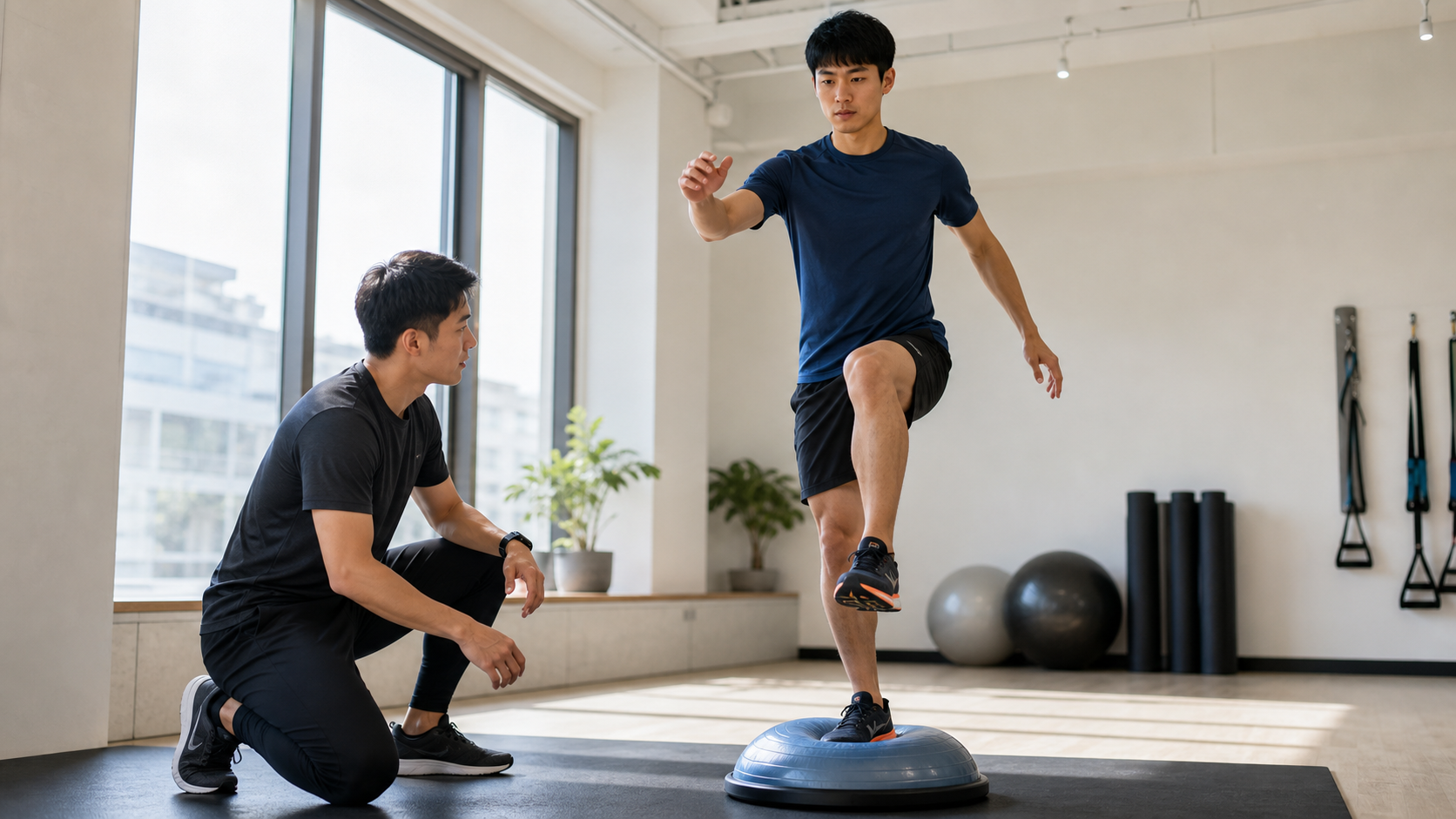
- Stand on a folded yoga mat, balance board, or the flat side of a BOSU ball (dome side up)
- Goal: Maintain a stable stance for 20–30 seconds
- Unstable surfaces recruit more fine stabilizer muscles, further enhancing proprioceptive efficiency
Stage 4: Single-Leg Balance with Dynamic Tasks
- Perform arm movements (such as a throwing motion) or eye-tracking tasks while standing on one leg
- Simulates the multitasking demands of running
| Training Stage | Difficulty | Eyes | Standing Surface | Target Time |
|---|---|---|---|---|
| Stage 1 | Beginner | Open | Flat ground | 30–60 seconds |
| Stage 2 | Novice | Closed | Flat ground | 15–30 seconds |
| Stage 3 | Intermediate | Open | Unstable surface | 20–30 seconds |
| Stage 4 | Advanced | Open/Closed | Unstable surface + task | 15–20 seconds |
The Scientific Basis and Application of Bosu Ball Training
The Bosu ball (Balance Trainer) is a hemispherical unstable training device; with the dome side up or down, it provides varying degrees of instability. For runners, the main benefits of Bosu ball training are:
- Increased ankle proprioceptive input: The unstable surface forces continuous fine adjustments at the ankle joint, strengthening sensorimotor integration
- Activation of deep stabilizer muscles: Deep core muscles, the soleus, and the tibialis anterior are forced to remain engaged
- Psychological uncertainty training: Simulates the neural adaptation of stepping on uneven ground during actual road running
Bosu Ball Exercises for Runners (dome side up):
- Bosu Single-Leg Stance: Same as Stage 3 training above, 3 × 20 seconds per side
- Bosu Squat: Stand on the Bosu ball platform with both feet and perform squats, training both lower-body strength and balance, 3 × 10 reps
- Bosu Lunge: Place the front foot on the Bosu ball and perform lunges, highly targeted at stability control during landing, 3 × 8 reps (per side)
- Box Jump to Bosu: Jump from the ground onto the Bosu ball, training rapid stabilization upon landing—advanced version
- Bosu Lateral Step: Quickly step on and off the Bosu ball side to side with both feet, training lateral stability reaction speed
Important Notes:
Bosu ball training is not about making it as hard as possible. Research shows that over-reliance on unstable surface training (such as performing all strength work on unstable surfaces) can actually reduce maximal force output. It is recommended that Bosu ball training account for 20–30% of total lower-body training volume, with strength training on stable surfaces remaining the primary means of building strength.
The Transfer Benefits of Balance Training to Running
Scientific Research Support:
Multiple studies show that 4–6 weeks of proprioceptive training can significantly reduce the recurrence rate of ankle sprains (by approximately 30–40%) and improve dynamic stability indices in running. For runners with a history of ankle sprains, proprioceptive training is an essential component of the rehabilitation program.
Balance Training Opportunities in Daily Life:
Balance training does not necessarily require extra training time. Here are practice opportunities that can be incorporated into daily routines:
- Perform single-leg stance while brushing your teeth (2 minutes per session, twice a day)
- Perform eyes-closed single-leg stance while waiting for the bus or MRT
- Stand on one leg while putting on the other shoe
Practical Recommendations
- Weekly frequency: Balance training can be done daily (such as single-leg practice while brushing teeth), while formal training sessions 2–3 times per week are sufficient
- Runners with a history of sprains: Proprioceptive training after an ankle sprain should only begin once there is no pain and joint swelling has subsided, restarting from Stage 1
- Ultra-trail race preparation: Intensify Bosu ball and unstable surface training 6–8 weeks before the race to simulate the variability of trail landings
- Assessing your starting point: Use the single-leg stance test (30 seconds eyes open, 15 seconds eyes closed) to assess your baseline level and track training progress
Conclusion
Balance training is the most undervalued tool in a runner’s injury-prevention toolbox. Just 5–10 minutes of daily single-leg stance practice, combined with 2–3 weekly sessions of Bosu ball or unstable surface training, can significantly improve ankle stability, reduce the risk of sprains, and make you more confident and safer when running on all types of terrain. Investing in balance training is a smart decision for a longer-lasting running career.
Related Reading
- Runner’s Balance Training: Progressing from Single-Leg Stance to Dynamic Balance
- Basketball Single-Leg Stability and Proprioception: No More Rolling Ankles, No More Crooked Jump Shots
- Road Running Special Feature | From Knee Pain to Stability: A Jogging Rehabilitation Guide (R049)
- Athlete Balance and Fall Prevention: A Practical Guide from Single-Leg Stance Assessment to Fall Prevention in Older Adults
[教學] Premiere 影片 手震 修正 教學 防抖 單眼 影像 GoPro 穩定 Video Stabilization
8 年前
西進武嶺 免費訓練分析服務 Intervals | 練不夠還是練過頭?你哪一種類型選手?AI模型告訴你! | 備戰神器 | 公路車 訓練 | CT Yeh
4 年前
彰化 139縣道 單車 穩定測試
10 年前
沉浸室內單車練功房開箱! 100吋大畫面,最便宜的花費? 居然還能K歌!? | 公路車 | CT Yeh
3 年前
白沙屯媽祖進香在家走!UREVO 坡度自調走步機 / 可連接訓練遊戲APP MyWhoosh / 邊看直播邊走起來 / CT Yeh
11 個月前
#公路車 #Fitting 靠人工智慧APP 幫你調整單車
6 年前
實景訓練台) 彰化經典百K 高強度喵團 90分鐘 跟著一起練功 2019 Indoor workout Changhua Classic 100 Taiwan
7 年前
元宇宙單車運動!智騎 X7 Pro 智能訓練台 ThinkRider 居家線上練功
5 年前