Introduction
You run a lot, train hard, yet suffer from recurring injuries—this is a common predicament for many dedicated runners in Taiwan. Injuries often don’t stem from a single instance of overtraining, but rather from the long-term accumulation of underlying movement deficiencies. How can these issues be identified before injuries occur? The Functional Movement Screen (FMS) offers a scientifically grounded assessment tool.
Developed by American physical therapists Gray Cook and Lee Burton in the 1990s, FMS uses 7 movement tests to evaluate the quality of an individual’s fundamental movement patterns, identifying left-right asymmetries and movement limitations to predict injury risk. Multiple studies have validated FMS’s predictive validity in professional athletes—athletes with an FMS total score below 14 or with any movement asymmetry (bilateral score difference ≥ 1 point) show significantly higher injury rates.
For Taiwanese runners, FMS assessment is more than just injury prediction; it provides a structured framework for physical evaluation, helping you understand your movement weaknesses and develop more effective supplementary training plans.
The 7 FMS Movement Tests
Each movement is scored 0–3: 3 = performed perfectly, 2 = completed but with compensatory movements, 1 = unable to complete, 0 = pain during the test (requires medical consultation first).
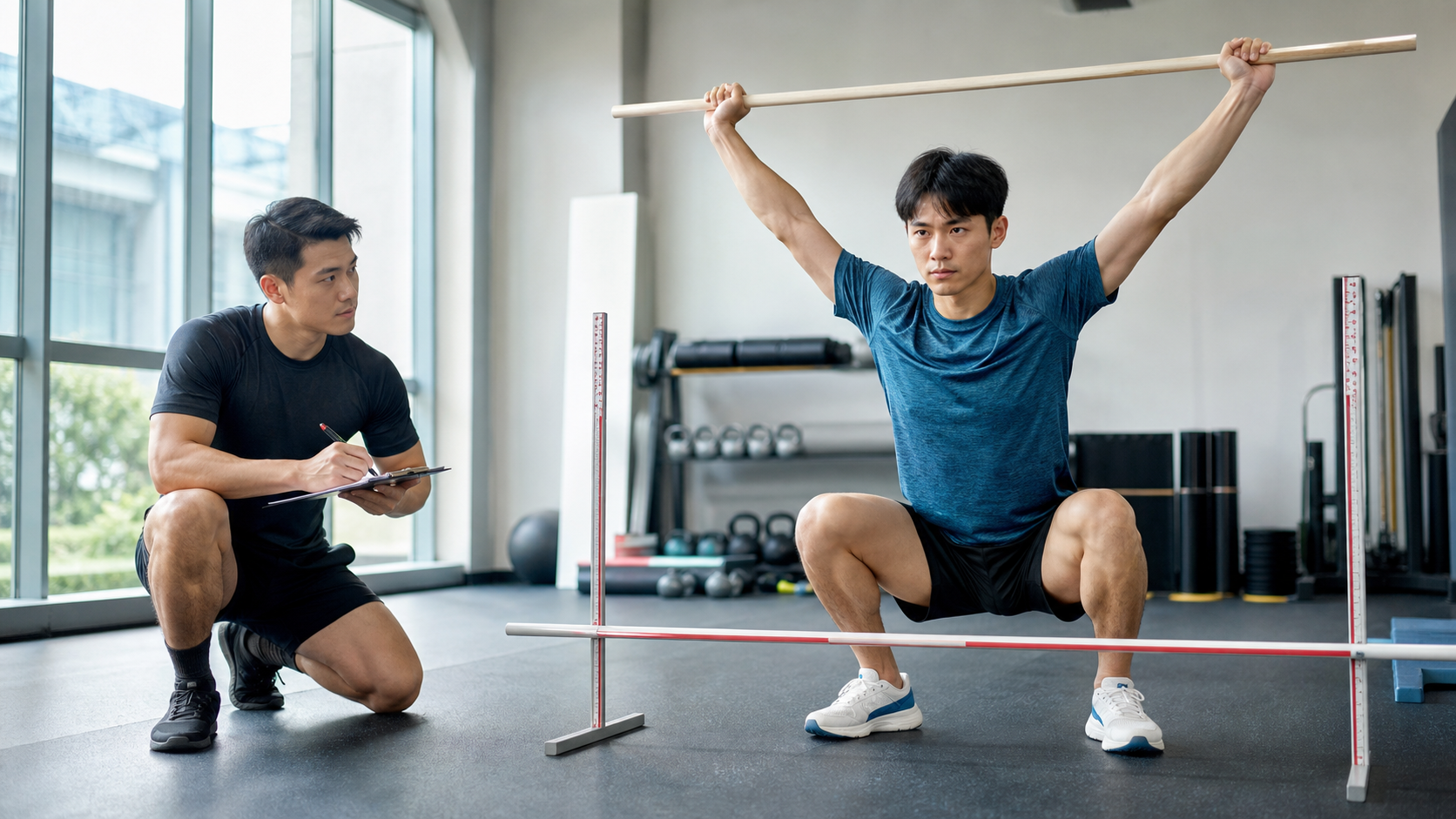
1. Deep Squat
- Feet shoulder-width apart, holding a dowel overhead, perform a full squat
- Assesses: whole-body mobility and stability coordination
- Common runner issues: insufficient ankle dorsiflexion (unable to squat below parallel), indicating tight calves; arms leaning forward, indicating insufficient thoracic spine mobility
2. Hurdle Step
- Set a “hurdle” with a cord at tibial tuberosity height, stand on one leg, step the other leg over the hurdle
- Assesses: single-leg stance stability, hip dissociation (ability to flex one hip while extending the other)
- Highly relevant for runners: simulates the running gait; common issues include ankle instability in the stance leg or weak hip flexors in the moving leg
3. In-Line Lunge
- Stand with feet front and back along a straight line, perform a lunge
- Assesses: sagittal plane stability and mobility, hip flexibility
- Common runner issues: torso leaning to the side, indicating weak gluteus medius; knee collapsing inward, indicating insufficient quadriceps control over the femur
4. Shoulder Mobility
- One hand reaches down from overhead, the other reaches up from behind the back; measure the distance between the two fists
- Assesses: thoracic spine rotation and shoulder joint mobility
- Runner application: insufficient shoulder mobility affects arm swing efficiency and consequently limits chest expansion during running
5. Active Straight Leg Raise
- Lying supine, actively raise one leg to its maximum angle while keeping the other leg flat on the ground
- Assesses: hamstring flexibility and pelvic stability
- One of the most relevant tests for runners: tight hamstrings are the most common flexibility issue among Taiwanese runners, limiting stride length and increasing lower back strain
6. Trunk Stability Push-Up
- Men place hands at shoulder height, women at chest height, then perform a push-up
- Assesses: spinal stability under symmetrical sagittal plane loading
- Lower back sagging scores 1 (unstable); inability to complete scores 0
7. Rotary Stability
- Four-point kneeling position, perform diagonal (same-side arm and leg) or unilateral extension while maintaining trunk stability
- Assesses: neuromuscular coordination and core rotational control during multi-planar movements
- Highly running-related: running is inherently a rotational movement; this test directly assesses the rotational stability required for running
| FMS Test | Most Common Runner Score | Impact on Running | Improvement Focus |
|---|---|---|---|
| Deep Squat | 2 | Squat quality affects downhill running | Ankle dorsiflexion exercises |
| Hurdle Step | 2 | Gait asymmetry | Single-leg balance training |
| In-Line Lunge | 2 | Knee instability | Gluteus medius strengthening |
| Active Straight Leg Raise | 1–2 | Restricted stride length | Hamstring stretching |
| Rotary Stability | 1–2 | Excessive trunk rotation | Core anti-rotation training |
Training Correction Strategies After FMS Assessment
Start by improving the lowest-scoring movements (Principle: correct first, then strengthen):
- If the Deep Squat scores 1: first address ankle dorsiflexion limitations (calf stretching, foam rolling), then proceed with squat training
- If there is any movement asymmetry (one side scores 2, the other side scores 1): prioritize training the weaker side to achieve bilateral symmetry
- Do not add load to movements with low FMS scores: before movement quality improves, adding weight only reinforces faulty movement patterns
An 8-Week FMS Improvement Plan for Runners:
- Weeks 1–2: Stretching and release for restricted movements (fascial release, static stretching)
- Weeks 3–4: Incorporate corrective exercises (unloaded movement pattern establishment)
- Weeks 5–6: Gradually add functional movement training (light loading)
- Weeks 7–8: Re-assess FMS, confirm improvements, and integrate into regular training
Practical Recommendations
- Best timing for FMS assessment: before the season begins, before increasing mileage, or when returning to running after injury recovery
- Limitations of self-assessment: FMS is best administered by a trained assessor; many physical therapists and athletic trainers in Taiwan offer this service; self-assessment carries inherent subjective bias
- Don’t overinterpret scores: FMS is a screening tool, not a diagnostic tool. A low score doesn’t mean you will get injured, but rather indicates a risk factor worth attention
- Re-assess every 8–12 weeks: track improvement progress and confirm that corrective training is effective
- Resources in Taiwan: sports medicine clinics at major hospitals, athletic trainer associations, and professional running training centers all offer FMS-related services
Conclusion
FMS Functional Movement Screening provides runners with a systematic framework for understanding their body’s limitations. Through the assessment of 7 fundamental movements, you can identify the weaknesses most worth investing in within your training plan and correct them in the most efficient way, reducing injury risk and enhancing running performance. An annual FMS assessment, combined with a targeted corrective training plan, is a wise investment for dedicated Taiwanese runners seeking a long-term, healthy running career.
Related Reading
- Application of Functional Movement Screening (FMS) in Road Running Training
- Application of Functional Movement Training (FMS) in Cycling
- Multifactorial Pathomechanics and Conservative Treatment Research on Runner’s Knee (Patellofemoral Pain Syndrome, PFPS)
- Running Gait Analysis: A Self-Analysis Method Using Your Phone to Film Your Running Form
西進武嶺 免費訓練分析服務 Intervals | 練不夠還是練過頭?你哪一種類型選手?AI模型告訴你! | 備戰神器 | 公路車 訓練 | CT Yeh
4 年前
#公路車 #Fitting 靠人工智慧APP 幫你調整單車
6 年前
西進武嶺配速器 3.0更新 / NEW 免功率FTP估算! / 大數據xAI體能模型 / 如何模擬人止關前集團效應 / 配速儲存功能 / AI全台自行車賽事行事曆 / 公路車 / CT Yeh
1 年前
2018 田中馬拉松 全程健跑 VR 360 環景錄影 體驗現場狂野加油氣氛! Insta 360
7 年前
實景訓練台) 彰化經典百K 高強度喵團 90分鐘 跟著一起練功 2019 Indoor workout Changhua Classic 100 Taiwan
7 年前
Fitting訓練兩用功率車 ! Thinkrider ST900 完整實測!/ 坡度升降 / 鄰居測試/ smart bike/公路車/ CT Yeh
2 年前
DJI Osmo Action 5 Pro 首發最強!單車運動攝影機! 一顆電池錄完KOM 西進武嶺? / 超狂夜拍效果 / 4奈米AI晶片/ 一鍵數據合成 / 公路車 / CT Yeh
1 年前
Never Stop 西進武嶺 前後雙機 完整全程錄影 訓練台 實境
8 年前