Introduction
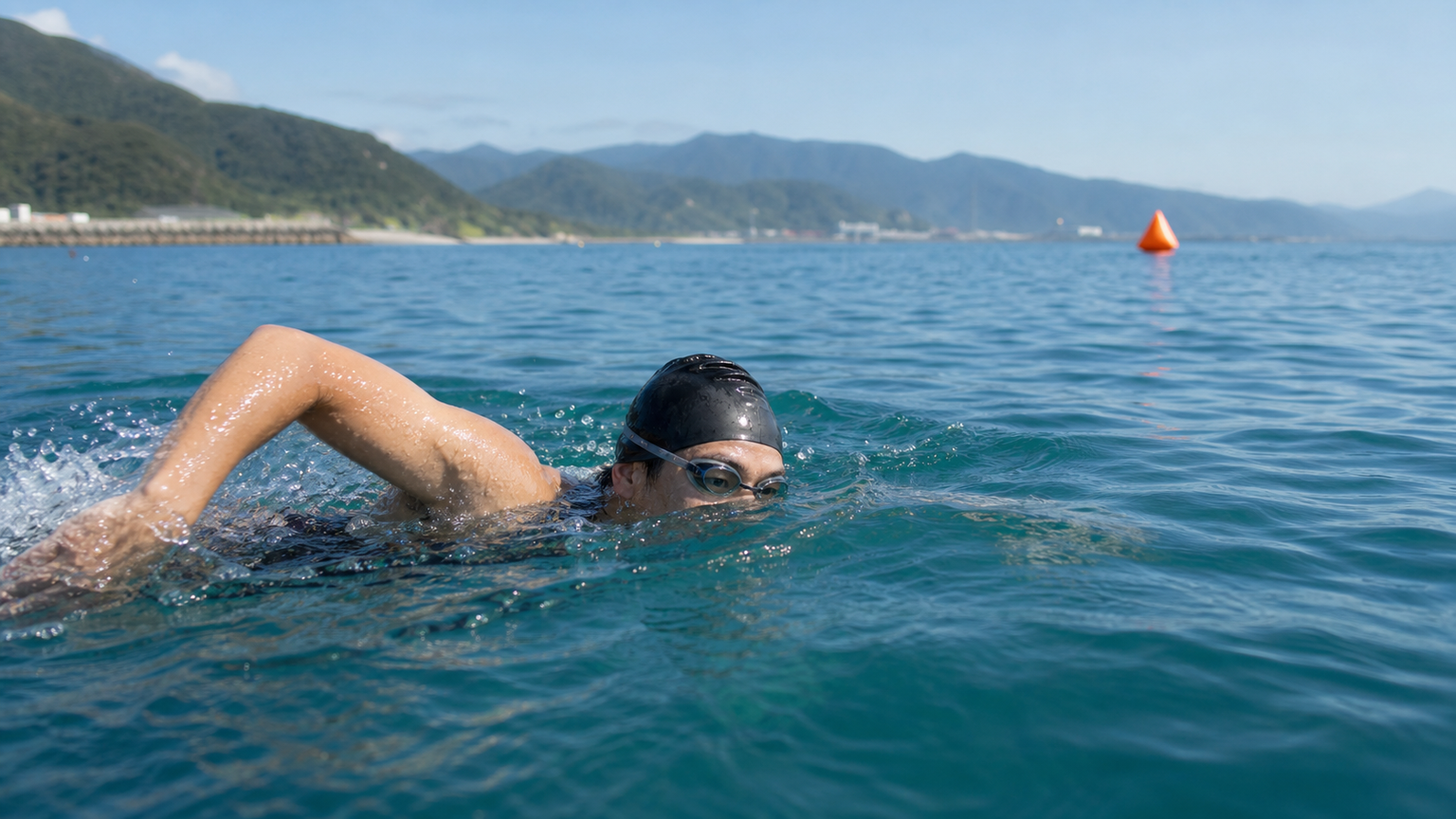
In a pool, black lines and walls let us get used to sensing direction with our eyes closed. But once you step into open water—whether it’s the blue coral reef waters of Penghu, South Bay in Kenting, or Longdong Bay on the Northeast Coast—all you see is an endless expanse of water and faintly visible marker buoys in the distance. Many athletes discover during their first open-water race that they’ve swum 15–20% farther than necessary, all because of poor navigation.
This article takes you from the fundamental principles to practical race-day techniques, giving you a systematic grasp of open-water navigation.
Why Swimming in a Straight Line Is Harder Than You Think
The strength in your left and right arms naturally differs slightly, and with the added interference of currents and waves, most people unconsciously drift toward their dominant-hand side in an environment without reference points. Studies show that swimmers with their eyes closed can deviate by more than 10 degrees within just 25 meters. Translated to a 1500-meter triathlon distance, that easily adds over 200 meters of wasted distance.
Sources of deviation:
- Asymmetric arm stroke: The dominant hand enters the water at a slightly different angle or pulls with slightly more force
- Breathing habits: Unilateral breathing causes slight body rotation
- Currents and waves: Lateral currents continuously push the body off course
- Mental tension: An overly tense head position disrupts balance
The Crocodile Eye (Sighting) Technique Explained
“Sighting” is the most essential navigation skill in open water, commonly called the “crocodile eye”—briefly lifting your head to check direction without interrupting your swimming rhythm.
Standard Movement Sequence
- Timing of the lift: As the stroking arm is about to extend forward into the water, smoothly raise your head so your eyes just break the surface
- Eye height: Only your eyes need to be 2–3 cm above the water—no need to lift until your chin clears the surface
- Quick scan: Lock onto your target (buoy, bridge pier, building on shore) within 0.5–1 second
- Immediately return: Put your head back in the water and breathe at the same time (either side breathing or forward breathing works)
- Rhythm continuity: Don’t pause; continue into the next stroke cycle
Target Selection Priority
| Priority | Target Type | Best Used When | Notes |
|---|---|---|---|
| 1 | Race marker buoys | Visibility is good | Buoys may be blocked from view |
| 2 | Tall buildings/mountains on shore | Long-distance segments | More stable and easier to identify |
| 3 | Swimmer’s back ahead of you | Drafting tactics | They may also drift off course |
| 4 | Direction of the sun | Emergency situations | High margin of error; use with caution |
Race-Day Frequency and Energy Balance
Lifting your head has a cost: every sighting causes your hips to sink briefly, increasing drag and consuming 3–5% extra energy. Therefore, sighting frequency should be adjusted based on the race phase:
- First 200 meters after the start: Sight every 6–8 strokes; the crowd is dense and direction is most unstable
- Middle straightaway: Sight every 10–14 strokes (about every 20–30 seconds); extend the interval when water conditions are stable
- Approaching a turn buoy: Shorten to every 6 strokes to ensure precise rounding
- When visibility is obstructed (sun glare, big waves): Shorten to every 4–6 strokes
Practical Advice for Taiwan Race Venues
Penghu Fireworks Festival Triathlon: The start faces west, and the sun angle is low during early-morning races. Wear tinted goggles (amber or gray), and familiarize yourself with the buoy colors and the lighthouse position on shore beforehand.
Kenting South Bay: In summer, the northeast monsoon is weaker and the water is relatively calm, so you can reduce sighting frequency; however, watch out for underwater currents—correct your line immediately if you feel yourself drifting.
Longdong/Fulong on the Northeast Coast: Wave conditions are complex. Choose fixed landmarks on shore (such as a distant ridgeline) as auxiliary targets to reduce visual interference from wave crests.
Training Methods: Bridging from Pool to Open Water
- Eyes-closed swimming drill: In the pool, swim half a length (12.5 meters) with your eyes closed to feel your drift direction and make targeted corrections
- Bilateral breathing training: Alternate breathing every 3 or every 5 strokes to balance left and right arm power
- Ball-on-head drill: Place a tennis ball on your head and swim 200 meters, forcing you to minimize your head-lift angle
- Open-water simulation: Practice sighting while swimming circles along the outer edge of a pool without lane lines
Conclusion
Navigation is the invisible source of speed in open-water swimming. A clean, low-energy sighting can save 30–60 seconds of lost time in a 1500-meter race. Starting today, incorporate deliberate sighting practice into every training session, and make your sense of direction the most reliable weapon you have in open water.
Related Reading
- Open-Water Navigation: Lifting Your Head to Breathe and Target Positioning
- Open-Water Straight-Line Navigation Sighting: Head-Lift Frequency and Minimum-Energy Techniques
- Open-Water Visual Navigation: Rhythm Training with a Head Lift Every 6–8 Strokes
- Open-Water Positioning Navigation: Visual Correction and Energy-Saving Strategies for Swimming Straight
CT 喇低賽) 武嶺牽車 才是王道 西進牽車四小時內秘訣 攝手位置 如何判斷 防抽筋小秘訣
7 年前
備戰 戀戀197 賽前關門點分析 西濱團練 #公路車 4K高畫質
6 年前
西進武嶺 自製新版AI配速表產生器 x 賽前攻略 抱佛腳! 沒有功率計也可以產生配速表嗎?有什麼其他眉角賽前要注意的呢? | 西進武嶺 / 東進武嶺 KOM 攻略 | 公路車 | CT Yeh
4 年前
一起升級!海鷗盃LSD團練...JJSC Zone2招待 騎到手抖 / 公路車 / CT Yeh
2 天前
戰略) Zwift Race 如何咬在第一集團 如何評估自己要開多少推力 (請開1.5倍速看)
7 年前
2023桃園團體繞圈賽 / 海鷗繞圈賽 | 全程空拍數據版 | 公路車 | CT Yeh
2 年前
2025 海鷗團體繞圈賽 網路直播 超激烈裁判長視角 / EIPC 李廷威、Waypoint 等眾多高手競爭 / feat. 卡密兒主持 / 海鷗繞圈賽
9 個月前
FTL 與 SYB 車隊專訪 西進武嶺 實用攻略分享! 2小時 如何練?!你不知道的眉角!新手準備武嶺必看 EP1 | 實力派女車友 | 精華版 | 公路車 | CTYeh
4 年前