Introduction
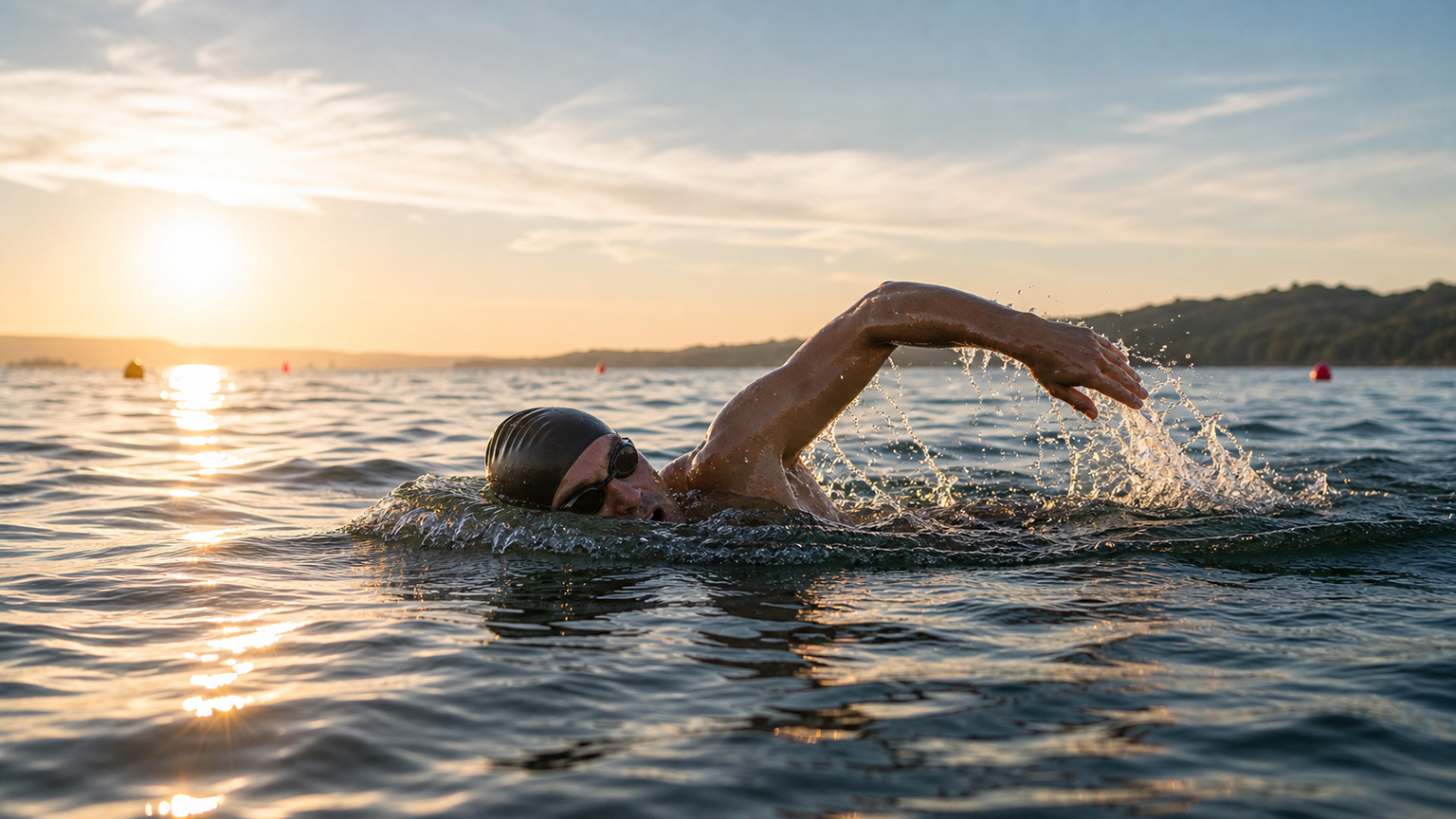
In a pool, every 25 or 50 meters, the wall provides feedback, and with a stopwatch for timing, pace management is relatively straightforward. But in open water, there are no external reference points: no walls, no lane lines, and buoys can be 500 meters apart. Add in the interference of currents and waves—how do you maintain a steady pace?
This is one of the biggest challenges for swimmers transitioning from the pool to open water. This article provides a pacing framework for open water built around stroke rate.
Why Pacing Goes Wrong in Open Water
- Starting adrenaline: The mass start pushes heart rate and stroke rate unintentionally high
- No visual reference: Without walls and lane lines, “feel” becomes unreliable
- External interference: Currents and wave conditions cause speed fluctuations, making it hard to perceive true pace
- Drafting effect: Swimming at someone else’s pace can pull you away from your optimal speed
- Psychological pressure: Race conditions cause muscle tension, reducing efficiency
A Pacing System Built on Stroke Rate
Since you can’t get real-time speed feedback in open water, stroke rate (cycles per minute) is the most reliable proxy indicator for pacing.
Establishing Your Personal Stroke Rate Baseline
During pool training, record the relationship between stroke rate and pace at different intensities:
| Intensity Zone | Stroke Rate (cycles/min) | Expected Feel | Best Use |
|---|---|---|---|
| Easy aerobic | 50–58 | Can speak full sentences | Warm-up, recovery segments |
| Target race pace | 60–68 | Can speak short phrases, steady breathing | Main race segments |
| Threshold intensity | 70–76 | Can only say single words | Final surge |
| Maximum sprint | 78+ | Unable to speak | First 200m of the start |
Individual variation is significant—the numbers above are for reference only. We recommend a “stroke rate calibration session” in the pool: swim 400 meters at your target pace and record your natural stroke rate using a metronome or heart-rate watch. That number is your “cruising stroke rate.”
The Golden Ratio of Energy Distribution in Open Water
Negative Split
Research consistently shows that a negative split—starting slower and finishing faster—is the optimal strategy for long-distance swimming:
- First half: 95–98% of target pace (slightly slower)
- Second half: 100–105% of target pace (slightly faster)
Many amateur athletes start too fast, accumulate heavy lactate buildup in the middle of the race, and slow down dramatically in the second half—resulting in a slower overall time than a steady-pace approach.
Pacing Points for Each Segment
Start to 200 meters: A slightly higher stroke rate is acceptable to establish position, but your breathing should not feel “gasping for air”
200–500 meters: Actively drop to cruising stroke rate—this is the hardest step for many, requiring you to deliberately slow down under competitive pressure
Middle segment (500m to final 300m): Maintain cruising stroke rate, performing a “body scan” every 5 minutes
Final 300–500 meters: Assess remaining energy; if you have reserves, gradually increase stroke rate for the finish
The Body Scan Technique
At regular intervals during the swim, perform a quick “body scan” to assess your energy state:
- Breathing feel: Is it still relatively smooth? Can you take a full breath during each breath?
- Arm feel: Is fatigue accumulating? Do you have power behind your catch?
- Leg status: Are your legs kicking forcefully, or have they shifted to semi-automatic assistance?
- Overall tension: Is your neck and shoulder area overly tight? (Tension = wasted energy)
Based on the scan results, fine-tune your stroke rate or actively relax your neck and shoulders on the next breath.
The Energy-Saving Effect of Drafting
Drafting is a legal and effective energy-saving strategy in open-water swimming, with research showing it can reduce oxygen consumption by approximately 20–25%:
- Best drafting position: Diagonally behind the swimmer ahead (to their left or right rear), not directly behind them
- The problem with directly behind: You get kicked in the face by their kick wash, and the drafting effect is actually worse
- 45-degree diagonal behind: You’re carried by the pressure wave of the swimmer ahead’s “wake,” with the least drag
You still need to navigate on your own while drafting—avoid relying entirely on the swimmer ahead (they may be drifting off course too).
Training Methods
- Metronome swimming: Use an underwater metronome (such as the FINIS Tempo Trainer) to lock in your target stroke rate for 1000–2000 meters
- Even-pace awareness training: Swim 10×100 meters in the pool, with each repeat within 2 seconds of the target, to develop pace sense
- Open-water pace testing: Wear a GPS watch during training and compare subjective feel against actual speed
- Simulated start surge then settle: Sprint the first 50 meters, then deliberately drop back to your target stroke rate to practice “active deceleration”
Conclusion
Pacing ability in open water is, at its core, a deep awareness of your own body. By establishing a personal stroke rate baseline, practicing negative-split strategy, and making good use of drafting, you can precisely control every ounce of energy in an environment with no external aids. This ability is the core difference between those who merely finish and those who compete.
Related Reading
- Reading Your Pace in Open Water: How to Feel Your Speed Without Lane Lines
- Open-Water Pacing Strategy: How to Smartly Allocate Every Kilocalorie of Energy
- Swimming Pace-Sense Training: How to Judge Your Pace Without Looking at the Clock
- Open-Water Pacing and Psychology: How Not to Fall Apart in Water Where You Can’t See the Finish
西進武嶺 自製新版AI配速表產生器 x 賽前攻略 抱佛腳! 沒有功率計也可以產生配速表嗎?有什麼其他眉角賽前要注意的呢? | 西進武嶺 / 東進武嶺 KOM 攻略 | 公路車 | CT Yeh
4 年前
西進武嶺 免費訓練分析服務 Intervals | 練不夠還是練過頭?你哪一種類型選手?AI模型告訴你! | 備戰神器 | 公路車 訓練 | CT Yeh
4 年前
#公路車 #西進武嶺 配速配瓦實驗 坡度分析 四小時內攻略 建大盃 NeverStop #西進武嶺攻略
6 年前
西進武嶺配速器 3.0更新 / NEW 免功率FTP估算! / 大數據xAI體能模型 / 如何模擬人止關前集團效應 / 配速儲存功能 / AI全台自行車賽事行事曆 / 公路車 / CT Yeh
1 年前
西進武嶺各路段 前8000名 大數據分析 配速攻略/功率/心律/推力比/維持率/踏頻/踏瓦比/牽車率 大公開 | 建大盃 NeverStop 可參考 | 公路車 | CT Yeh
5 年前
武嶺配速表最佳使用方式 #bike
1 年前
備戰 戀戀197 賽前關門點分析 西濱團練 #公路車 4K高畫質
6 年前
單車AI教練!全新 ChatGPT4o 幫你分析訓練成果!排武嶺課表,分析騎車姿勢! 太神了! / 公路車 / CT Yeh / feat. 緯緯
2 年前