Introduction
The magic of triathlon lies not just in the sum of three sports, but in the overall race that includes two transition zones. T1 (swim→bike transition) and T2 (bike→run transition) together often account for 3–8% of total race time among age-group athletes. For athletes finishing a half-distance race (1.9 km swim) in 5–6 hours, refined transition technique can save 2–5 minutes, equivalent to a 5W power output improvement.
This article focuses on the complete T1 optimization process, from exiting the water to leaving the transition area on the bike.
T1 Time Composition Analysis
| Segment | Typical Age-Group Time | Elite Athlete Time | Room for Improvement |
|---|---|---|---|
| Run from water to transition area | 1:00–2:00 | 0:45–1:15 | Leg strength and route |
| Removing wetsuit | 0:45–2:00 | 0:20–0:40 | Highly technical |
| Removing swim cap and goggles | 0:10–0:20 | 0:05–0:10 | Simplified movements |
| Putting on cycling shoes | 0:20–0:45 | 0:10–0:20 | Pre-setup |
| Putting on helmet and glasses | 0:15–0:30 | 0:10–0:15 | Practiced sequence |
| Leaving transition area with bike | 0:10–0:20 | 0:05–0:10 | Route familiarity |
Wetsuit Removal Technique
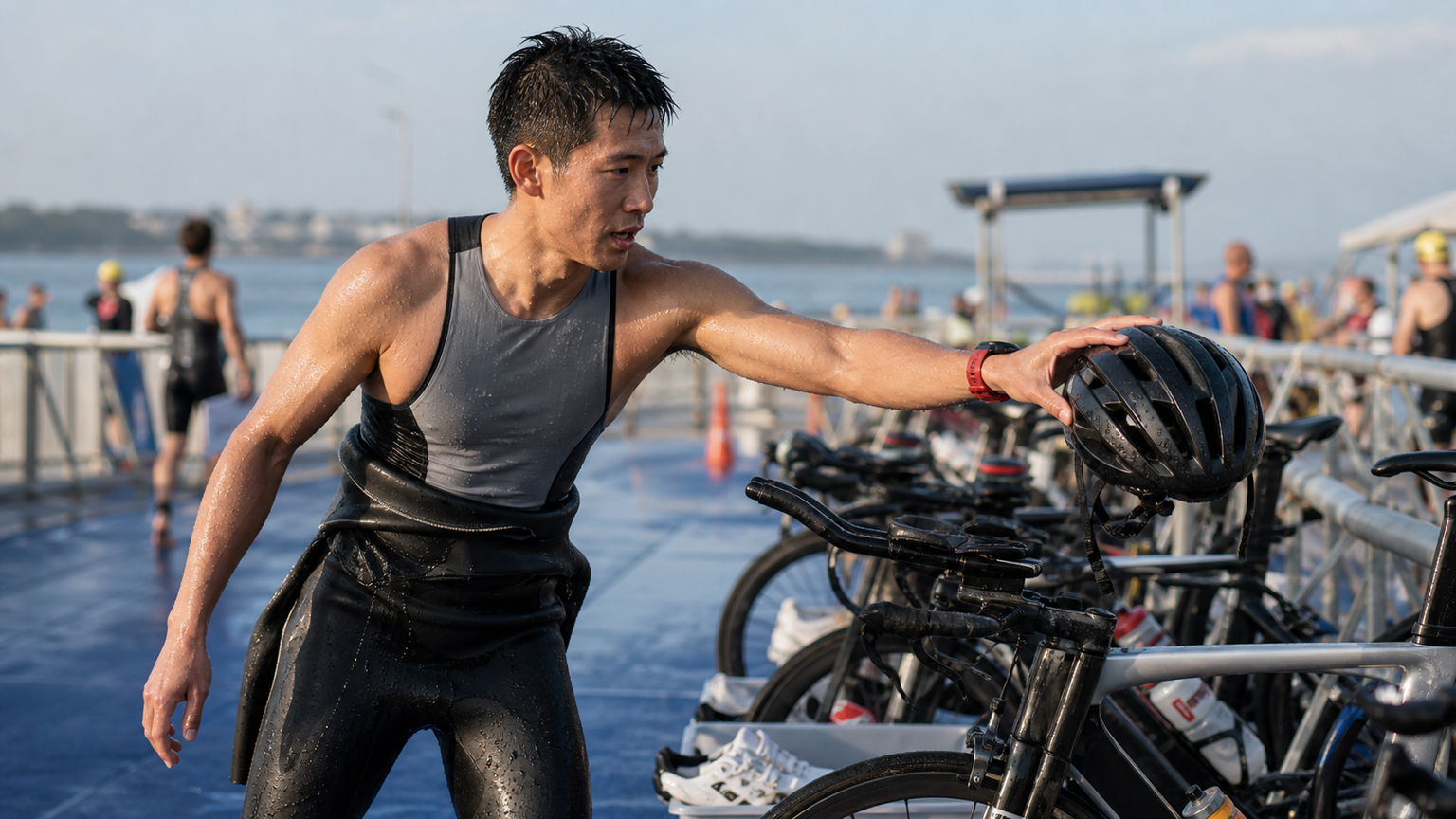
Wetsuit removal is the most technical segment in T1 and where the biggest time differences occur.
Four Steps to Fast Wetsuit Removal
- Prepare before exiting the water: In the final 50–100 meters of the swim, begin unzipping the wetsuit’s back zipper (or have a lifeguard assist), loosening the suit first
- Remove upper body upon exit: The moment you stand up, reach both hands back to grab the collar, flip it forward to free both shoulders and arms
- Continue removing while running: On the way to the transition area, keep pushing the wetsuit down from the waist, stripping it off while running
- Squat and kick off: When it reaches the ankles, squat down in one step, step on the suit and kick it off, then repeat on the other side
T1 Optimization Preparation When Wearing a Wetsuit
- Apply petroleum jelly or silicone lubricant around the ankles to significantly reduce removal resistance
- Test and confirm the fit of your race wetsuit (an overly tight wetsuit doubles removal time)
- Female athletes should pay attention to the fit around the shoulder area
Golden Principles of Transition Area Setup
Setup Order (From Outside In)
Bike → Helmet (opening facing up, placed on the saddle)
         ↓
      Cycling glasses (placed inside the helmet)
         ↓
   Cycling shoes (if starting on the ground, opening facing outward)
         ↓
     Nutrition (already opened, inserted in the bottle cage)
Key Setup Details
- Pre-buckle the helmet strap to its maximum: Don’t leave yourself fumbling with adjustments in the heat of the moment
- Elastic laces on cycling shoes: Replace regular laces with elastic ones to skip tying (saves 15–20 seconds)
- Pre-attach the race number belt to the top tube: Avoid searching for the number belt in the chaos
- Do a trial run in the water first: Walk through the transition area before the race to memorize your spot
T1 Movement Sequence Optimization
The reason many age-group athletes are slow in T1 isn’t that each movement is slow, but that the sequence of movements is wrong. Here is the recommended optimal sequence:
- Exit the water, unzip (or have it pre-unzipped)
- Run toward the transition area, removing the upper-body wetsuit on the way
- Arrive at the bike, remove the wetsuit from the legs at this point
- Remove the swim cap (can keep it on or take it off in one motion), remove goggles and hang them on the wrist
- Put on the helmet (priority! The bike cannot be moved without the helmet on)
- Put on cycling shoes
- Put on glasses
- Take the bike and push it to the mount line at the exit
Key sequence principle: The helmet must always go on before the cycling shoes—never the reverse.
Running from Water to Transition Area
Many athletes neglect developing their ability to run after exiting the water. After a long swim, blood pools in the upper body, and the legs initially feel a brief “cotton leg” sensation.
- Practice “running immediately after swimming” in training to help your body adapt to this transition
- After pool training, immediately change into running shoes and jog 400 meters to feel and adapt to the transition sensation
- During pre-race warm-up, do a short jog to warm up the legs
Taiwan-Specific Applications
Penghu and Kenting summer heat: Body temperature rises rapidly during T1, making wetsuit use less likely; but if worn, high temperatures make the wetsuit harder to remove (due to sweat), so apply extra lubricant.
Northeast coast autumn/winter races: Cooler temperatures mean longer wetsuit wear time, making removal technique even more critical.
Beach-to-transition-area distance: Some Taiwan races (such as Fulong) feature longer runs from the water, requiring focus on ankle-level effort and practicing running on sand.
Conclusion
T1 is one of the highest-return-on-investment training items in triathlon. Spending 2–3 hours practicing transition movements can save 30–90 seconds in every race, with absolutely no need for greater fitness. Start practicing at home today: set up your transition area, repeat the T1 sequence 10 times, and turn it into muscle memory.
Related Reading
- Swim-to-Bike Transition (T1) Efficiency: Optimizing Seconds for Wetsuit Removal, Shoeing, and Mounting
- Mastering the Triathlon Transition Area: Techniques and Tactics for T1 and T2
- Triathlon Transition Training: Speed Drills for T1 (Swim→Bike) and T2 (Bike→Run)
- Triathlon Transition Strategy: How to Save Every Second in T1 and T2
西進武嶺 免費訓練分析服務 Intervals | 練不夠還是練過頭?你哪一種類型選手?AI模型告訴你! | 備戰神器 | 公路車 訓練 | CT Yeh
4 年前
2016 桐花飛舞 單車挑戰 精華片段
10 年前
2019 夏季KOM 5小 完賽心得 準備攻略 東進武嶺 夏季登山王之路 Taiwan KOM Challenge
7 年前
多到選擇障礙... 換個單車把帶想一個小時 / BTP / 編織&軟木特有材質超吸睛! / 公路車 / CT Yeh
1 年前
FTL 與 SYB 車隊專訪 西進武嶺 實用攻略分享! 2小時 如何練?!你不知道的眉角!新手準備武嶺必看 EP1 | 實力派女車友 | 精華版 | 公路車 | CTYeh
4 年前
Live) 備戰2019彰化經典百K 賽前攻略 (已完賽請看新影片
7 年前
靠單車減肥35公斤 心得分享與整理
7 年前
TIME 公路車 Alpe d'Huez 21 開箱實錄! 購車/Fitting/組車/心得 | 新車入艙 | 時間的主人 CT Yeh
3 年前