Introduction
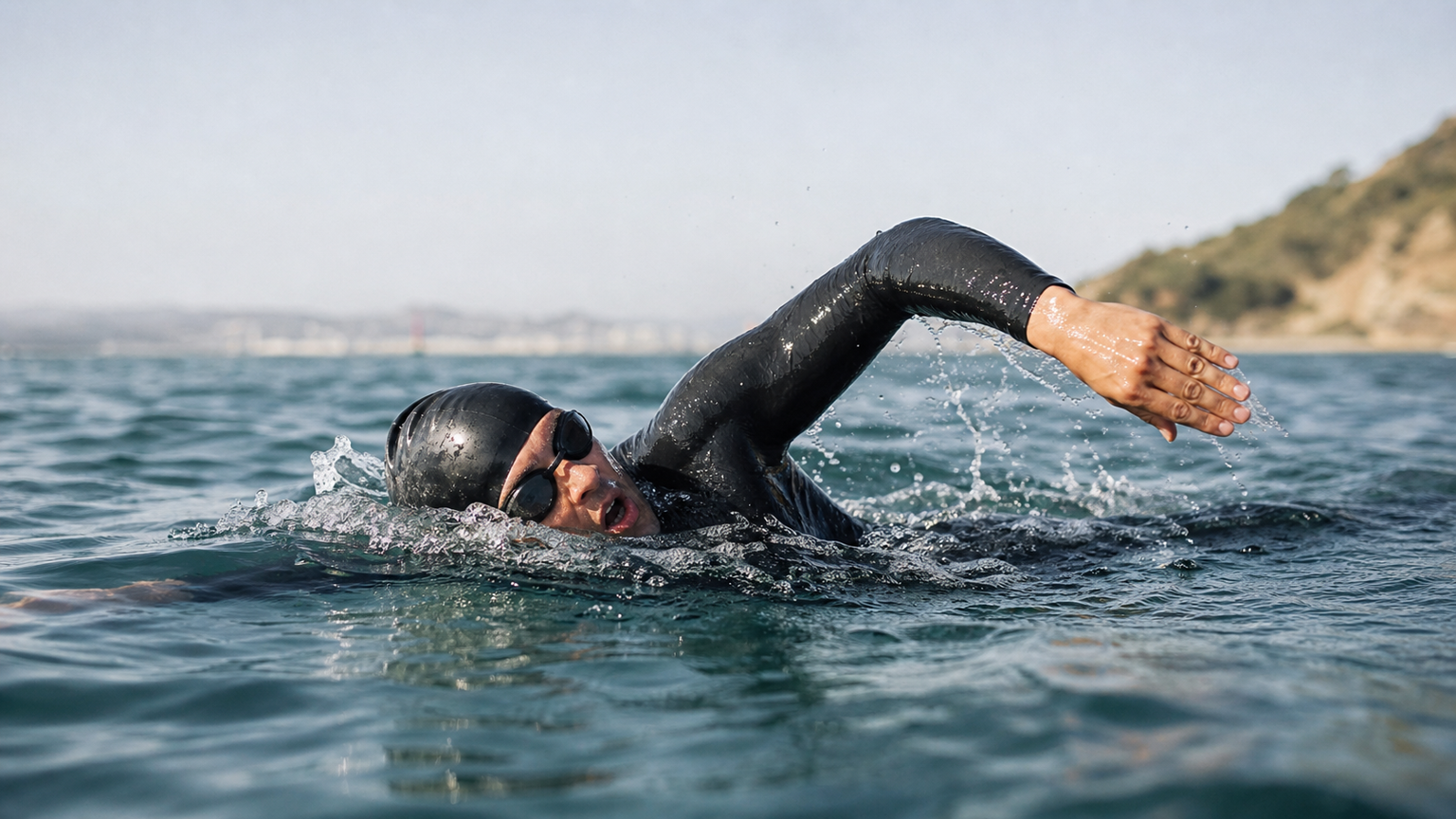
Breathing is the most fundamental survival need in swimming, and it is also the most easily overlooked technical detail. In a 1500-meter pool training session, breathing feels effortless; but in open water, facing the interference of waves, currents, and competitors, breathing technique instantly becomes a critical bottleneck for performance.
In long-distance open water swimming (1500 meters and above), the cumulative effect of breathing quality is highly significant: the slight difference in efficiency of each breath translates into a considerable energy gap after 1000–2000 breathing cycles.
Review of Basic Breathing Mechanics
Efficient freestyle breathing requires several coordinated actions:
- Body-roll breathing: The head follows the body’s natural rotation to break the surface, rather than lifting independently
- Minimal breathing height: Only the corner of the mouth needs to clear the water; no need to lift the head significantly
- Explosive exhalation: Exhale forcefully in the water (not slowly), freeing up space for the inhale
- Unconscious breathing: The breathing motion does not affect stroke efficiency (no pause, no deceleration)
The Logic of Choosing Unilateral vs. Bilateral Breathing
| Breathing Pattern | Strokes per Breath | Advantages | Disadvantages | Best Suited For |
|---|---|---|---|---|
| Unilateral (2-stroke) | Every 2 strokes | Ample oxygen supply, faster rhythm | Imbalance between left and right sides | High-intensity sprints, rough waves |
| Bilateral (3-stroke) | Every 3 strokes | Balances both sides, reduces drift | Slightly less oxygen supply | First choice for long-distance cruising |
| Bilateral (5-stroke) | Every 5 strokes | Energy-efficient, fewer breathing interruptions | Requires high aerobic capacity | Cruising for advanced swimmers |
| Mixed pattern | Alternating 3+5 | Flexible adaptation | Requires practice for coordination | Coping with complex wave conditions |
Recommendations for Long Distances
For open water swimming over 1500 meters, breathing every 3 strokes (bilateral) is the best choice for most swimmers, because:
- It balances strokes on both sides, reducing natural drift
- It provides ample oxygen supply, maintaining aerobic metabolic efficiency
- It offers an opportunity to survey the surroundings every 3 strokes (timing for sighting)
Breathing Adjustments in Wave Conditions
The biggest breathing challenge in open water is waves. Here are strategies for different wave conditions:
Waves Coming Head-On
- Sense the timing of the waves and breathe in the trough (the low point between waves)
- Temporarily increase stroke rate (switch to breathing every 2 strokes), then return to 3-stroke breathing after passing the wave
- Roll slightly toward the downstream side when breathing, allowing waves to pass over the shoulder rather than hitting the face
Waves from the Side
- Consistently breathe on the side away from the waves (blocking the waves behind the shoulder)
- If the wave direction is consistent during the race, unilateral breathing can be used for that period
- Breathing on the clean side (away from waves) yields better quality and avoids swallowing water
When Riding Swell
- Maintain posture and refrain from breathing during the moment the swell propels you forward, accumulating momentum
- Breathe during the gap between swells (when speed decreases) for optimal energy efficiency
The Psychological Stabilizing Effect of Breathing Rhythm
Research indicates that a regular breathing rhythm has a significant positive impact on psychological stability during exercise. The “3–2–3” rhythm (breathe every 3 strokes, twice in a row, then switch sides) can establish:
- Predictable breathing cycles: The brain knows “when the next breath will come,” reducing anxiety
- Diaphragmatic breathing guidance: A stable rhythm makes it easier to trigger full diaphragm breaths
- Attentional anchor: In open, empty water, the breathing rhythm becomes a cognitive anchor for staying calm
Maintaining Breathing Technique Under Long-Distance Fatigue
In the later stages of long-distance swimming, fatigue erodes breathing technique, leading to several common degradation patterns:
- Excessive head lift: Breathing becomes like “gasping with the head raised” rather than “rolling to breathe”
- Holding the breath too long: Forgetting to exhale early in the water, then rushing to exhale and inhale at the moment of breathing
- Interrupting the stroke to breathe: Pausing the stroke during breathing, causing speed fluctuations
Countermeasure: When fatigued, proactively reduce breathing frequency (switch to 5-stroke breathing) to restore technique quality, prioritizing this over maintaining speed. “Swimming slower with good technique” is more efficient than “swimming faster with collapsing breathing.”
Open Water Breathing Scenarios in Taiwan
Penghu in summer: Wave conditions are mild; primarily use bilateral 3-stroke breathing, temporarily switching to unilateral when passing boat wakes.
Northeast coast in autumn/winter: The swell direction brought by the northeast monsoon is regular; consistently breathe on the side away from the waves, and the rhythm actually becomes stable once adapted.
Kenting’s South Bay: The water surface is relatively calm, making it an excellent venue for practicing 5-stroke breathing.
Training Recommendations
- Exhalation training: For the first 200 meters of every swim session, practice only “fully exhaling in the water” to confirm the breathing foundation
- Fixed breathing rhythm sets: Set 3×400 meters, strictly executing 3-stroke breathing without changing it due to fatigue
- Wave simulation: Have a partner splash water at the poolside to practice breathing adjustments when a wave approaches
- Open water comparison test: Over the same distance, use 2-stroke, 3-stroke, and 5-stroke breathing respectively, comparing heart rate and finish time
Conclusion
Breathing technique is the fundamental skill most worth long-term investment in swimming. In long-distance open water, the quality of every breath quietly influences your performance. Establishing a stable, efficient, and flexible breathing rhythm is the core ability that allows you to perform at your best in any sea conditions.
Related Reading
- Swimming Breathing Technique: Analysis of Pros and Cons of Side Breathing and Bilateral Breathing
- Open Water Breathing Strategies: Choosing Between Unilateral and Bilateral Breathing by Situation
- Advanced Open Water Breathing Rhythm: The Tactical Value of Bilateral Breathing
- The Physiology of Swimming Breathing: The Relationship Between Breathing Rhythm and Blood Oxygen Saturation
#公路車 #Vo2Max #最大攝氧量 測驗 體驗 | 心肺測試
6 年前
西進武嶺 免費訓練分析服務 Intervals | 練不夠還是練過頭?你哪一種類型選手?AI模型告訴你! | 備戰神器 | 公路車 訓練 | CT Yeh
4 年前
CT 喇低賽) 武嶺牽車 才是王道 西進牽車四小時內秘訣 攝手位置 如何判斷 防抽筋小秘訣
7 年前
風櫃嘴 衝刺慢動作回放!
8 年前
實景訓練台) 彰化經典百K 高強度喵團 90分鐘 跟著一起練功 2019 Indoor workout Changhua Classic 100 Taiwan
7 年前
戰略) Zwift Race 如何咬在第一集團 如何評估自己要開多少推力 (請開1.5倍速看)
7 年前
一日北高前的西濱集訓 | 跟著11小時軍團 | 300W踩不動的大逆風 | 輪車破風差幾瓦?
6 年前
一起升級!海鷗盃LSD團練...JJSC Zone2招待 騎到手抖 / 公路車 / CT Yeh
2 天前