Introduction
Night riding is a daily routine for many cyclists in Taiwan—riding along the Tamsui riverside bike path after work, heading out before dawn on weekends to conquer mountain roads, or urban commuters cycling to and from work. Regardless of the night riding scenario, a reliable set of lights is non-negotiable equipment. However, with options ranging from a few hundred NT$ for blinking lights to high-output headlights over NT$5,000, the choices can be overwhelming. This article starts with the core specifications to help you find the light setup that best fits Taiwan’s needs.
Core Specifications Explained
Lumens
Lumens measure the total light output of a source, but the notion that “higher lumens are always better” isn’t entirely correct:
| Scenario | Recommended Lumens (Headlight) | Notes |
|---|---|---|
| Urban night riding (well-lit streets) | 300–600 lm | Prioritize being seen; avoid dazzling oncoming traffic |
| Suburban mixed sections | 600–1,000 lm | Balance between illumination and being seen |
| Mountain roads without streetlights | 1,000–2,000 lm | Requires genuine road illumination capability |
| High-speed descents (>50km/h) | 2,000 lm and above | Short reaction time; needs longer throw distance |
Beam Pattern
Beam pattern affects actual riding safety more than lumen count. When evaluating a headlight’s beam pattern, pay attention to:
- Hot Spot: The brightest area at the beam’s center, determining long-distance throw capability
- Spill: Peripheral light that helps you perceive the environment on both sides of the road
- Cut-off Line: High-quality lights feature a distinct cut-off line to prevent glare for oncoming vehicles
- Uniformity: Some budget lights have high lumen counts but uneven beam patterns—overly bright in the center and too dark at the edges
Taiwan’s mountain roads have many curves, so it’s advisable to choose models with better spill rather than flashlight-style designs with only an intense hot spot.
Battery Life and Charging
- USB-C Charging: The mainstream interface for modern lights; you can top up with a power bank while out riding
- Replaceable Battery Design: For long-distance rides or bikepacking, spare batteries instantly solve low-power issues
- Low Battery Warning: Automatically reduces brightness when remaining power is insufficient, preventing sudden blackouts
- Difference Between Actual and Rated Battery Life: Manufacturers typically rate maximum runtime at the lowest brightness setting; in high-output mode, you often get only 20–30% of the rated time
Taiwan’s Specific Night Riding Needs
Taiwan’s Road Characteristics
Taiwan’s night riding environments are diverse, requiring different setups for different scenarios:
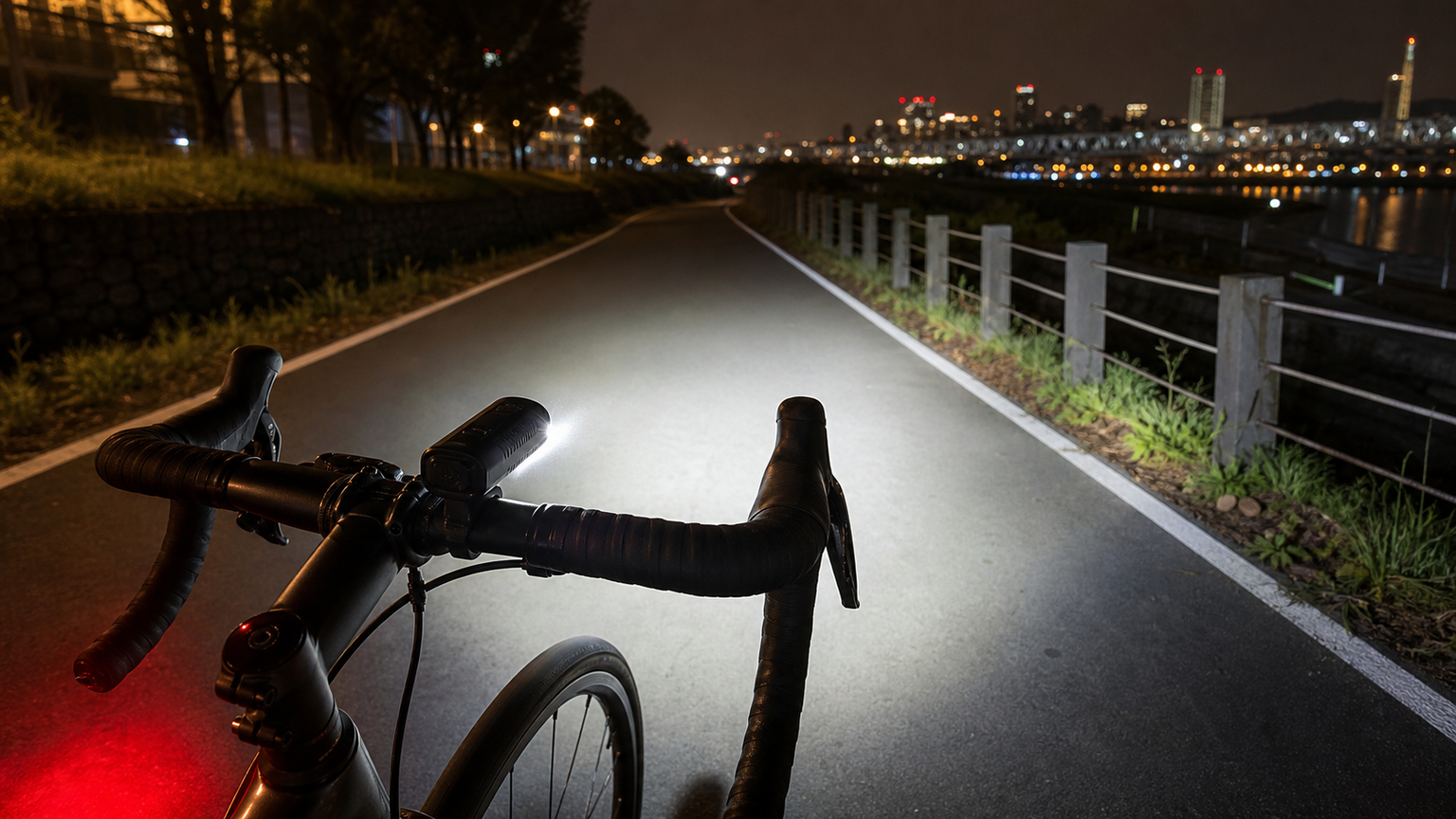
- Riverside bike paths: Good pavement and adequate street lighting; prioritize “being seen”—a 600 lm blinking light suffices
- Mountain provincial highways (e.g., Beiyi Highway): Many curves and fast descents; requires a stable light source of 1,500 lm or more
- Rural/industrial roads: Rough terrain with no streetlights at all; a dual setup of headlight plus helmet light is recommended
Taillight Selection
The taillight’s core mission is “being seen by vehicles,” not illumination. Key buying points:
- At least 50 lumens of brightness, with a flash frequency of approximately 2–5 Hz to most effectively attract drivers’ attention
- Taiwan regulations (Article 79 of the Road Traffic Safety Rules) require a red taillight when riding at night
- Water resistance rating of IPX4 or higher to handle Taiwan’s sudden rain
- Integrated taillights (mounted on saddle bags or helmets) increase visibility from different angles
Budget Recommendations for Essential Taiwan Night Riding Lights
- Urban commuting (NT$2,000–4,000): 600 lm USB-C rechargeable headlight + 30–80 lm blinking taillight
- Weekend mountain night rides (NT$5,000–10,000): 1,200–2,000 lm wide-beam headlight + taillight of 100 lm or more
- Ultra-long-distance challenge rides (NT$10,000+): 2,000 lm+ headlight with replaceable battery + backup headlight + helmet-mounted taillight
Practical Tips
- Don’t be tempted by cheap, unbranded knockoff lights; poor circuit design can lead to overheating or short circuits
- Check the water resistance rating before purchasing; IPX4 (splash-proof) is the minimum recommendation for use in Taiwan
- Mount quality is more often overlooked than the light itself; vibration on rough roads can loosen the mount
- Verify charge level before night riding; it’s recommended to charge to 100% before every ride
- Backup power: for long rides, carry a power bank to avoid losing illumination in the dark of the mountains
Conclusion
Taiwan’s night riding culture is thriving, and a good light setup isn’t just about personal safety—it’s also a matter of respect for other road users. When shopping, lumen count is a starting point but not the finish line; beam pattern design, battery life, and mount stability matter just as much. Given Taiwan’s diverse riding environments, it’s recommended to prepare at least two light setups for different scenarios, so every night ride is both worry-free and safe.
Related Reading
- The Complete Bike Light Buying Guide: Lumens, Taiwan Regulations, and Night Riding Safety Needs
- Bike Light Buying Guide: Headlight Lumens and Taillight Visibility Standards
- Bicycle Light Buying Guide: Illumination Solutions to Keep You Safe in the Dark
- Bike Light Buying Guide: Headlight Lumen Requirements and Taillight Flash Pattern Safety Considerations
單車 一日北高 ( 雙城 ) 肥宅雙人瘋狂行 紀錄片 REACTO
10 年前
再快都跟的上!? 單車跟隨攝影機之王 HOVERAir X1 PROMAX 全面實測 / 唯一!8K畫質&自行車專用模式和跟蹤信標&前後避障 / DJI Neo 可參考/ 公路車 / CT Yeh
1 年前
趣味單車配件:多功能智慧尾燈 / 有方向燈 可app編輯圖案!? / GRC x Lumii 聯名款 / 公路車 CT Yeh
9 個月前
多到選擇障礙... 換個單車把帶想一個小時 / BTP / 編織&軟木特有材質超吸睛! / 公路車 / CT Yeh
1 年前
4K單車實境) 舊陽金P字道 第1P 仰德大道至小油坑 誤跟武嶺神人們 被拉爆爽飛天 Taiwan Cycling Climb Route Recommend
7 年前
單車賞雪 裝備準備及注意事項分享 | 公路車
5 年前
沉浸室內單車練功房開箱! 100吋大畫面,最便宜的花費? 居然還能K歌!? | 公路車 | CT Yeh
3 年前
大家都在開箱的...單車用藍芽對講耳機真的有幫助嗎? SENA BiKom 20 長距離旅遊 & 海鷗繞圈賽 實際體驗心得 / 公路車 / CT Yeh
9 個月前