Introduction
In Taiwan’s 25-meter short-course competition environment, a 100-meter freestyle requires three turns, and the quality of each turn directly impacts the final time. Many Taiwanese swimmers invest significant time in stroke technique while overlooking the turn as “free speed”—a well-executed flip turn can save 0.3–0.5 seconds per turn compared to opponents without expending extra energy.
The Complete Flip Turn Sequence
A full flip turn can be broken down into the following five sub-movements:
- Approach Rhythm: Stroke rate control over the final 2–3 strokes to avoid “stepping on the wall” or “reaching for the wall”
- Forward Roll Initiation: Head tucks down, core engages, and the roll begins
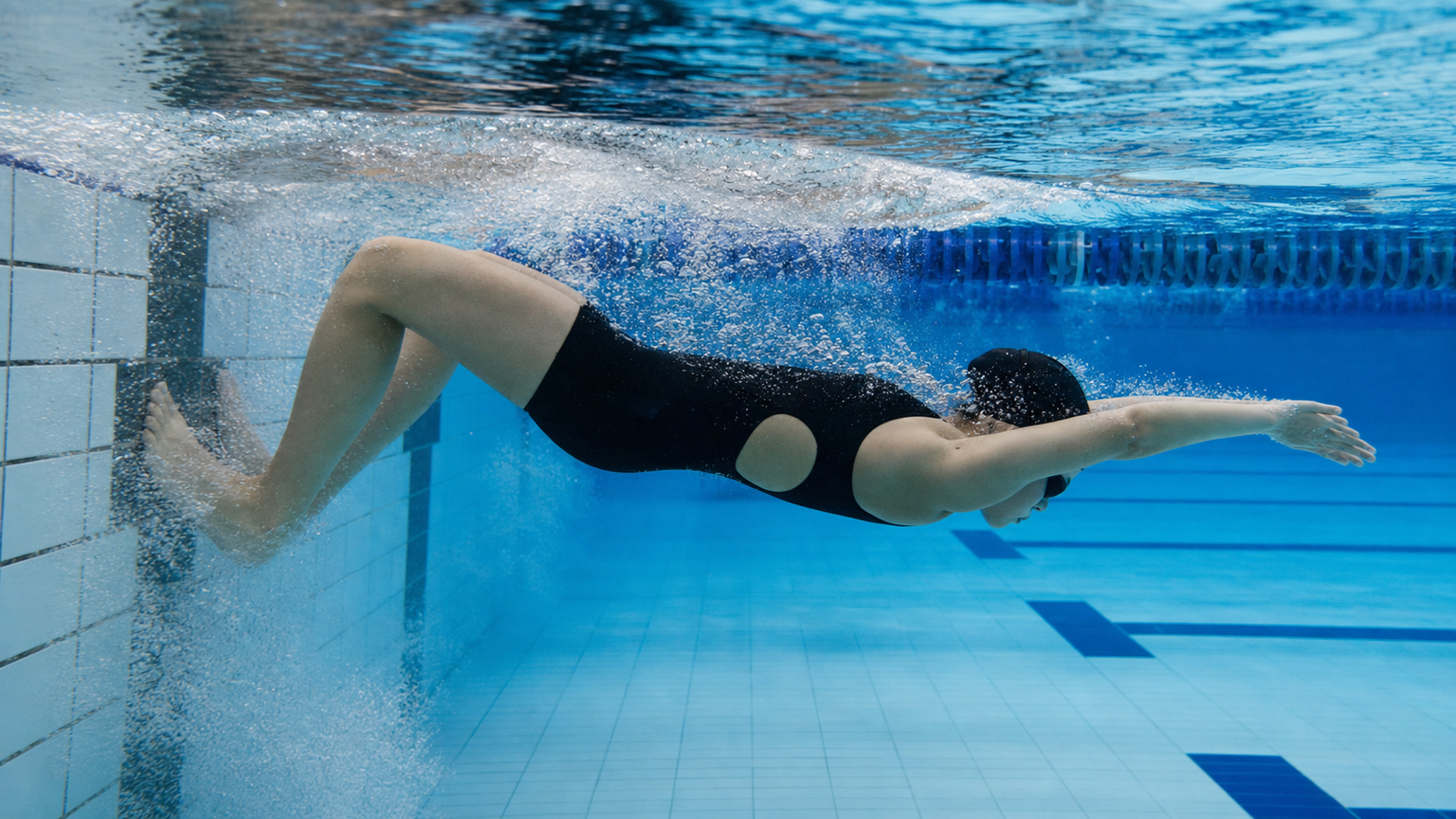
- Wall Plant Position: The height and angle at which both feet land on the wall
- Push-off Drive: Explosive extension of the quadriceps and glutes off the wall
- Streamline Glide: Entering a streamlined position after push-off, gliding until speed drops to swimming pace
The Critical Impact of Wall Plant Angle
The wall plant angle is the most overlooked aspect of turn efficiency.
Plant Depth and Push-off Direction
| Plant Depth | Push-off Angle | Effect | Best Suited For |
|---|---|---|---|
| Shallow (within 30cm of surface) | Toward the surface | Quick surfacing after push-off, suited for sprints | 50m sprints |
| Medium (30–50cm) | Near horizontal | Longest streamline glide after push-off | 100–200m |
| Deep (50cm+) | Toward the bottom | Requires more effort to surface, less efficient | Generally not recommended |
Most swimmers are advised to maintain a plant depth of 30–45 cm below the surface, with a push-off direction that is near horizontal with a slight upward angle, making the post-push-off streamline glide path the most efficient.
Foot Spacing and Sole Placement
- Foot spacing: shoulder-width apart, avoiding too narrow (reduced push-off power) or too wide (increased drag)
- The soles should fully contact the wall; push-off power is greatest when the knees are bent at approximately 90–110 degrees
- Avoid gripping the wall with the toes; distribute force evenly across the entire sole
Mastering Push-off Timing
“Pushing too early” and “pushing too late” are both common mistakes:
- Pushing too early: Pushing off before the body has fully rotated, resulting in an angled push-off direction and significant speed loss
- Pushing too late: Spending too long on the wall, losing momentum and pushing off with insufficient speed
Correct timing: Begin the push-off the instant the body completes its rotation and both feet make contact with the wall—total wall contact time should not exceed 0.3 seconds.
Optimizing the Streamline Glide
The streamlined position after push-off is the continuation of turn efficiency:
- Arms pressed against the ears, hands stacked, fingers pointing forward
- Core tightened, back straight, hips not sinking
- Toes pointed, ankles relaxed
- Generally recommended to glide until speed drops to approximately 85–90% of swimming pace before starting the kick; avoid over-gliding
Special Considerations for Taiwan’s Short-Course Pools
Many older 25-meter pools in Taiwan have softer turn walls (rubber padding), which feel different from standard pools when pushing off. Recommendations:
- Practice on soft walls initially to feel the force feedback, then transition to hard walls once adapted
- Turn wall heights vary across municipal pools; check the distance by treading water beforehand
Practical Advice
Dedicate 10–15 minutes per session to turn-specific drills: repeat the sequence of a 5-meter sprint from the wall → flip turn → 5-meter streamline glide (8–12 repetitions), focusing only on the turn without swimming long distances. This method quickly builds muscle memory and improves turn efficiency. Additionally, use a stopwatch to record turn time (from wall contact to leaving the wall), aiming to compress it to under 0.8 seconds.
Conclusion
Turn technique is one of the highest-return training investments in competitive swimming. While stroke technique can take months to show results, turn technique can improve significantly after 2–4 weeks of focused practice. For swimmers who regularly train in Taiwan’s short-course pools, mastering the flip turn is the fastest path to breaking personal bests.
Related Reading
- Complete Turn Technique Analysis: Wall Plant Timing and Push-off Angle for Freestyle Flip Turns
- Refining Swimming Turn Technique: Push-off Timing and Streamline Maintenance in Flip Turns
- The Mechanics of Push-off in Swimming Turns: Technical Details for Maximum Propulsion
- Refining Turn Technique: Hand-Foot Coordination and Push-off Power Optimization in Touch-and-Roll Turns
CT 喇低賽) 武嶺牽車 才是王道 西進牽車四小時內秘訣 攝手位置 如何判斷 防抽筋小秘訣
7 年前
Live) 備戰2019彰化經典百K 賽前攻略 (已完賽請看新影片
7 年前
實景訓練台) 彰化經典百K 高強度喵團 90分鐘 跟著一起練功 2019 Indoor workout Changhua Classic 100 Taiwan
7 年前
公路車 爬坡 破PR 紀錄 小技巧 分享
6 年前
抖肩舞 台灣x日本交流版 (台灣 vs 前橋) 赤城山登山賽 coincidance
8 年前
西進武嶺 免費訓練分析服務 Intervals | 練不夠還是練過頭?你哪一種類型選手?AI模型告訴你! | 備戰神器 | 公路車 訓練 | CT Yeh
4 年前
風櫃嘴時間 預測西進武嶺時間?13000名車友統計數據分析告訴你 !
5 年前
2023桃園團體繞圈賽 / 海鷗繞圈賽 | 全程空拍數據版 | 公路車 | CT Yeh
2 年前