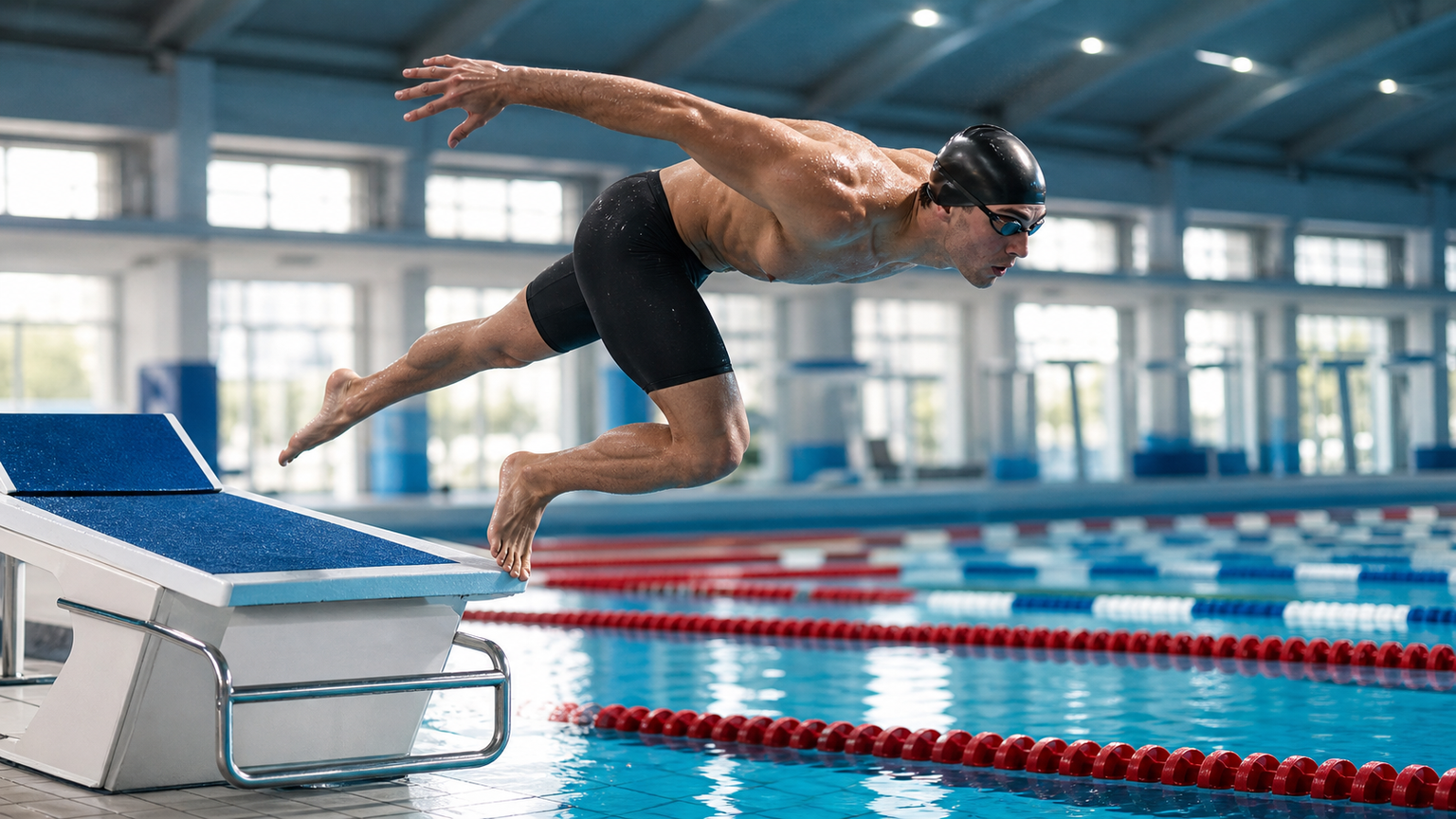
Introduction
In swimming competitions, the 0.6–0.9 seconds from the starting signal to the body entering the water often determines the rhythm of the entire race. Major swimming events in Taiwan (including the National High School Athletic Games and National Intercollegiate Athletic Games swimming events) all use electronic starting blocks, making starting technique even more critical. This article will compare in detail the technical characteristics of the Grab Start, Track Start, and the backstroke in-water start, helping athletes choose the starting method that suits them best.
Grab Start
The Grab Start is the most traditional starting method, with both feet standing parallel at the front edge of the starting block and both hands gripping the block edge.
Technical Key Points
- Feet shoulder-width apart, toes curling over the block edge
- Body leaning forward, center of gravity shifted to approximately the front 1/3 of the foot
- Upon hearing the starting signal, explosively extend both legs to push forward
- Entry angle of approximately 25–30 degrees, aiming to “slice through” rather than “slam into” the water
Advantages and Limitations
- Advantages: Stable posture, lower technical barrier, suitable for beginners
- Limitations: Reaction Time (RT) is approximately 0.02–0.05 seconds slower than the Track Start
Track Start
The Track Start originates from track-and-field sprint starting posture, with one foot forward and one foot back. It is currently the most commonly used starting method among the world’s top sprint swimmers.
Technical Key Points
- Dominant foot (usually the right foot) placed forward, non-dominant foot placed back; front foot toes gripping the block, rear foot ball of foot on the block
- Both hands gripping the block, hand position approximately between the feet or slightly forward
- Lower the center of gravity; upon hearing the signal, the rear foot pushes first, followed immediately by the front foot, creating a faster starting reaction
Why the Track Start Has a Faster Reaction
From a physics perspective: the staggered stance lowers the center of gravity and increases forward lean, shortening the moment arm and reducing the time from stillness to leaving the block. Research data shows that the Track Start’s average reaction time is approximately 0.62 seconds, about 0.06 seconds faster than the Grab Start’s approximately 0.68 seconds.
Comparison of Three Starting Methods
| Comparison Item | Grab Start | Track Start | In-Water Start (Backstroke) |
|---|---|---|---|
| Applicable Strokes | Freestyle/Breaststroke/Butterfly | Freestyle/Breaststroke/Butterfly | Backstroke |
| Average Reaction Time | 0.66–0.72 seconds | 0.60–0.66 seconds | 0.80–0.90 seconds |
| Technical Difficulty | Low | Moderate | High |
| Glide Distance After Entry | Moderate | Slightly shorter (flatter angle) | Shorter |
| Commonality in Taiwan Events | Commonly used by student groups | Commonly used by top-tier athletes | Exclusive to backstroke |
Backstroke In-Water Start Technique
Backstroke is the only stroke that starts from the water, requiring special technical demands:
- Both hands gripping the in-water handles (backstroke bars), feet planted on the wall, hips kept higher than the knees
- After the “take your mark” command, the body forms an arched position, raising the hips
- After the starting signal, push off the wall with both feet, swing both arms backward, and enter the water with the head tilted back
- Entry angle of approximately 30–40 degrees, avoiding an overly flat body position that causes excessive splash
Common Backstroke Start Errors
- Hips too low, causing the body to jump upward rather than backward upon takeoff
- Arm swing too slow, failing to fully utilize the arm’s reaction force
- Head lifting too early after entry, breaking the streamlined position
Practical Considerations for Taiwan Competition Venues
Starting block heights, angles, and materials vary across some swimming pools in Taiwan (especially older community pools). Recommendations:
- Perform at least 3 practice dives during pre-race warm-up to feel the block surface friction
- The rear foot position for the Track Start needs fine-tuning based on the starting block’s slope angle
- The National High School Athletic Games and National Intercollegiate Athletic Games use standard Omega electronic starting blocks, which differ from regular training pools
Practical Advice
Beginners are advised to first establish fundamental movement patterns with the Grab Start, ensuring a stable entry angle before transitioning to practicing the Track Start. During the transition period, perform 5 maximal-effort Track Start dives in the warm-up set of each training session, observing only the segment from takeoff to entry without swimming hard, focusing on feeling the acceleration off the block.
Conclusion
Starting technique is the most easily quantifiable aspect to improve in competitive swimming—through timers and video analysis, athletes can instantly see data on reaction time and entry angle. With Taiwan’s swimming events placing increasing emphasis on details, mastering proper starting technique is an effective strategy for improving times and gaining a competitive edge.
Related Reading
- Competition Starting Techniques: Grab Start vs Track Start
- Swimming Starting Techniques: Speed Differences Between Grab Start and Rearward Start
- Block Dive vs In-Water Start: Technical Choices and Competition Rules Analysis
- Starting Block Techniques: Reaction Time Comparison Between Crouch Start and Grab Start
CT 喇低賽) 武嶺牽車 才是王道 西進牽車四小時內秘訣 攝手位置 如何判斷 防抽筋小秘訣
7 年前
Live) 備戰2019彰化經典百K 賽前攻略 (已完賽請看新影片
7 年前
滑雪新手們慘摔學習全紀錄(請開字幕),滑雪好好玩 | Snowboard + Ski | 岩原 スキー場 | 滑雪APP使用 | GoPro Max
6 年前
Zwift跨國線上追逐賽 第二站 台灣 TTR vs. 日本 JETT 第二場 (台灣追日本) | 數百位國內外公路車高手,同場較勁 | 多視角賽事直播
4 年前
戰略) Zwift Race 如何咬在第一集團 如何評估自己要開多少推力 (請開1.5倍速看)
7 年前
首發 Garmin Edge 850 車錶 深入開箱!? / 公路車 / CT Yeh
10 個月前
#PUSHBIKE 原來這麼好玩! 小朋友 滑步車 初體驗 超可愛
6 年前
爬坡ITT實境)台中 魔王 松鼠坡 首航 6:12 大肚山 大三元 科福路
8 年前