Introduction
Backstroke is the only one of the four competitive strokes swum face-up, and the limited visibility makes technical awareness more difficult. Many backstroke learners in Taiwan often complain that “swimming in a straight line is hard” and “I can’t generate power from my pull,” and the root of these problems often points to the same core technical element: Body Roll. This article will systematically break down the three key elements of backstroke technique.
The Importance of Body Roll
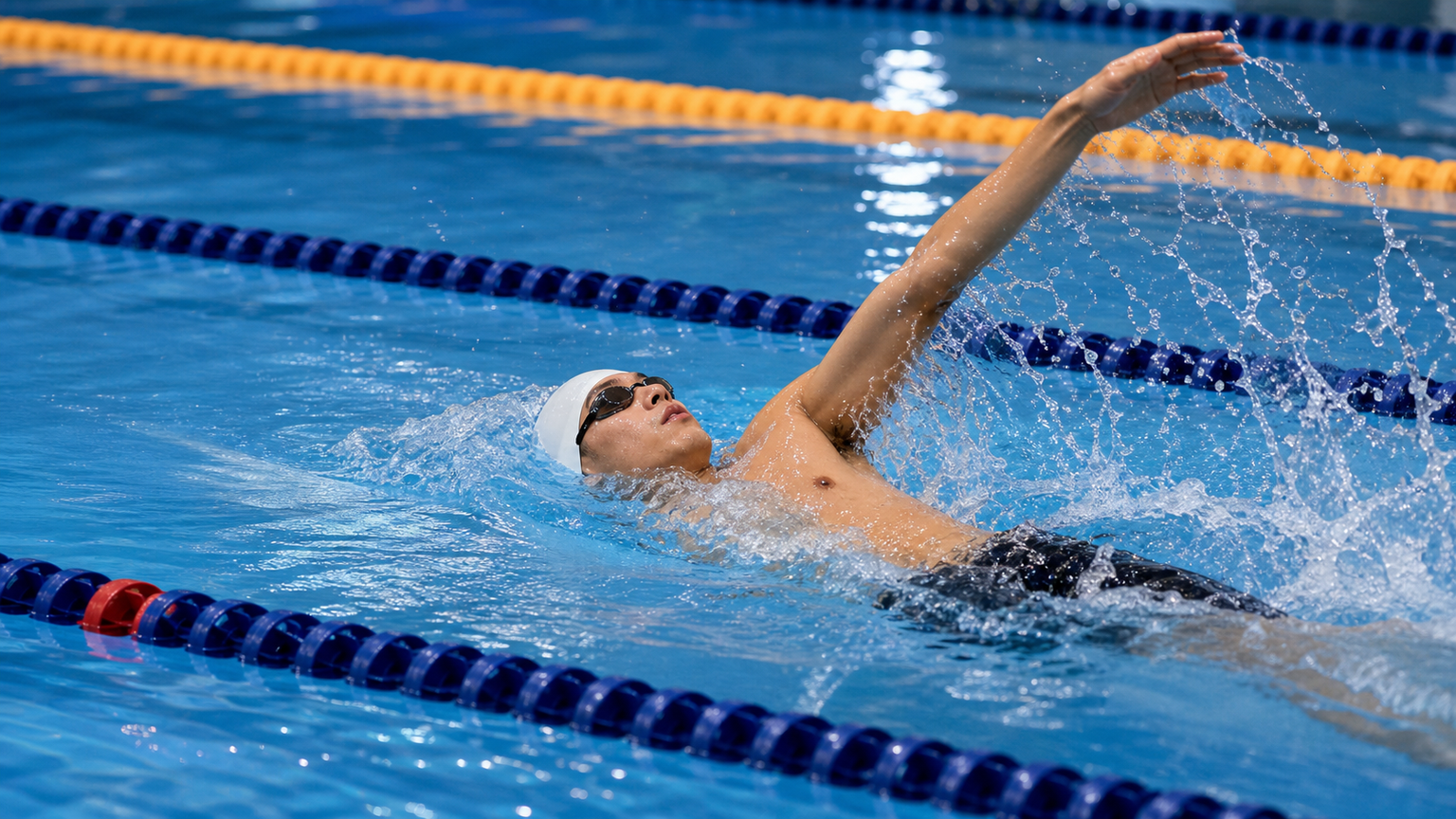
Body roll refers to the lateral rotational movement of the body around the spine during the backstroke pull, with an ideal amplitude of approximately 35–45 degrees per side.
Three Major Benefits of Body Roll
- Increased pull depth: When the body tilts to the side, the pulling hand can reach deeper water layers, contacting water with more stable flow, making the propulsion more efficient
- Reduced frontal drag: The side-lying position has a smaller frontal drag cross-section than a flat supine position
- Engages the latissimus dorsi: The rolling motion activates the latissimus dorsi—the largest back muscle group—to participate in the pull, greatly increasing propulsion per stroke
The Risk of Excessive Roll
Roll angles exceeding 50–55 degrees are actually counterproductive:
- Reduced kicking efficiency (legs struggle to maintain an effective kick plane)
- The pull path deviates, generating lateral force components rather than forward propulsion
- Increased body snaking, worsening straight-line swimming
Optimizing Arm Entry Angle
Correct Entry Position
When the arm enters the water in backstroke, the ideal position is “directly above the shoulder line, elbow straight, pinky entering first”:
| Entry Position | Effect | Problem |
|---|---|---|
| Outside the shoulder line (too wide) | Higher stability | Arm must adduct during the catch, wasting distance |
| Directly above the shoulder line | Optimal entry efficiency | Requires good shoulder joint flexibility |
| Inside the shoulder line (crossing midline) | Looks streamlined | Easily causes body snaking |
Recommended entry angle: the arm should be at approximately 60–70 degrees to the water surface, avoiding fully vertical entry (excessive impact) or overly flat entry (creating slapping sounds and drag).
Catch Movement After Entry
The high-elbow catch in backstroke is similar to freestyle:
- After entry, the arm extends toward the back of the shoulder while the elbow bends to initiate the catch
- The forearm rotates so the palm faces toward the feet (rather than the surface)
- Keep the elbow higher than the wrist to form an effective paddle surface
Kick Coordination and Body Position
The Function of the Kick
The functions of the backstroke kick (primarily six-beat) include:
- Maintaining a horizontal body position, preventing the hips from sinking
- Coordinating with body roll to reinforce rotational power on each stroke
- Providing additional propulsion (especially in sprint distances)
Common Hip-Sinking Problems
Among Taiwanese swimmers, hip sinking in backstroke is quite common, and the causes are usually:
- The head is held too high (correct posture: ears below the water surface, gaze upward at approximately 45 degrees)
- Insufficient core strength to maintain a level waist
- The kick is initiated from the knees rather than the hips
Straight-Line Training Methods
The most unique challenge of backstroke is not being able to see ahead:
- Ceiling line training method: In an indoor pool, stare at the seam line on the ceiling while swimming to feel body drift
- Pull buoy assistance: Hold a pull buoy and perform kick drills, removing arm interference to feel the body roll
- Closed-eye straight-line training: Swim short distances with eyes closed, then observe the direction of drift to identify the side with imbalanced strength
Special Considerations for Backstroke Training in Taiwan
Indoor pools in Taiwan vary in ceiling height and lighting, so the effectiveness of ceiling line training depends on the facility. It is recommended to use standard facilities such as the National Sports Training Center or National Taiwan Normal University for technical training.
Practical Recommendations
Schedule one “backstroke technique day” per week, following this sequence:
- Kick only × 200m (with a pull buoy between the legs, arms at the sides, feeling hip position)
- Single-arm pull × 4×50m (other arm at the side, reinforcing the roll sensation on each side)
- Full stroke with stroke counting (record stroke count every 50m, aiming for fewer than 18 strokes)
- Sprint × 2×50m, feeling how the technique holds up at speed
Conclusion
Improving backstroke technique is an inside-out process—body roll, core stability, and arm entry angle must all work in coordination. For backstroke swimmers in Taiwan, investing time in technical details is often more effective at improving times than simply increasing training volume.
Related Reading
- Refining Backstroke Technique: The S-Shaped Pull Path and Kick Rhythm Coordination
- Key Technical Points for Backstroke: Rotation Axis and Stroke Efficiency Improvement Guide
- Freestyle Body Rotation: The Hidden Key to Efficiency Gains
- The Core of Backstroke Technique: The Triangular Relationship Between Body Roll, Straight-Arm Entry, and a Stable Kick
如何把 GoPro 影片 翻轉 批次 轉正?
6 年前
[教學] Premiere 影片 手震 修正 教學 防抖 單眼 影像 GoPro 穩定 Video Stabilization
8 年前
Insta 360 One 超級防手震技術實測
7 年前
CT 喇低賽) 武嶺牽車 才是王道 西進牽車四小時內秘訣 攝手位置 如何判斷 防抽筋小秘訣
7 年前
抖肩舞 台灣x日本交流版 (台灣 vs 前橋) 赤城山登山賽 coincidance
8 年前
類空拍神器 Feiyu Pocket 2s (有優惠連結)三軸穩定 運動攝影機 開箱!比GoPro 還強的滑順視角!三小時長時間錄影 行車記錄器 | 環花東365實測 | 公路車 CT Yeh
4 年前
一起升級!海鷗盃LSD團練...JJSC Zone2招待 騎到手抖 / 公路車 / CT Yeh
1 天前
一日北高/長距離團騎 常見問題補充篇 / 組團或跟團的眉角 / 壯車友容易被瘦車友慢性拉爆 / 原來屁股痛可能是這個原因...? / 風場配速法 / 公路車 / CT Yeh
2 年前