Introduction
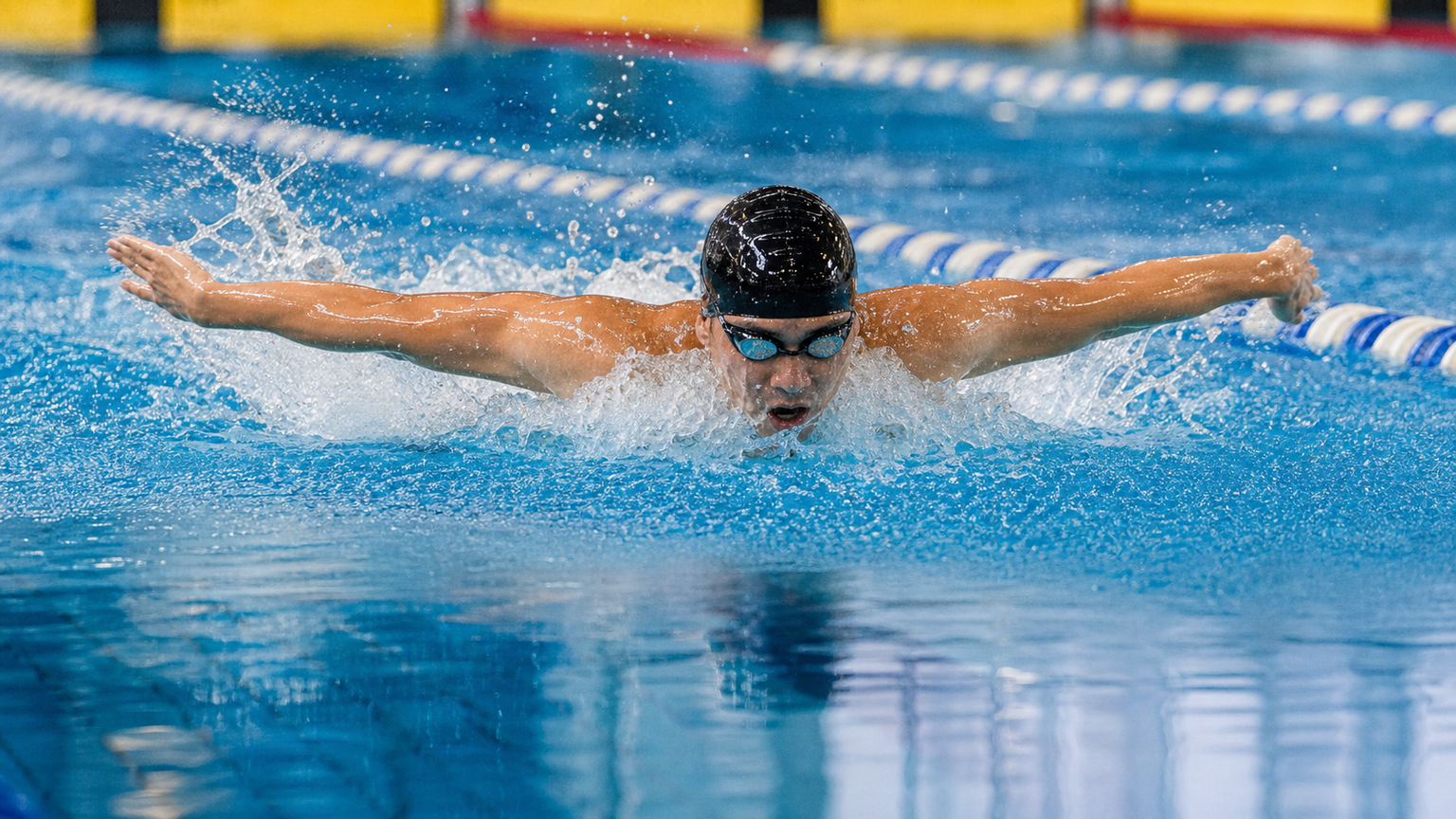
Butterfly is widely recognized as the most technically demanding competitive stroke, and also the most physically exhausting. Many swimmers in Taiwan are both fascinated and intimidated by it—fascinated by its beauty and explosive power, intimidated by the stamina drain that can leave you “dead in the water.” The secret to butterfly speed lies not in “pulling harder,” but in finding the correct wave rhythm: the wave transmission traveling from head to toe, and the precise synchronization of breathing, arm pulls, and kicks.
The Physics Behind the Wave Rhythm
Butterfly propulsion works on a principle similar to dolphins or whales—using the undulation of the spine to drive a full-body wave motion, allowing every stroke to harness the body’s momentum.
The Wave Transmission Path
Starting from the head, wave energy travels in sequence:
Head → Shoulders → Waist → Hips → Knees → Feet
Each segment lags about 0.05–0.1 seconds behind the previous one, creating a continuous wave effect. This “proximal-to-distal” energy transfer is the core of butterfly efficiency.
Timing the Two Kicks
Each butterfly stroke cycle includes two kicks:
| Kick Timing | Name | Function | Intensity |
|---|---|---|---|
| As the hands enter the water | First Kick | Helps the body dive down, assists the catch | Lighter |
| As the hands finish the push | Second Kick | Primary propulsion, coordinates with the breath | Heavier |
Common Timing Mistakes
- Both kicks with equal force: Wastes energy and reduces propulsion efficiency; the correct pattern is a “light-heavy” rhythm
- Kicking too deep (legs dropping more than 30 cm): Dramatically increases drag and burns extra energy
- Kicking too shallow: Insufficient propulsion, shortening the distance traveled per stroke
Mastering Breathing Timing
Breathing timing is the element most likely to disrupt the butterfly rhythm:
The Correct Breathing Sequence
- Finish the arm push → the head is naturally lifted out of the water (not actively raised)
- Exhale and inhale quickly through the mouth, in no more than 0.3 seconds
- As the arms extend forward into the water, press the head down and under
Breathing Frequency Strategies
- Breathe every stroke: Suitable for beginners; consumes more energy but ensures ample oxygen
- Breathe every two strokes: The competitive standard; reduces drag from lifting the head to breathe
- No breath for 25m: A technique for the final stretch of short sprints; many world-class swimmers use it in the first half of the 50m butterfly
Controlling Body Undulation Amplitude
Many swimmers in Taiwan have overly large undulation, looking more like they’re “diving rather than swimming”:
- Ideal undulation amplitude: Vertical head displacement of about 15–20 cm
- Problem with excessive undulation: More vertical movement, less horizontal propulsion—tiring but slow
- Problem with insufficient undulation: Weak kicking power, failing to fully utilize the body wave’s momentum
The Role of the Core Muscles in the Wave Rhythm
The butterfly wave rhythm is driven by the coordinated effort of the following muscle groups:
- Rectus abdominis and transversus abdominis: Control the range of the waist’s downward and upward movement
- Quadratus lumborum and erector spinae: Produce spinal extension
- Gluteus maximus: Drives the hip-down kicking motion
- Quadriceps: Knee extension completes the final acceleration of the kick
Managing Stamina in Butterfly
The biggest challenge in butterfly is rapid energy depletion. Here are common stamina management strategies used by butterfly swimmers in Taiwan:
- Pacing the first half: In a 100m butterfly, consciously control kick amplitude in the first 50m to avoid burning out early
- Breathing strategy: Breathe every two strokes in the early stages, then switch to breathing every stroke later on
- Use streamline gliding: The 0.1–0.2 seconds of streamlined posture after each hand entry is a crucial rest opportunity
Practical Advice
Butterfly rhythm training can follow this progressive approach:
- Dolphin kick (arms at sides) × 4×25m: Feel the body wave without pulling
- Single-arm butterfly (other arm extended forward) × 4×25m: Reduce intensity and feel the pull timing
- Butterfly with 3-stroke breathing × 4×50m: Establish proper breathing rhythm
- Full-stroke timed swim × 2×50m: Test technique stability at speed
Conclusion
The wave rhythm of butterfly is a skill to be “felt” with the body, not “thought” through with the mind. Many swim coaches in Taiwan tell their students to “imagine you’re a dolphin”—this vivid imagery actually points precisely to the essence of butterfly: let the body’s wave flow naturally, rather than muscling through the water. Once you find your own rhythm, the beauty and speed of butterfly will emerge together.
Related Reading
風櫃嘴 衝刺慢動作回放!
8 年前
抖肩舞 台灣x日本交流版 (台灣 vs 前橋) 赤城山登山賽 coincidance
8 年前
西進武嶺 免費訓練分析服務 Intervals | 練不夠還是練過頭?你哪一種類型選手?AI模型告訴你! | 備戰神器 | 公路車 訓練 | CT Yeh
4 年前
一起升級!海鷗盃LSD團練...JJSC Zone2招待 騎到手抖 / 公路車 / CT Yeh
2 天前
教學) 如何做出專業 慢動作 影片 Slow Motion 120fps GoPro 7 ActionCam AX700 A99II
7 年前
[教學] Dashware 教學 如何製作有 速度 功率 心律的 騎車影片 Guages Video
8 年前
西進武嶺 自製新版AI配速表產生器 x 賽前攻略 抱佛腳! 沒有功率計也可以產生配速表嗎?有什麼其他眉角賽前要注意的呢? | 西進武嶺 / 東進武嶺 KOM 攻略 | 公路車 | CT Yeh
4 年前
[教學] Premiere 影片 手震 修正 教學 防抖 單眼 影像 GoPro 穩定 Video Stabilization
8 年前