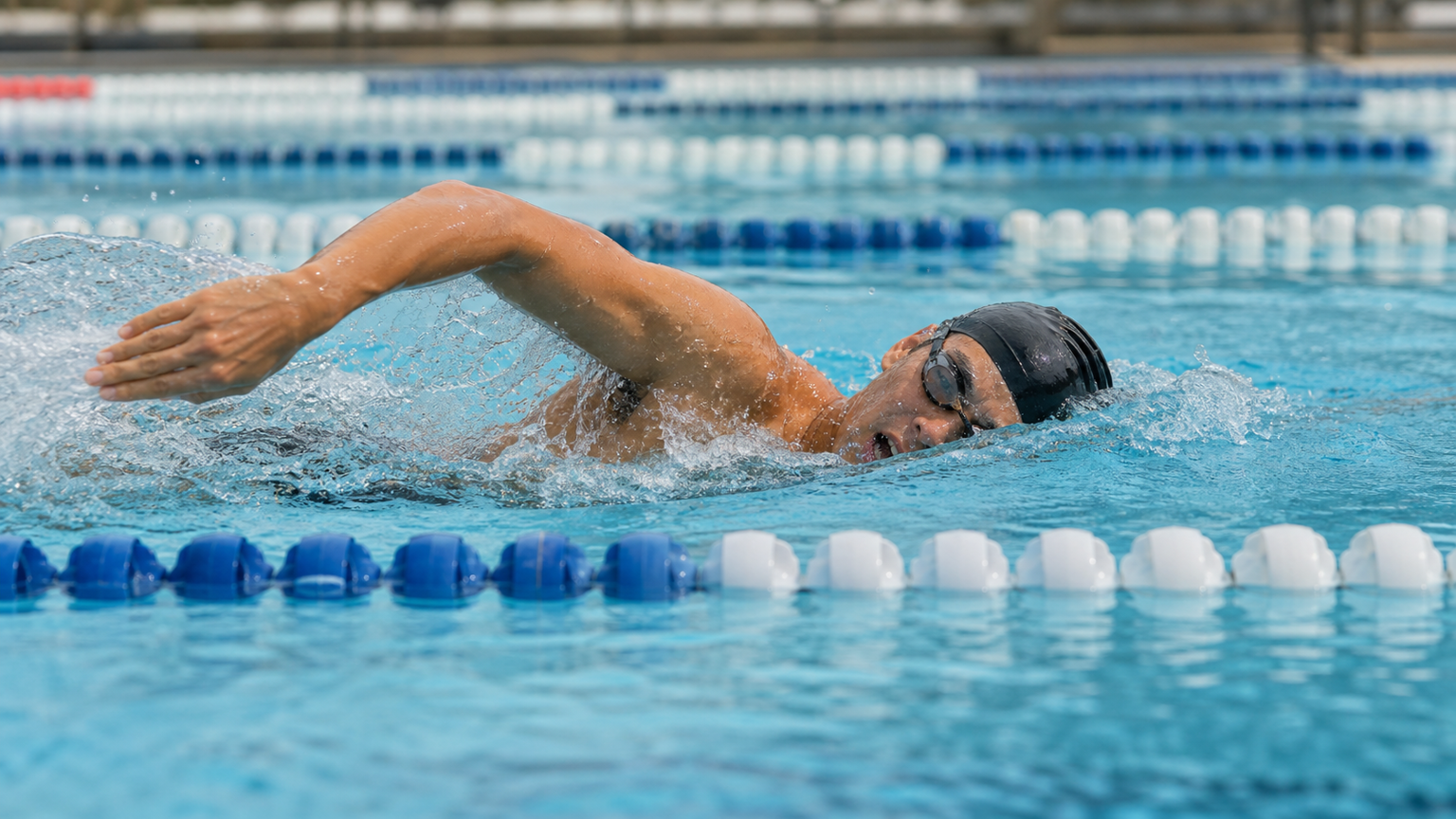
Introduction
Breathing is the aspect of freestyle technique that most affects stroke symmetry. Many swimmers in Taiwan are accustomed to breathing to one fixed side, which over time leads to imbalanced stroke mechanics between the left and right arms, and even body drift during longer distances. Bilateral breathing (breathing every three strokes, alternating sides) is the core training method to address this issue, but its application strategy in competition is more complex than in training.
The Training Value of Bilateral Breathing
Why Practice Bilateral Breathing?
- Stroke symmetry: Breathing evenly on both sides prevents one arm from pressing down excessively (the arm on the breathing side often has an improper entry angle due to head lift)
- Improved straight-line swimming: Especially in open-water swimming (such as triathlon events in Taitung and Penghu), bilateral breathing allows swimmers to stay on course without relying on visual correction
- Balanced muscle development on both sides: Long-term unilateral breathing causes excessive load on the pectoralis major and shoulder joint on the breathing side; bilateral breathing balances muscle development
- Tactical flexibility: Once comfortable with bilateral breathing, swimmers can flexibly breathe to either side during races as needed (e.g., to observe opponents’ positions)
How to Transition from Unilateral to Bilateral Breathing
Challenges in the early transition phase:
- Longer breath-holding time: Changing from breathing every 2 strokes to every 3 strokes reduces breathing frequency by 33%, causing an initial feeling of oxygen debt
- Decline in technique on the habitual side: Breathing on the weak side feels stiff and disrupts overall rhythm
Progressive Transition Plan
| Week | Training Focus | Training Volume |
|---|---|---|
| Weeks 1–2 | Use bilateral breathing only in technique sets | 200–400m bilateral per session |
| Weeks 3–4 | Switch aerobic endurance sets to bilateral | 600–800m bilateral per session |
| Weeks 5–6 | Bilateral for all sets except sprint intervals | 1000m+ per session |
| Weeks 7–8 | Try bilateral in sprint sets too, observe speed differences | Adjust based on individual condition |
Targeted Drills for the Weak Side
- Single-arm stroke drill: Pull with only the weak side (the side you don’t normally breathe to) to strengthen breathing coordination on that side
- 2-1-2 breathing rhythm: Two strokes breathing to the habitual side, one stroke without breathing, two strokes breathing to the weak side, gradually familiarizing the weak side with the breathing motion
- Wall breathing drill: Stand in the shallow end of the pool and repeatedly practice the head-turn breathing motion to the weak side, feeling the correct technique of keeping the nose below the water surface with only the corner of the mouth breaking the surface
Key Technical Details of Breathing
Regardless of unilateral or bilateral breathing, the following technical details are crucial:
- Rotate the head, don’t lift it: Breathing is driven by body roll rotating the head; the head should not lift out of the water (the forehead should stay touching or slightly submerged)
- Breathe from the corner of the mouth: Don’t lift the whole face out of the water; only the corner of the mouth needs to clear the surface
- Quick breath: Keep inhalation time within 0.2–0.3 seconds; prolonged breathing severely disrupts stroke rhythm
- Entry angle of the breathing-side arm: The arm on the breathing side tends to drift due to head rotation; pay special attention to keeping the hand entering the water in front of the shoulder line
Race Breathing Strategies
This is the part that confuses swimmers most: you train bilateral breathing, but how should you breathe in a race?
Race Breathing Strategies by Distance
| Race Distance | Recommended Breathing Strategy | Reason |
|---|---|---|
| 50m | Breathe as little as possible (0–1 times) | Fastest speed; breathing creates the greatest drag penalty |
| 100m | Breathe every 2 strokes (biased toward the strong side) | Need sufficient oxygen while maintaining speed |
| 200m | Every 3 strokes in the first half, every 2 in the second half | Conserve oxygen early, replenish later |
| 400m and above | Primarily 3-stroke (bilateral) throughout | Aerobic-dominant; bilateral balance matters more |
Survey of Breathing Habits Among Taiwanese Swimmers
Based on general observations from university swim teams across Taiwan:
- Approximately 70% of Taiwanese freestyle swimmers habitually breathe to the right side
- Most swimmers adopt a breathing-every-2-strokes strategy in the 100m
- Triathletes have a relatively higher proportion of bilateral breathing due to open-water demands
Practical Advice
For Taiwanese swimmers looking to start practicing bilateral breathing, it is recommended to use bilateral breathing for the final 200m of each session as a “cool-down,” without chasing speed, simply feeling the difference between breathing left and right. After 3–4 weeks of consistency, the discomfort of bilateral breathing will noticeably diminish, and you can gradually increase the proportion of bilateral breathing in your training.
Conclusion
Bilateral breathing is an important indicator of freestyle technical completeness—a swimmer who can breathe freely to both sides with equal stroke quality demonstrates far greater technical maturity than one who can only breathe to a single side. Build the habit of bilateral breathing in training so that breathing choices in races become conscious tactical decisions rather than habitual constraints.
Related Reading
- Learning Methods and Pros/Cons of Bilateral Breathing in Freestyle
- Breathing Rhythm in Swimming: Timing and Long-Term Benefits of Bilateral Breathing Training
- Improving Breathing Laterality in Swimming: A Progressive Bilateral Breathing Training Plan
- Swimming Breathing Technique: Analysis of Pros and Cons of Side Breathing vs. Bilateral Breathing
CT 喇低賽) 武嶺牽車 才是王道 西進牽車四小時內秘訣 攝手位置 如何判斷 防抽筋小秘訣
7 年前
西進武嶺 免費訓練分析服務 Intervals | 練不夠還是練過頭?你哪一種類型選手?AI模型告訴你! | 備戰神器 | 公路車 訓練 | CT Yeh
4 年前
一個測試有沒有認真練車的方法😂 #公路車
10 個月前
碟煞公路車 優缺點?換車一年半實際經驗分享 / 公路車 / CT Yeh
2 年前
備戰 戀戀197 賽前關門點分析 西濱團練 #公路車 4K高畫質
6 年前
抖肩舞 台灣x日本交流版 (台灣 vs 前橋) 赤城山登山賽 coincidance
8 年前
碟煞公路車 銑面器 !? 原來銑完差這麼多! 降低蹭碟機率! | TIME 公路車 保養小記錄 | CT Yeh
3 年前
如何把 GoPro 影片 翻轉 批次 轉正?
6 年前