Introduction
Many swimmers, after finishing an open-water race, just want to get out of the water, change clothes, drink, and eat—which is completely understandable. However, for athletes who take recovery seriously, the 10–20 minutes after finishing represent a golden window: with a proper cool-down swim, you can significantly accelerate your body’s recovery and reduce muscle soreness the next day.
This article explains why active recovery works, how to design a post-race cool-down for open water, and how to integrate post-race recovery into your overall training plan.
Why Active Recovery Instead of Passive Rest
After intense exercise, a large amount of lactic acid and metabolic waste accumulates in the muscles. Stopping exercise immediately does lower your heart rate, but it also slows blood circulation, which in turn slows the clearance of metabolic waste.
Active Recovery maintains blood circulation through low-intensity exercise (30–50% of maximum heart rate), which:
- Clears lactic acid 25–40% faster than passive rest
- Allows muscle temperature to drop gradually, reducing stiffness caused by sudden cooling
- Keeps synovial fluid in the joints flowing, reducing joint discomfort
- Psychologically provides a buffer for transitioning from “competition mode” to “relaxation mode”
Research generally supports active recovery over passive rest, with particularly notable benefits for high-intensity endurance athletes.
Special Considerations for Open-Water Post-Race Cool-Downs
A cool-down after an open-water race differs from one in a pool, with the following special conditions:
| Factor | Open-Water Special Situation | Adjustment Strategy |
|---|---|---|
| Water temperature | May be cooler, prolonged exposure poses hypothermia risk | Shorten cool-down time, monitor your body temperature |
| Safety | Fewer rescue personnel after the race ends | Make sure someone is watching; do not do it alone |
| Mental state | Excitement or fatigue may impair judgment | Pre-plan your cool-down routine; do not decide on the spot |
| Space | The water is more open as swimmers exit | Choose a safe area, away from boats |
| Time | Pressure from transition area closing times | Complete the cool-down before exiting the water, or find another time |
Complete Post-Race Cool-Down Swim Protocol
Phase 1: Easy Swimming (5–8 minutes)
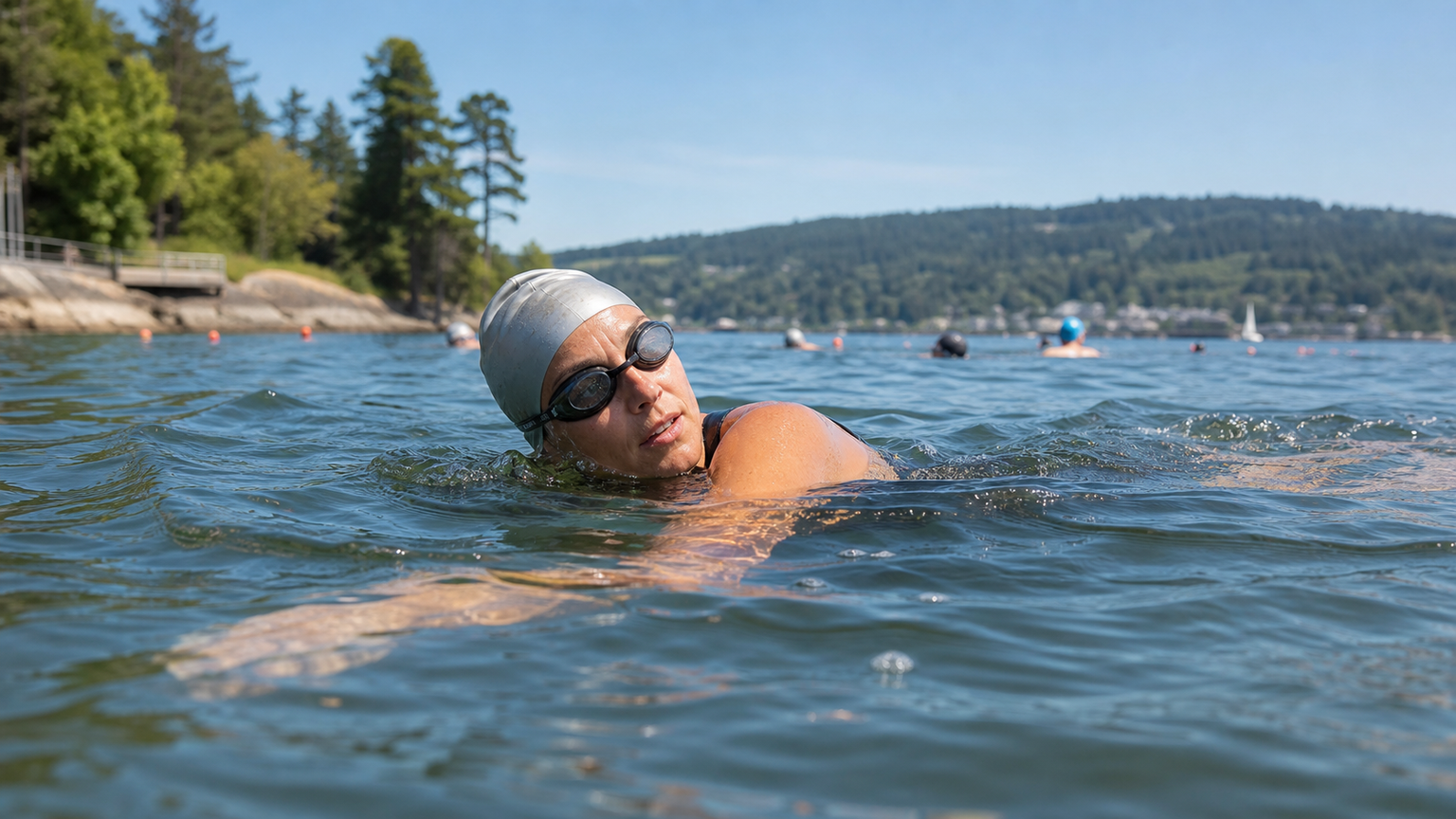
After the finish line, and with race officials’ permission, continue swimming in the water for 5–8 minutes:
- Intensity: Extremely easy, feels like walking, breathing is completely effortless
- Stroke: You may choose backstroke (allowing full arm extension) or an easy freestyle
- Breathing frequency: Breathe every 2 strokes to ensure adequate oxygen supply
- Route: Swim along the shore, not out toward open sea (judgment is impaired when fatigued)
Benefits of backstroke for cool-down:
- Opens the chest, aiding deep breathing recovery
- Rotates the shoulders in the opposite direction, counteracting the forward-pushing muscle actions of swimming
- Face-up position allows easy breathing, relieving the breathing tension from the race
Phase 2: Stretching Kicks (3–5 minutes)
Still in the water, perform stretching kicks:
- Single-arm kick with a kickboard (if available): 1 minute per side, focusing on leg relaxation
- Relaxed back float: Completely relax the body and float for 1–2 minutes, letting all muscles naturally lengthen
- In-water shoulder mobility: Slowly perform 8–10 shoulder circles in the water to reduce accumulated shoulder tightness
Phase 3: Immediate Post-Exit Care (5–10 minutes)
The first 5–10 minutes after exiting the water are equally critical:
- Rapid rewarming: Immediately wrap yourself in a towel or dry clothing to prevent rapid heat loss
- Replenish with electrolyte drinks (not plain water): The body loses electrolytes after a race; plain water may dilute blood electrolyte concentration
- Light land-based stretching:
- Standing calf stretch (pushing against a wall)
- Cross-body shoulder stretch (one arm across the chest, held with the other hand)
- Hip flexor lunge stretch (to address contraction from kicking during swimming)
- Avoid sitting still immediately: Keep standing or walk slowly to let your heart rate decrease gradually
Cool-Down Time Recommendations by Race Distance
| Race Type | Swim Distance | Recommended Cool-Down Time | Focus |
|---|---|---|---|
| Sprint Triathlon | 750 m | 5–8 minutes | Easy, slow swimming is sufficient |
| Olympic Triathlon | 1500 m | 8–12 minutes | Backstroke + kicking stretches |
| Half Ironman (70.3) | 1900 m | 10–15 minutes | Full three phases |
| Full Ironman (226) | 3800 m | 10–15 minutes | But watch for hypothermia risk |
| Pure Open Water (5–10 km) | 5 km and above | Personal judgment | May switch to land-based stretching |
Post-Race 48-Hour Recovery Nutrition Points
Although this article focuses on in-water cool-downs, complete recovery includes nutritional support:
- 30–60 minutes post-race: Carbohydrates + protein (4:1 ratio), such as a banana + Greek yogurt
- Race day afterward: Adequate hydration (with electrolytes), avoid excessive alcohol (it impairs recovery)
- The next day: A protein-focused diet to support muscle repair; easy walking or swimming (no more than 30 minutes)
Cool-Down Practices at Taiwan Events
Penghu Ironman: Lifeguards remain on the beach after the race, so you can do a brief cool-down swim in designated areas. Note the transition area closing time—if you need to retrieve your gear, you must exit the water first.
Northeast Coast Summer Events: The water temperature is comfortable, making it an ideal environment for a full cool-down. For winter events, prioritize keeping warm and shorten your in-water cool-down time.
Conclusion
Finishing is not the end—it is the beginning of the recovery process. A 10–15 minute in-water cool-down is one of the most efficient investments you can make for your body. Cultivate the habit of active post-race recovery so you can return to your next training session more quickly during peak season and keep building your competitive edge.
Related Reading
- Swim Cool-Down and Recovery Workouts: The Recovery Step You Can’t Skip After Training
- Quick Recovery After a Swim Race: Nutrition and Relaxation in the 30 Minutes Post-Race
- End-of-Season Swim Training: Active Recovery Workouts After the Competition Season
- Recovery Training for Swimmers: Easy Swimming, Deep-Water Running, and Relaxation Techniques
[教學] Premiere 影片 手震 修正 教學 防抖 單眼 影像 GoPro 穩定 Video Stabilization
8 年前
FTL 與 SYB 車隊專訪 西進武嶺 實用攻略分享! 2小時 如何練?!你不知道的眉角!新手準備武嶺必看 EP1 | 實力派女車友 | 精華版 | 公路車 | CTYeh
4 年前
CT暗黑廚房) 車友必備 宇宙無敵鮮蚵湯 幫助訓練恢復 天然食補 好市多 超肥鮮蚵 破PR
7 年前
如何把 GoPro 影片 翻轉 批次 轉正?
6 年前
一起升級!海鷗盃LSD團練...JJSC Zone2招待 騎到手抖 / 公路車 / CT Yeh
2 天前
西進武嶺 免費訓練分析服務 Intervals | 練不夠還是練過頭?你哪一種類型選手?AI模型告訴你! | 備戰神器 | 公路車 訓練 | CT Yeh
4 年前
Live) 備戰2019彰化經典百K 賽前攻略 (已完賽請看新影片
7 年前
西進武嶺 自製新版AI配速表產生器 x 賽前攻略 抱佛腳! 沒有功率計也可以產生配速表嗎?有什麼其他眉角賽前要注意的呢? | 西進武嶺 / 東進武嶺 KOM 攻略 | 公路車 | CT Yeh
4 年前