Swimming Resistance Training: Integrating Paddles, Resistance Parachutes, and Pull Buoys into Your Workout Plan
Introduction
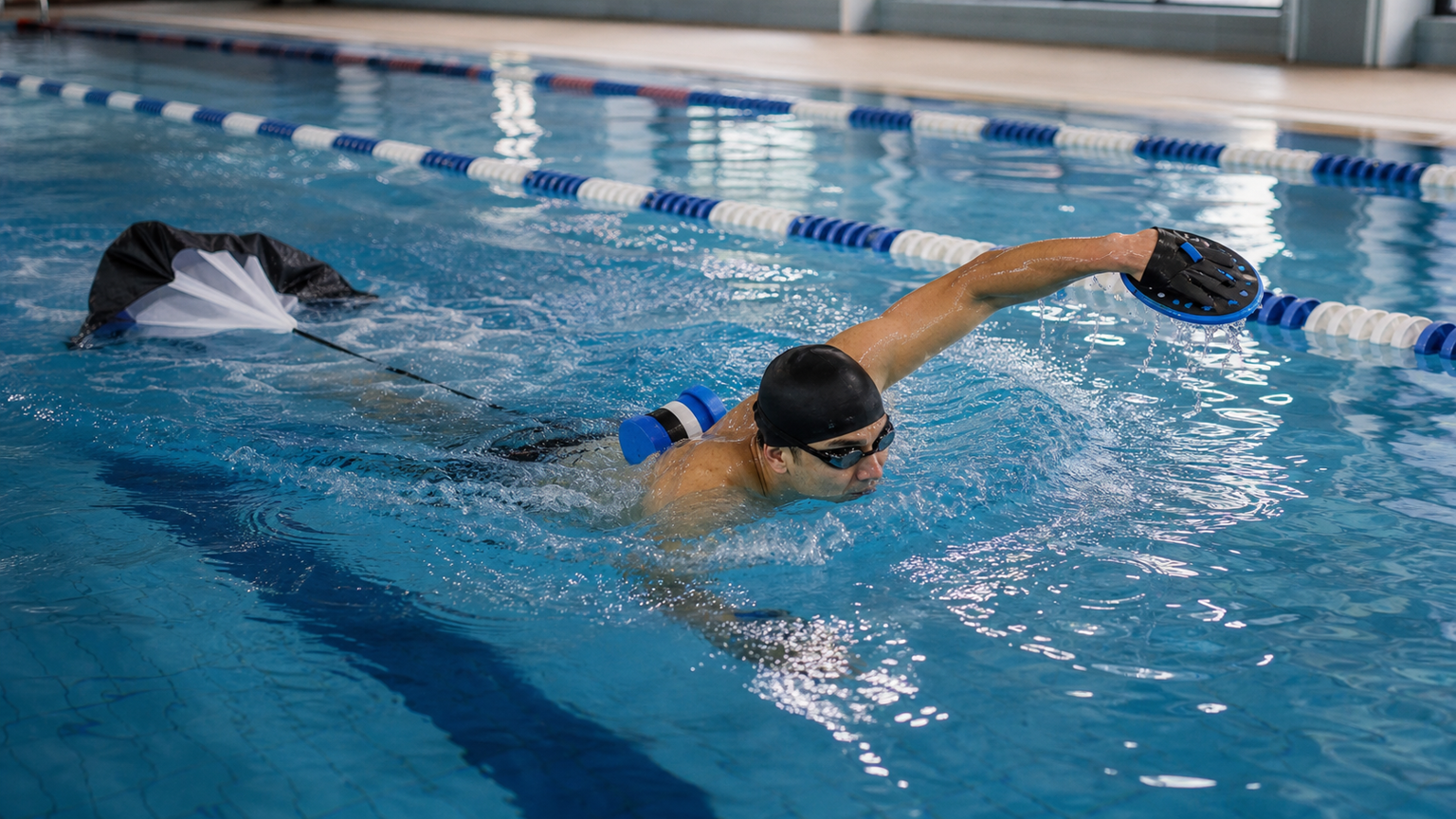
Walking into any major swim training center in Taiwan, you’ll find a variety of assistive equipment lined up by the pool: paddles, pull buoys, drag parachutes, kickboards… These tools aren’t just props to make training more interesting—each piece targets specific technical flaws and muscular weaknesses with a clear training purpose. This article explains the principles behind each piece of equipment and provides an integrated training plan.
Training Purposes of the Three Core Tools
1. Paddle
Paddles are strapped to the palms to increase the surface area of the pull (typically 1.5–2 times that of the hand).
Training Effects:
- Amplified feel for the water: When hand position is wrong or the elbow drops, paddles create noticeable asymmetric resistance, immediately exposing technical flaws
- Enhanced upper-body strength: A larger surface area requires more force to pull water, functioning as upper-body resistance training
- Improved distance per stroke (DPS)
Cautions:
- Paddle size should not be too large, as it can mask hand-position flaws
- Swimmers with shoulder injuries should use them cautiously; oversized paddles can easily cause rotator cuff injuries
- It’s recommended to pair paddles with a pull buoy (no kicking) to isolate the upper-body movement
2. Drag Parachute
The drag parachute is attached to the waist and opens in the water to create resistance, simulating swimming in a higher-resistance environment.
Training Effects:
- Strengthens the entire body’s propulsive musculature (not just the upper body)
- Improves the ability to maintain stroke rate under resistance
- After overload training, removing the parachute sharpens speed perception (contrast effect)
Workout Application:
- 4×50m with parachute → 4×50m without parachute (use the contrast effect to feel the speed increase)
- The drag parachute suits intensity work within 200m, not long-distance aerobic sets
3. Pull Buoy
The pull buoy is held between the thighs, providing buoyancy to replace the support function of kicking.
Training Effects:
- Isolates upper-body training: Removing leg propulsion makes the pull the sole source of propulsion
- Improves body-position awareness: The buoyancy of the pull buoy can sometimes mask true core weaknesses; pay attention to whether the hips remain level
- Provides a “assisted” speed reference: Pure pull speed is usually faster than full stroke, which can be used to evaluate pulling technique
Integrated Weekly Plan for the Three Tools
| Training Day | Primary Tool | Workout Content | Training Purpose |
|---|---|---|---|
| Monday | Paddles + Pull Buoy | 8×100m, paddles + pull buoy, 30 seconds rest between reps | Technique amplification, upper-body strength |
| Wednesday | Drag Parachute | 4×50m (with parachute) → 4×50m (without parachute) × 2 rounds | Overload strength + speed contrast |
| Friday | Mixed Tools | 400m (pull buoy) → 400m (unassisted) → 400m (paddles + pull buoy) → 400m (unassisted) | Comprehensive technical integration |
Common Mistakes in Tool Usage
- Pull Buoy Dependency: Some swimmers rely on pull buoys for extended periods, but when swimming unassisted, their legs don’t adapt and hip-drop problems become worse
- Oversized Paddles: Many paddles sold in Taiwan are large-size designs; giving them to beginners with insufficient strength causes shoulder joint compensation instead
- Improper Parachute Use: Don’t use the drag parachute during technical sets—technique tends to break down under high fatigue
Availability and Usage Guidelines for Pool Equipment in Taiwan
- Taipei municipal pools and university pools typically offer equipment rental services
- Self-purchased equipment recommendations: paddles (size S, suitable for beginner-to-intermediate swimmers), pull buoy (standard model)
- Few pools provide drag parachutes; it’s recommended to purchase your own (around NT$400–800 online)
Practical Advice
Beginners are advised to start with a pull buoy to build basic feel for the water in the pull, then introduce paddles. The drag parachute suits intermediate-to-advanced swimmers with a stable technical foundation. The volume of tool-assisted work should not exceed 40% of the day’s total training volume, leaving enough unassisted swimming time for natural technical integration.
Conclusion
Assistive equipment is a tool for swim training, not the goal itself. Systematically integrating paddles, drag parachutes, and pull buoys to target your specific weaknesses with precision allows limited training time to deliver maximum results. The balance between assisted and unassisted swimming is the long-term strategy for improving swim speed.
Related Reading
- The Complete Guide to Swim Resistance Tools: Strategies for Using Paddles, Drag Parachutes, and Resistance Cords
- Swim Resistance Training: Designing Workouts with Banded Kicking, Drag Parachutes, and Resistance Bands
- In-Water Resistance Training: Transferring Swim Aid Work to Land-Based Functional Training
- How to Properly Use Resistance Aids (Paddles/Resistance Pants)
西進武嶺 免費訓練分析服務 Intervals | 練不夠還是練過頭?你哪一種類型選手?AI模型告訴你! | 備戰神器 | 公路車 訓練 | CT Yeh
4 年前
訓練台體驗) 2019台北自行車展 三大家 訓練台體驗 Tacx Neo Flux 2 Xepdo Apx Wahoo Kickr
7 年前
3D 列印車褲墊 / 舒適改善? / 無痕 x 分區壓縮 / ATK & Decider系列 / JE22黑科技 / #公路車 #CTYEH
11 個月前
一日北高前的西濱集訓 | 跟著11小時軍團 | 300W踩不動的大逆風 | 輪車破風差幾瓦?
6 年前
一日北高/長距離團騎 常見問題補充篇 / 組團或跟團的眉角 / 壯車友容易被瘦車友慢性拉爆 / 原來屁股痛可能是這個原因...? / 風場配速法 / 公路車 / CT Yeh
2 年前
一日北高 實用 單車手機架!Bone蹦克磁吸單車手機綁 //環島/室內訓練 / 導航的APP推薦 / 日本島波海道取景 / 公路車 / CT Yeh
2 年前
鉅齒紋輪組!? ControlTech MEG-T50 EVO 碳纖維幅條輪組/ 功率對比實驗 / 公路車 / CT Yeh
2 年前
一起升級!海鷗盃LSD團練...JJSC Zone2招待 騎到手抖 / 公路車 / CT Yeh
2 天前