Energy Management in Individual Medley (IM): Strategic Planning of Strengths and Weaknesses Across the Four Strokes
Introduction
The Individual Medley (IM) is the most challenging event in competitive swimming, requiring athletes to complete butterfly, backstroke, breaststroke, and freestyle in sequence within a single race. Many university swim team athletes in Taiwan regard the IM as an “all-around test,” but they often lack a systematic pacing strategy, leading to either burning out in the first two strokes and collapsing in the last two, or being overly conservative early on and wasting significant time in the opening segments.
Physiological Analysis of the Four IM Strokes
Each stroke differs in energy expenditure, technical complexity, and fatigue accumulation:
| Stroke | Relative Energy Cost | Fatigue Transfer | Technical Maintenance Difficulty |
|---|---|---|---|
| Butterfly (1st stroke) | Highest | Heavy upper-body expenditure | First to break down under fatigue |
| Backstroke (2nd stroke) | Medium-high | Inherits upper-body fatigue | Core required to maintain body rotation |
| Breaststroke (3rd stroke) | Medium | Shifts to lower-body dominance | Coordination fatigue most apparent |
| Freestyle (4th stroke) | Lowest | Sprint-type expenditure | Highest technical maintainability |
Pacing Strategy for the 200m IM
The 200m IM covers a total distance of 200 meters, with 50 meters per stroke, and typically takes 2–3 minutes to complete (depending on ability level).
Recommended Pacing Distribution
Using an athlete with a 200m IM time of 2:30 (150 seconds) as an example:
| Stroke | Suggested Time | Percentage of Total | Intensity Strategy |
|---|---|---|---|
| Butterfly 50m | 34–36 seconds | ~24% | Controlled pace, no all-out sprint |
| Backstroke 50m | 36–38 seconds | ~25% | Steady, feel the transition rhythm |
| Breaststroke 50m | 40–42 seconds | ~27% | Often the slowest stroke, maintain technique |
| Freestyle 50m | 32–34 seconds | ~22% | All-out sprint, burn remaining energy |
Tactical Choices at the Butterfly Start
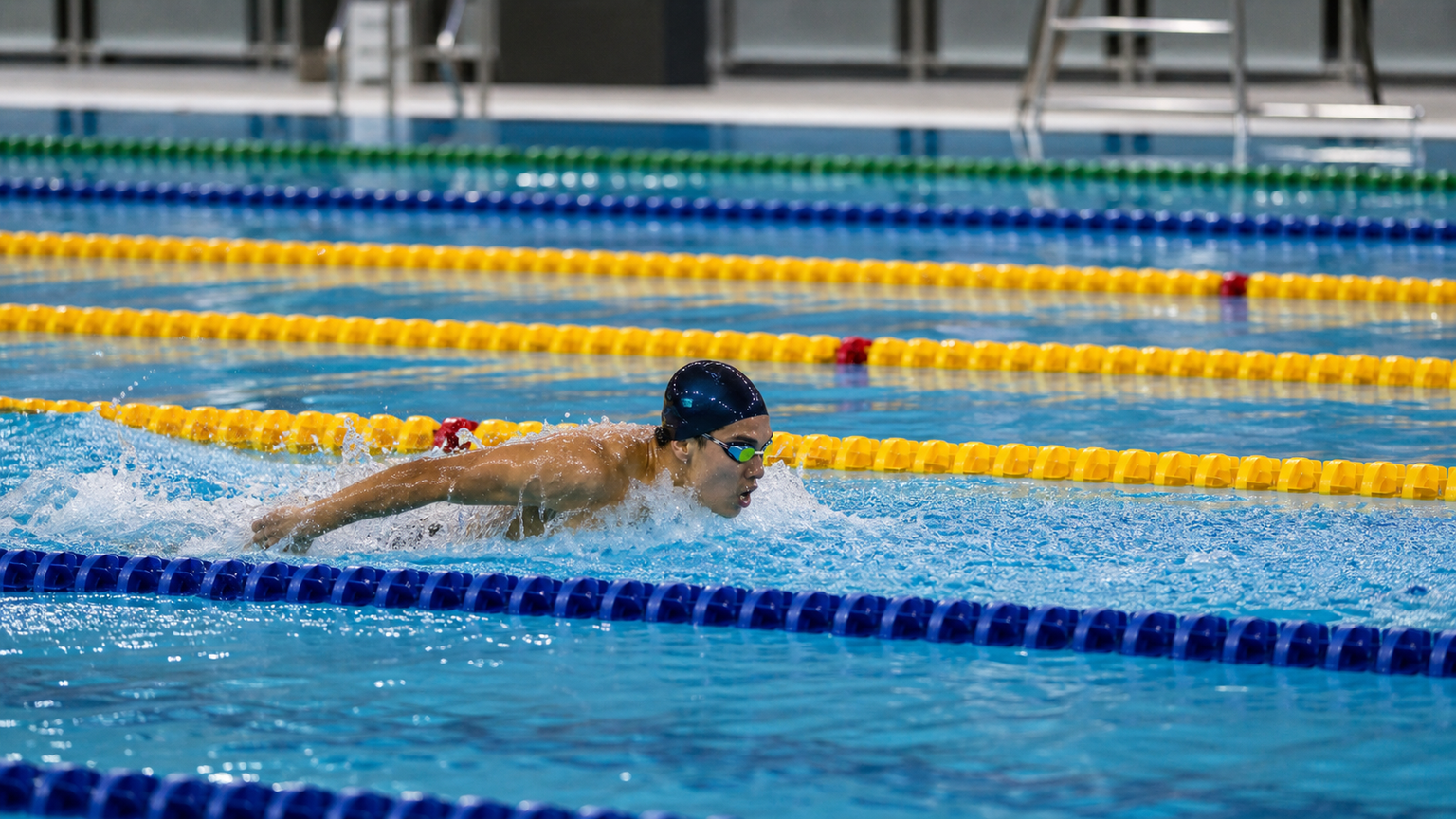
Butterfly opens the IM, and many athletes tend to go out too fast due to excitement or nervousness:
- Conservative strategy: Complete the 50m butterfly 2–3 seconds slower than your best 50m butterfly time, preserving energy for the remaining three strokes
- Aggressive strategy: Start close to your best time, suitable for athletes whose butterfly is a strength and whose last two strokes (especially freestyle) are also strong
Common mistake among Taiwanese athletes: Butterfly too fast → upper body already severely fatigued at the start of backstroke → breaststroke technique collapses → freestyle becomes a struggle to finish.
Pacing Strategy for the 400m IM
The 400m IM is an endurance test, with 100 meters per stroke, typically taking 4–6 minutes to complete.
Pacing Strategy for Each Stroke
- Butterfly 100m: Maintain an easy undulating rhythm for the first 50m, then gradually build speed in the last 50m. Rhythm is key—no sprinting
- Backstroke 100m: After the transition, take advantage of backstroke’s relatively lower energy cost to let the upper body recover slightly, pushing forward at a steady pace
- Breaststroke 100m: Usually the most time-consuming stroke in the IM; use the lower-body-dominant effort to let the upper body continue recovering, and glide fully
- Freestyle 100m: Gradually increase speed in the first 50m, then sprint all-out in the final 25m
Technical Points During Transitions
The “turns” in the IM—contacting the wall—are technical details:
- Butterfly to backstroke turn: Touch the wall with both hands, then immediately flip over into a backstroke push-off
- Backstroke to breaststroke turn: Touch the wall with one hand (pay attention to the rules)
- Breaststroke to freestyle turn: Touch the wall with both hands simultaneously, then rotate into a freestyle push-off
Training Strategies for Weak Strokes
Most athletes have strengths and weaknesses among the four strokes, and IM improvement usually comes from fixing the weakest stroke:
- Identify the weakest stroke with the largest time gap among the four, and invest in dedicated technical training
- Aim for at least 2 “weak-stroke strengthening” sessions per week, with 400–600m of weak-stroke volume per session
- IM rhythm transition drills: swim consecutive 25m butterfly → 25m backstroke → 25m breaststroke → 25m freestyle to practice the feel of switching strokes
Common Strength-Weakness Patterns Among Taiwanese IM Athletes
Based on observations from Taiwanese university swimming competitions:
- Most male athletes are strongest in freestyle, with breaststroke as the weak stroke
- Most female athletes are relatively stable in backstroke, with butterfly as the primary weak stroke
- Breaststroke technique deteriorates the fastest (coordination breaks down first under fatigue)
Practical Recommendations
Athletes looking to improve their IM times are advised to regularly perform “split timing”—recording the time for each stroke separately, calculating the strength-to-weakness ratio of each stroke, and developing a personalized improvement plan. Additionally, schedule at least one full timed 200m or 400m IM practice per week to familiarize yourself with the feel and rhythm of stroke transitions.
Conclusion
Performance in the Individual Medley depends not only on swimming speed across the four strokes, but also on smart pacing and stroke transition technique. For Taiwanese IM athletes, understanding your own strength-weakness profile and developing a personalized pacing strategy is the key transformation from “finishing the IM” to “swimming the IM fast.”
Related Reading
- Individual Medley (IM) Strategy: Pacing Across the Four-Stroke Order
- Pacing for the 200m Swimming Medley: Energy Management Across the Four-Stroke Order
- Race Strategy for the Swimming Medley: Four-Stroke Order and Pace Distribution
- Four-Stroke Transition Strategy for the 200m Individual Medley: The Art of Order Advantage and Pacing
西進武嶺 免費訓練分析服務 Intervals | 練不夠還是練過頭?你哪一種類型選手?AI模型告訴你! | 備戰神器 | 公路車 訓練 | CT Yeh
4 年前
2019 夏季KOM 5小 完賽心得 準備攻略 東進武嶺 夏季登山王之路 Taiwan KOM Challenge
7 年前
Live) 備戰2019彰化經典百K 賽前攻略 (已完賽請看新影片
7 年前
live) 超越北高 之一日北高12小時 策略
7 年前
2024桃園團體自由車邀請賽!4K環台賽等級拍攝 全賽事精華!/ 集團大摔車 / 60隊菁英好手衝線 / 公路車 CT Yeh
1 年前
西進武嶺 自製新版AI配速表產生器 x 賽前攻略 抱佛腳! 沒有功率計也可以產生配速表嗎?有什麼其他眉角賽前要注意的呢? | 西進武嶺 / 東進武嶺 KOM 攻略 | 公路車 | CT Yeh
4 年前
實景訓練台) 彰化經典百K 高強度喵團 90分鐘 跟著一起練功 2019 Indoor workout Changhua Classic 100 Taiwan
7 年前
2026 輪霸西濱200K 挑戰VLOG / 第一集團 / 首次參加..經驗不足、膀胱不足 /死守6H內 / AI戰鬥力顯示系統 / 公路車 / CT Yeh
4 個月前