Introduction
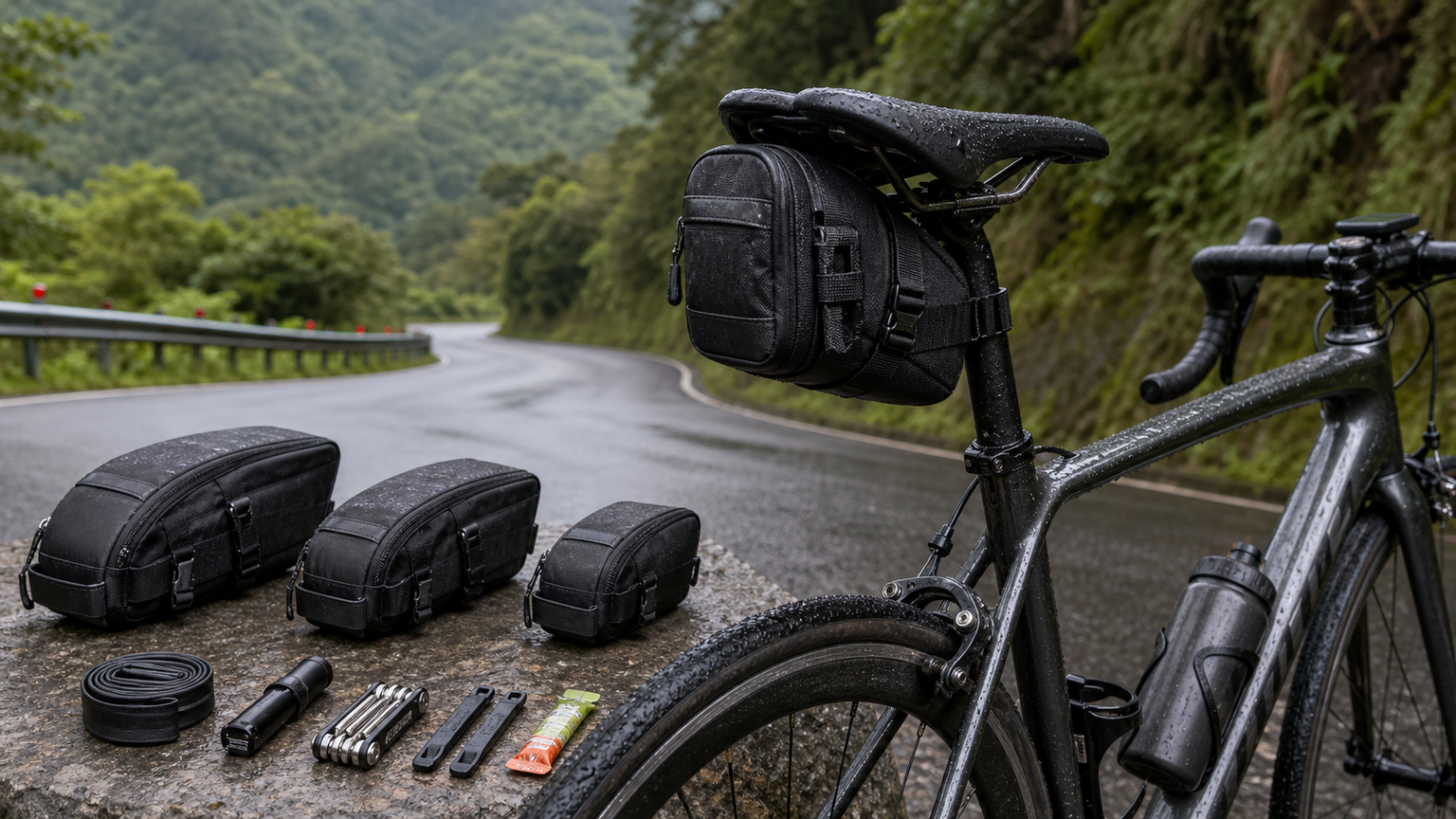
During long-distance cycling, how to carry essential gear without compromising aerodynamics and riding balance is a challenge every rider must face. The saddle bag is the most traditional and most popular carrying solution, ranging from mini spare-tube bags to oversized bags that can hold a full set of change of clothes, with a wide variety of options on the market. However, different capacity designs, waterproofing ratings, and mounting systems perform significantly differently in Taiwan’s rainy environment and rugged mountain roads.
Capacity Tiers and Suitable Scenarios
| Capacity Tier | Capacity Range | Items That Can Be Carried | Suitable Scenarios |
|---|---|---|---|
| Mini | 0.2–0.5L | 1 spare tube, tire levers, patch kit | Daily city riding, short training rides |
| Small | 0.5–1.0L | Spare tube + tools + supplies | Weekend rides |
| Medium | 1.0–2.0L | 2 spare tubes + tools + phone + wallet | Daily long-distance, mountain riding |
| Large | 2.0–3.0L | Above + lightweight windbreaker or spare jersey | Full-day long-distance, challenge events |
| Extra-Large | 3.0L and above | Includes overnight gear | Bikepacking, bicycle touring |
The most common choice in Taiwan is the 0.5–1.5L small-to-medium size, which is sufficient for carrying repair tools and basic supplies while not affecting rear-wheel visibility or aerodynamic performance.
Waterproofing Performance Assessment
Taiwan’s rainy season (May–October) brings abundant rainfall each year, making waterproofing an important consideration for Taiwanese riders:
Waterproofing Rating Explanation
- Water Resistant: Surface coating resists light splashing; sustained heavy rain or direct submersion will cause penetration
- Waterproof: Uses waterproof main fabric with sealed zippers or roll-top closures, capable of withstanding sustained rainfall
- Fully Waterproof: Welded seams (not stitched), equivalent to dive-grade protection, contents are safe from soaking
Many Taiwanese riders have encountered sudden torrential downpours while riding in Yilan’s mountainous areas. In such situations, fully waterproof designs ensure spare tubes and tools stay dry, preventing patch kits from losing their adhesive and becoming unusable.
Mounting System Comparison
The mounting stability of a saddle bag directly affects the riding experience. Below is a comparison of the main mounting systems:
Traditional Velcro + Metal Hook System
- Easy to install, compatible with various saddle and seatpost specifications
- Larger-capacity bags tend to sway on rough roads
- Velcro loses adhesion over time with prolonged use and requires periodic replacement
AERO Quick-Release System (e.g., Topeak Aero Wedge)
- Patented quick-release connector, installs or removes in 10 seconds
- Excellent stability, virtually no sway even with larger-capacity bags
- Requires a specific connector, cannot be mounted under all saddles
Magnetic Mounting System (e.g., Silca Mattone)
- Latest-generation design, completely tool-free
- Extremely lightweight, suitable for competitive riders
- Higher price, limited compatibility
Recommended Directions for Taiwanese Riders
- Daily repair backup bag (below 0.5L): Topeak Aero Wedge Mini, stable mounting, brand has full distribution in Taiwan
- Weekend mountain riding (1–1.5L): Fully waterproof roll-top design, such as Revelate Designs or Restrap Saddle Bag
- Long-distance challenge events (2L and above): Designs with ICE emergency contact info pocket, or integrated taillight mount
Practical Advice
- Saddle bag weight is concentrated at the rear; large models affect climbing balance, so for capacities above 1.5L it is recommended to switch to a hip pack or jersey pockets to distribute the weight
- Periodically remove and inspect the contents of the saddle bag to avoid spare tubes deforming under prolonged pressure or tools rusting
- Taiwan’s mountain roads have lots of gravel; a saddle bag with poor mounting stability will, over time, wear down the underside structure of the saddle from constant swaying
- Recommended number of spare tubes to carry: 1 for daily riding, 2 for long-distance riding, replace spare tubes every 3–5 years (rubber aging)
- When purchasing, check whether the bottom of the saddle bag has reflective detailing to increase nighttime visibility
Conclusion
Choosing a saddle bag may seem simple, but the balance between capacity, waterproofing, and mounting stability requires careful evaluation based on individual riding habits. For Taiwanese riders, fully waterproof performance and a stable quick-release mounting system are the features most worth investing in, especially given Taiwan’s changeable weather and rugged mountain road conditions. Choose the right saddle bag, and your emergency repair tools will always be ready, allowing you to handle any unexpected situation with composure.
Related Reading
- Cycling Bag and Backpack Buying Guide: Full Analysis of Frame Bags, Saddle Bags, and Hydration Packs
- Complete Review of Cycling Bag Types: Capacity and Accessibility Comparison of Frame Bags, Saddle Bags, and Top Tube Bags
- Cycling Bag Buying Guide: Capacity and Weight of Top Tube Bags vs. Stem Bags vs. Seatpost Bags
- Running Hydration Belts and Packs: The Logic Behind Choosing Long-Distance Running Gear
單車 一日北高 ( 雙城 ) 肥宅雙人瘋狂行 紀錄片 REACTO
10 年前
單車 重低音 藍芽喇叭 音質實測 SoundBot SB525 Real Sound Test
8 年前
#公路車 #Fitting 靠人工智慧APP 幫你調整單車
6 年前
大家都在開箱的...單車用藍芽對講耳機真的有幫助嗎? SENA BiKom 20 長距離旅遊 & 海鷗繞圈賽 實際體驗心得 / 公路車 / CT Yeh
9 個月前
多到選擇障礙... 換個單車把帶想一個小時 / BTP / 編織&軟木特有材質超吸睛! / 公路車 / CT Yeh
1 年前
用了AirTag 單車就不怕被偷?盲點大測試 結果… |公路車|CT Yeh
5 年前
摔車後補裝備: 好市多新款單車安全帽& Specialized Romin 北高整路屁股都不痛的坐墊 | 一千元居然有MIPS | CT Yeh | 公路車
4 年前
洗單車神器 吹水機! 實際洗車用用看 暴力洗鍊條大法 | 公路車 | CT Yeh
4 年前