Introduction
When cycling in Taiwan’s summer, sweat loss can reach 500–1,000ml per hour, making hydration the most fundamental requirement for maintaining riding efficiency. However, many riders don’t pay much attention to choosing a bottle cage, only realizing the importance of the angle for reaching water, severe bottle rattling, or insufficient frame tube clearance on long rides—only then do they understand that choosing a bottle cage is actually quite nuanced.
Comparison of Bottle Cage Types
| Mounting Position | Bottle Access Direction | Compatible Frames | Advantages | Disadvantages |
|---|---|---|---|---|
| Top tube cage | Front access | Most road bikes | Easiest to reach, standard setup | Limited load capacity, check for large bottles |
| Down tube cage | Front access | Most road bikes | Standard setup, best stability | Requires leaving the handlebar when reaching down |
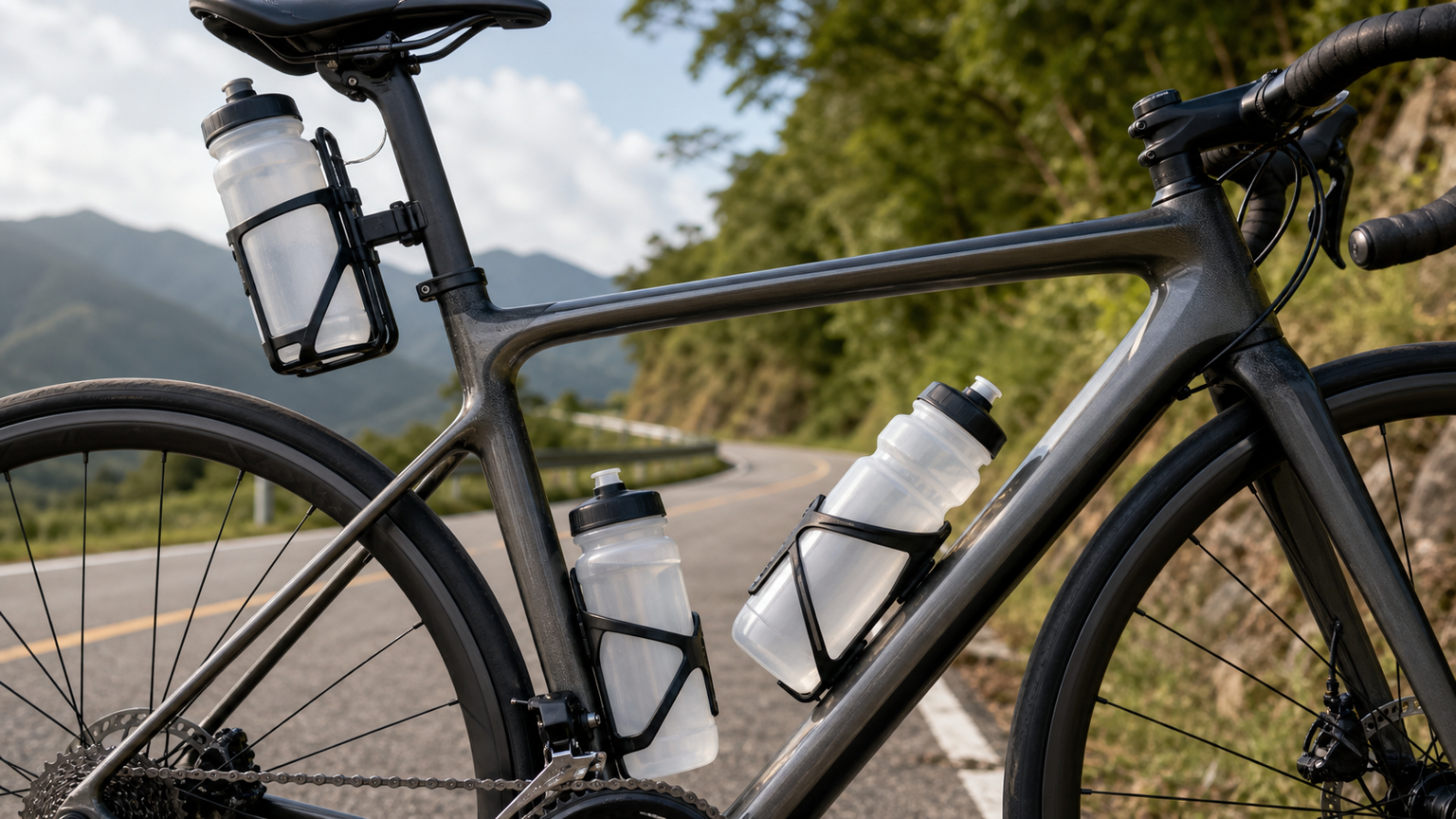
| Slanted tube/seat post | Side or rear access | Requires mounting holes or clamps | Increases carrying capacity | Mounting stability varies by frame |
| Rear cage (behind saddle) | Rear access | Universal | Large capacity, suitable for long rides | Rearward weight shift affects handling |
| Under-cage mount (Cages Under) | Downward access | Frames with large triangle space | Doesn’t occupy tube space | Less intuitive to reach bottles |
Advantages of Side-Entry Bottle Cages
Side-entry bottle cages are increasingly popular among climbers, because in Taiwan’s mountain climbing scenarios, front access requires the rider to release one hand and reach forward and downward, which involves a larger range of motion; side-entry design lets fingers grab the bottle from the side, making the motion more natural:
- Suitable for bikes with limited slanted tube space: Most modern road bikes have triangle space for two bottles, but if the frame design is compact, side-entry allows smoother bottle access
- No major posture changes needed when climbing: Reaching sideways while maintaining pedaling rhythm is safer than front access
- Common brands: Elite Ciussi, Arundel Mandible, and other well-regarded side-entry designs
Applications of Rear-Entry Bottle Cages
Rear-entry designs typically appear on behind-saddle mounting racks (Behind Saddle Cage), suitable for long-distance challenges or triathlons where carrying large amounts of fluid is necessary:
- Can hold 1–2 bottles, greatly increasing fluid carrying capacity without adding backpack weight
- In an aero position (elbows on pads), rear-entry design makes it easy to reach back for a bottle
- Weight is concentrated at the rear; its effect on center of gravity needs attention, especially on descents
Slanted Tube Mounting (Clamp-On Bottle Cages)
When a frame lacks standard threaded mounting holes (some older models or specially designed frames), clamp-on bottle cages offer a flexible solution:
- Clamps onto the seat post, down tube, or underside of the head tube
- Mounting stability varies greatly depending on strap material and design; prone to rattling on gravel roads
- When purchasing, confirm whether the maximum strap diameter fits your frame’s tube diameter
Hydration Management Advice for Long Rides in Taiwan
Taiwan’s summer heat and long climbs are the biggest challenges for hydration strategies:
- Bottle setup for Wuling summit attempts: It’s recommended to carry at least two 750ml bottles; with supply stops far apart over the full 105km route, you need to calculate water requirements for each segment
- Sports drinks vs. plain water: For long challenges with over 2,000m of climbing, it’s recommended to fill one bottle with an electrolyte sports drink and the other with plain water
- Bottle selection: The 750ml capacity is the most common specification among Taiwanese riders, especially given high sweat rates in summer heat; transparent or semi-transparent bottles make it easy to check remaining water
Practical Advice
- Bottle cage material selection: Carbon fiber cages are lightweight (about 20–30g vs. 50–80g for aluminum alloy), but have less tolerance for bottle diameter variation, so bottle compatibility must be confirmed
- Steel cages are the most durable and hold bottles best on rough roads, making them suitable for Taiwan’s gravel-strewn mountain roads
- Use stainless steel screws for bottle cage mounts; in Taiwan’s high-humidity environment, steel screws tend to rust and loosen
- If you need to carry a third bottle, consider a handlebar bag or soft flasks in jersey pockets as a supplement
- Clean the crevices of bottle cages regularly; sweat and drink residue from summer rides in Taiwan can easily breed bacteria
Conclusion
Bottle cages are the most easily overlooked cycling accessory, but in Taiwan’s hot and mountainous riding environment, a securely mounted, easy-to-reach bottle cage setup makes hydration more natural, thereby maintaining riding efficiency and safety. Based on your primary riding scenario—fast flat riding or mountain climbing—choose the most suitable mounting position and bottle access direction, so that hydrating becomes a natural rhythm of the ride rather than a hassle that interrupts your pedaling.
Related Reading
- Bike Bottle Cages and Bottles: Aero Design and Hydration Convenience
- Bike Bottle Cages and Bottles: Optimizing Material, Mounting Position, and Capacity
- The Complete Guide to Bike Bottles and Cages: Materials, Capacity, and Installation Explained
- Bottle Cages vs. Hydration Systems: Traditional Bottles vs. Backpack Hydration Bladders
碟煞公路車 銑面器 !? 原來銑完差這麼多! 降低蹭碟機率! | TIME 公路車 保養小記錄 | CT Yeh
3 年前
單車 重低音 藍芽喇叭 音質實測 SoundBot SB525 Real Sound Test
8 年前
風櫃嘴 | 全台最多大砲的單車路線 | 尋寶網攝影師告訴你怎麼擺拍起來才好看 | 熱門攝影地點巡禮
6 年前
洗單車神器 吹水機! 實際洗車用用看 暴力洗鍊條大法 | 公路車 | CT Yeh
4 年前
多到選擇障礙... 換個單車把帶想一個小時 / BTP / 編織&軟木特有材質超吸睛! / 公路車 / CT Yeh
1 年前
#公路車 #Fitting 靠人工智慧APP 幫你調整單車
6 年前
單車 一日北高 ( 雙城 ) 肥宅雙人瘋狂行 紀錄片 REACTO
10 年前
訓練台體驗) 2019台北自行車展 三大家 訓練台體驗 Tacx Neo Flux 2 Xepdo Apx Wahoo Kickr
7 年前