Introduction
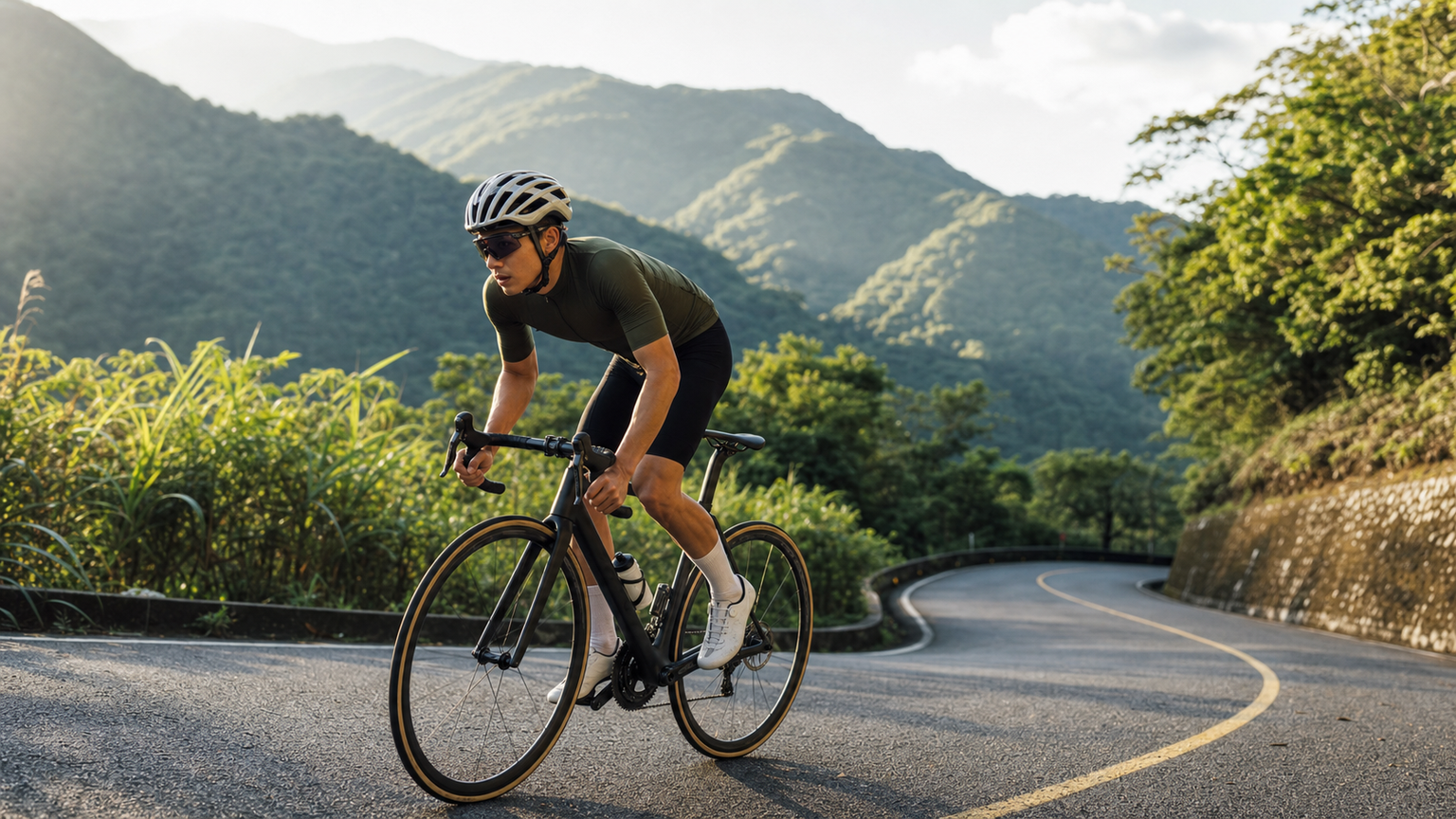
On Taiwan’s popular climbing routes like Wuling, Yangmingshan, or Wulai, you’ve surely seen pro cyclists occasionally stand up to pedal on climbs. That’s not just for show—standing to pedal is a precise strategic tool. Seated pedaling is the fundamental mode for climbing, while standing is a highly efficient weapon for specific situations. Mastering the switch between the two is a key skill for improving climbing performance.
Biomechanical Advantages of Seated Climbing
Seated pedaling is the primary position for long-distance climbs. When seated on the saddle, your body weight is supported by the saddle, allowing your legs to apply force in a more energy-efficient cycle.
Key advantages of seated climbing:
- Lower oxygen consumption: With the upper body fixed, respiratory muscles don’t need extra work to stabilize the torso, improving oxygen utilization efficiency
- Relatively stable heart rate: Muscle workload is predictable, making it easier to keep heart rate in the target zone
- Suitable for long distances: Can be maintained for longer periods without rapid fatigue
- Consistent pedaling rhythm: Easier to maintain a steady cadence and power output
However, seated climbing has its limits: when the gradient exceeds 10–12%, leg power alone is often insufficient to maintain speed, and that’s when standing comes into play.
Mechanical Characteristics of Standing Pedaling
Standing pedaling allows the rider’s body weight to act directly on the pedals, generating greater downward force. This isn’t just about the legs—the entire body’s weight is converted into propulsion.
Characteristics of standing pedaling:
- Higher power output: Studies show instantaneous power while standing can be 10–20% higher than seated
- Activates more muscle groups: Glutes, back muscles, abs, and arm muscles all engage for stabilization
- Greater cardiovascular demand: Oxygen consumption rises significantly, with heart rate typically increasing by 5–10 bpm
- Cannot be sustained for long: Muscles fatigue faster, usually lasting only 30 seconds to 2 minutes
Optimal Timing for Switching to Standing
Standing to pedal isn’t about doing it as much as possible—it’s about using it at the right moments. Here are common switching scenarios:
| Situation | Recommended Position | Notes |
|---|---|---|
| Gentle gradient (<6%) over long distance | Seated | Conserve energy, maintain efficiency |
| Steeper gradient (8–12%) | Primarily seated, occasional standing | Use standing to maintain rhythm and avoid sudden speed drops |
| Steep climb sprint (>12%) | Standing | Use body weight to output maximum power |
| Muscle fatigue mid-way through a long climb | Brief standing (20–30 seconds) | Switch muscle groups, giving seated muscles a short rest |
| Acceleration after a corner | Standing | Quickly re-establish speed |
| Final 500 meters to the summit | Standing or seated depending on energy | Decide based on remaining energy |
Proper Standing Technique
Many beginners make mistakes when standing to pedal that actually reduce efficiency:
- Lean forward but don’t arch your back: Shift your center of gravity slightly forward so your weight falls more naturally onto the pedals
- Keep arms slightly bent, applying some pull on the bars: The pulling force of your arms opposes the pushing force of your legs, creating greater torque
- Slight hip sway is normal: The bike will rock gently when standing—this is a natural expression of using your full body weight
- Don’t fully lock your knees: Keep knees slightly bent at the bottom of the pedal stroke to protect the joints
- Shift to one or two easier gears before switching: You typically need an easier gear when standing, so shifting early avoids chain jams
Application on Taiwan’s Routes
Take the Yangjin Highway (Yangmingshan to Jinshan) as an example: on the section from the Qixing Mountain slopes to Fengguizui, the gradient frequently varies between 6–14%:
- Gentle sections: Stay seated, keep heart rate in the aerobic zone (70–80% of FTP)
- Before consecutive hairpin turns: Stand up early, accelerate before the corner, and maintain momentum after exiting
- Short steep pitches (e.g., some 12–15% sections): Attack fully standing, then sit down immediately to recover once past
Practical Advice
- Deliberately practice standing pedaling in every training session, aiming to extend each standing effort from 15 seconds up to 60 seconds
- Practice smooth seated→standing→seated transitions on a stationary trainer, feeling out the timing for gear changes
- During climbing training, actively stand and pedal for 30 seconds every 5 minutes to let different muscle groups take turns resting
- Record the heart rate difference between seated and standing efforts to understand your body’s corresponding response
Conclusion
Standing pedaling is a secret weapon for climbers, but its effectiveness depends on timing. Don’t wait until your legs give out to stand up—instead, anticipate gradient changes proactively and make standing part of your rhythm management. Practice more on Taiwan’s mountain roads, and you’ll discover that climbing is no longer just about suffering through it, but a challenge full of strategic intrigue.
Related Reading
- Seated and Standing Transitions in Climbing: When Is Standing to Pedal Most Efficient
- Seated vs. Standing Climbing: When Is the Most Efficient Time to Switch
- Seated Climbing vs. Standing Climbing: Criteria for Deciding When to Get Up
- Seated vs. Standing: How to Transition to Improve Efficiency When Climbing
一日北高/長距離團騎 常見問題補充篇 / 組團或跟團的眉角 / 壯車友容易被瘦車友慢性拉爆 / 原來屁股痛可能是這個原因...? / 風場配速法 / 公路車 / CT Yeh
2 年前
CT 喇低賽) 武嶺牽車 才是王道 西進牽車四小時內秘訣 攝手位置 如何判斷 防抽筋小秘訣
7 年前
單車 梅山36灣 坡度介紹 路段介紹 空拍 (相關遊記影片,請參考說明或我的頻道喔,歡迎訂閱)
6 年前
大禹嶺 到 武嶺牌樓 全程前後實況錄影 | 北進武嶺 | 東進武嶺 | KOM | 訓練台 | 坡度分析 | Taiwan KOM Last 10 km HARD | 公路車
6 年前
風櫃嘴 | 全台最多大砲的單車路線 | 尋寶網攝影師告訴你怎麼擺拍起來才好看 | 熱門攝影地點巡禮
6 年前
單車 一日北高 ( 雙城 ) 肥宅雙人瘋狂行 紀錄片 REACTO
10 年前
滑雪新手們慘摔學習全紀錄(請開字幕),滑雪好好玩 | Snowboard + Ski | 岩原 スキー場 | 滑雪APP使用 | GoPro Max
6 年前
Never Stop 西進武嶺 前後雙機 完整全程錄影 訓練台 實境
8 年前