Introduction
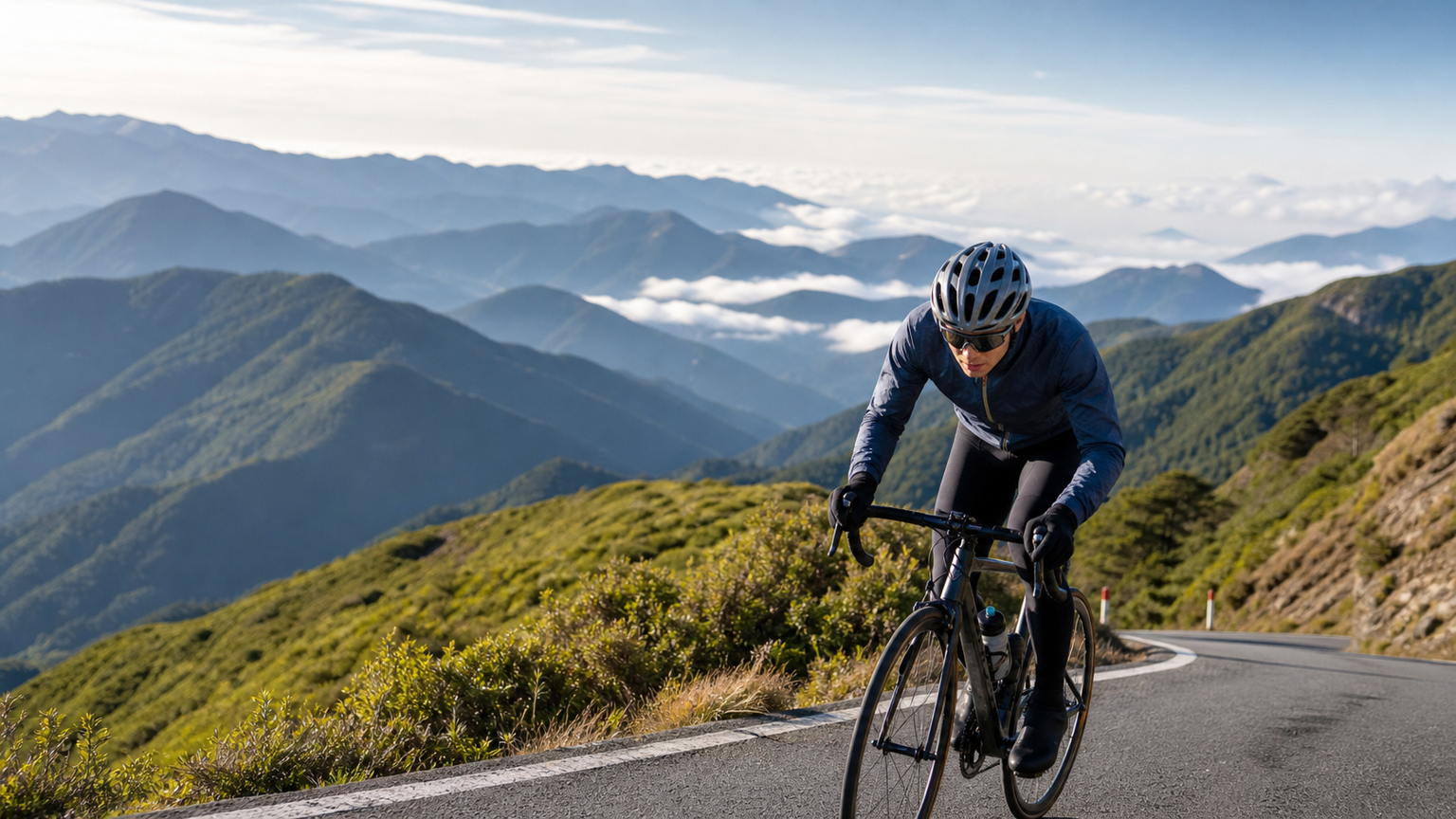
Taiwan is one of the few places in the world where you can cycle to mountainous areas above 3,000 meters. Wuling (3,275 m), the Hehuan Mountain area, Taipingshan, and the Alishan Highway are all famous high-altitude cycling routes. However, the impact of the high-altitude environment on the human body goes far beyond simply “thin air.” Low temperatures, low air pressure, intense ultraviolet radiation, and rapidly changing weather together create a completely different cycling challenge.
The Effects of High Altitude on Exercise Physiology
The Chain Reaction of Reduced Partial Pressure of Oxygen
For every 1,000 meters of elevation gain, atmospheric pressure drops by approximately 11%. By the time you reach Wuling (3,275 m), the partial pressure of oxygen in the air is about 67% of that at sea level. This means:
- Less oxygen is inhaled with each breath, reducing aerobic metabolic efficiency
- Heart rate rises: the body attempts to compensate for oxygen delivery by beating faster
- VO2max decreases: research shows that for every 1,000 meters of elevation gain, VO2max drops by approximately 6–8%
- Lactate threshold lowers: at the same perceived effort, the body enters anaerobic metabolism sooner
Heart Rate Distortion
At high altitude, the heart rate corresponding to the same power output is noticeably higher. This makes “heart rate pacing” unreliable at high altitudes:
| Altitude | Heart Rate Deviation at Equal Power | Recommended Pacing Basis |
|---|---|---|
| 0–500 m | Baseline | Heart rate or power |
| 500–1500 m | +3–5 bpm | Power or perceived effort |
| 1500–2500 m | +5–10 bpm | Power or perceived effort |
| Above 2500 m | +10–15 bpm | Rely primarily on power and perceived effort |
Warning Signs of Acute Mountain Sickness
For lowland riders without high-altitude acclimatization, acute mountain sickness may occur upon reaching above 2,500 meters:
- Headache (the most common early symptom)
- Nausea or feeling of vomiting
- Dizziness or reduced sense of balance
- Loss of appetite
- In severe cases, shortness of breath and abnormal heart rhythm
Important: If any of the above symptoms appear, immediately reduce riding intensity. If symptoms persist or worsen, you must descend and seek medical attention.
The Temperature Challenge of Taiwan’s Mountain Routes
Temperatures in Taiwan’s high mountains are much lower than in the lowlands. Taking Wuling as an example:
- Summer summit temperatures are around 12–18°C, but considering wind speed, the wind chill can drop below 8°C
- When descending at high speed, the wind chill can suddenly drop below 5°C
- When setting off in the early morning (4–6 a.m.), mountain temperatures may be below 10°C
The effects of low temperatures on cycling:
- Decreased muscle contraction efficiency: cold increases muscle viscosity, affecting both explosive power and sustained output
- Reduced finger dexterity: precision in operating brakes and shifting decreases, increasing safety risks
- Dropping core body temperature: prolonged cold exposure may lead to mild hypothermia
Equipment and Pacing Adjustments for High-Altitude Riding
Equipment Recommendations
- Layer clothing: lightweight moisture-wicking base layer + insulating mid layer + windproof outer layer, allowing you to quickly put on a jacket when descending
- Gloves: you may feel hot while climbing, but keep a pair of insulated gloves in your bag
- Head insulation: wear a thin cap under your helmet to prevent excessive heat loss from the head
- Spare rain jacket: afternoon thunderstorms are frequent in Taiwan’s high mountains; a lightweight rain jacket is essential gear
- Plenty of spare food: metabolism accelerates at high altitude, so nutritional needs are higher than in the lowlands
Pacing Adjustment Principles
On sections above 2,000 meters, it is recommended to proactively reduce your pace:
- Lower power targets by 10–15%: 75% of your FTP at high altitude is equivalent in effect to 85% at sea level
- Accept slower speeds: do not evaluate your performance using sea-level speed expectations
- Maintain a high cadence: a high cadence (75–85 RPM) reduces muscle tension and is even more important when oxygen is insufficient
- Actively deepen your breathing: consciously take deep breaths rather than letting your body fall into naturally shallow, rapid breathing
Practical Advice
- Arrive at a higher-altitude location the day before to spend the night (such as Cingjing Farm or Kunyang) to give your body initial time to acclimatize
- Hydrate sufficiently before departure; the high-altitude environment is relatively dry, and fluid loss is faster
- Avoid going to bed after midnight on the day of departure; adequate sleep improves high-altitude tolerance
- Carry enough carbohydrate supplies throughout the ride; appetite may decrease at high altitude, but energy expenditure remains high
- Inform your companions of your condition; never ride alone in the mountains
Conclusion
The magnificent scenery of Taiwan’s high-mountain cycling is worth the price of your preparation. Understanding the physiological effects of high altitude and making the corresponding pacing and equipment adjustments will not only enhance safety but also allow you to truly enjoy the breathtaking experience of riding through the clouds and mist. Every time you reach the summit of Wuling and watch Taiwan’s mountain ranges unfold beneath your feet, that feeling is something no lowland ride can provide. Set out with knowledge, and every high-mountain challenge you take on will be safer and more rewarding.
Related Reading
- The Physiology of High-Altitude Cycling: The Scientific Preparation for Taiwan’s Mountain Riding
- Altitude Effect Training for Cyclists: The Cardiopulmonary Stimulus of Taiwan’s High-Mountain Riding
- Hehuan Mountain High-Altitude Riding: Physiological Responses to Hypoxia and Pacing Adjustments
- High-Altitude Training: Physiological Adaptation and Training Adjustments Above 1,500 m
大武山後門26%歡樂陡坡!JJSC南台灣單車行Day2 / 被颱風追著跑 / 公路車 / CT Yeh
2 年前
#公路車 #Vo2Max #最大攝氧量 測驗 體驗 | 心肺測試
6 年前
大武山20%魔王陡坡【JJSC南台灣遊騎Day2】!屁股真的要裂開了...凡士林抹滿也沒用?神秘金教堂還有超便宜夜市
3 個月前
單車 一日北高 ( 雙城 ) 肥宅雙人瘋狂行 紀錄片 REACTO
10 年前
太平山單車員工旅遊 | 這樣玩CP值最高!| 公路車
5 年前
新竹羅平 x 天湖部落 大禹嶺級變態陡坡! 4K超高畫質 空拍 | 公路車
5 年前
台灣登山王之路 KOM 全程參賽4K臨空錄影 PART1 穿越峽谷地形! #東進武嶺 太魯閣 / 燕子口 / 天祥 / 西寶 PART1 (公路車 / CT Yeh)
3 年前
#北橫 + #北進武嶺 最硬的員工旅遊 EP1 | #公路車 #拉拉山 | 明池 | 武嶺 | 武陵農場 | 雲海 | Taiwan Cycling Route Wulin
6 年前